That decision — drayage or transloading — isn't trivial. Pick wrong and you're looking at unnecessary chassis fees, missed delivery windows, or compliance exposure on regulated cargo. Pick right and the shipment flows without friction.
These aren't competing services. They solve different problems at different points in the supply chain. Understanding which one your shipment actually needs starts with knowing what each one does.
Key Takeaways
- Drayage moves a sealed container short distances between transport nodes — no freight is touched
- Transloading physically transfers cargo between containers or transport modes for multi-modal routing or redistribution
- Both services frequently appear on the same shipment, used in sequence rather than as competing options
- Hazmat and overweight freight add compliance requirements to either service
- Distance, cargo type, destination count, and equipment compatibility drive the decision
Drayage vs. Transloading: Quick Comparison
| Factor | Drayage | Transloading |
|---|---|---|
| Freight handling | Zero — container stays sealed | Cargo is physically unloaded and reloaded |
| Distance | Short haul between transport nodes | Supports multi-modal, longer supply chain legs |
| Transport modes | Primarily truck-based | Involves at least two modes |
| Best for | Port clearance, intermodal transfers, border crossings | Redistribution, domestic equipment adaptation, multi-destination splits |
| Value-added services | None — intact container movement | Palletization, sorting, consolidation, relabeling |
What Is Drayage?
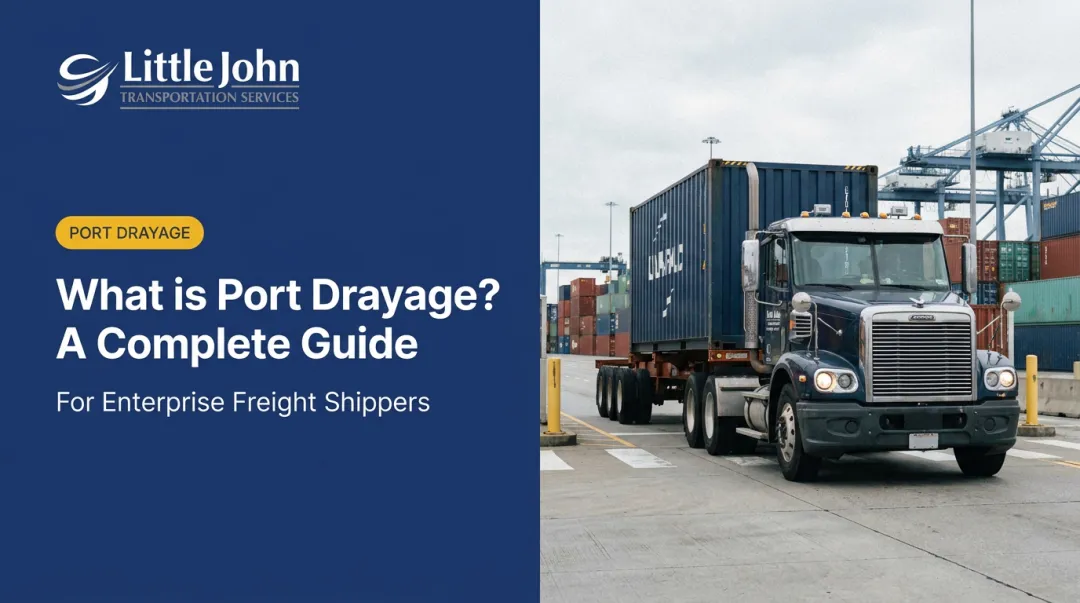
The FHWA defines drayage as the truck transport of rail or ocean freight to an intermediate or final destination — typically between a marine terminal, rail ramp, or border crossing and a nearby warehouse or distribution center. The container moves as a single sealed unit — never opened, never transferred.
Without drayage, ports and rail ramps would bottleneck within hours. IANA reports approximately 60 million intermodal drayage moves annually across North America, performed by 7,000 trucking companies.
Types of Drayage Service
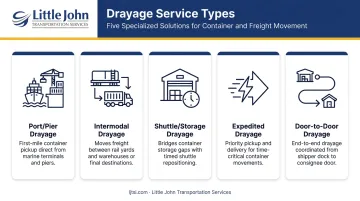
Not all drayage is the same. The main service types:
- Port/pier drayage — Container pickup at a marine terminal for delivery to a nearby warehouse or distribution center
- Intermodal drayage — Rail-to-truck movement between an inland rail ramp and a final destination
- Shuttle/storage drayage — Temporary repositioning when a consignee isn't ready to receive
- Expedited drayage — Time-critical moves with priority dispatch
- Door-to-door drayage — Complete container routing managed as a single move
Cost Drivers to Anticipate
Drayage costs go beyond the line-haul rate. Shippers get caught by:
- Chassis fees — IANA's 2024 survey found 72% of drayage carriers now control their own chassis, covering roughly 59% of marine loads; when chassis aren't available, costs spike
- Demurrage and detention — Nine major ocean carriers collected approximately $15.4 billion in detention and demurrage charges from 2020 through early 2025, per FMC data
- Pre-pull/yard-pull fees — Moving containers out of terminal to a yard before the consignee is ready
- Overweight and hazmat surcharges — Special permits and endorsement requirements add cost
At the Port of Los Angeles, truck-bound containers averaged 2.73 days of dwell in August 2025. Every day past the free time window is a fee. Those cost realities make carrier credentials and pre-move planning as important as the truck itself.
Drayage Use Cases
Cross-border drayage is where that point becomes concrete. An ocean container arriving at Laredo must clear customs, exit the commercial port of entry, and reach a distribution facility — all intact, all documented. The carrier requirements are specific:
- CTPAT validation for expedited lane access
- TWIC-certified drivers for secure facility entry
- Bilingual dispatch for cross-border coordination
- FMCSA HMSP authorization for any hazmat contents
Industries with consistent drayage demand:
- Automotive — JIT parts shipments from port to assembly plants where production can't wait
- Chemical/petrochemical — Hazmat-classified cargo requiring FMCSA HMSP-authorized carriers and hazmat-endorsed drivers
- AI infrastructure and data centers — High-value server and switchgear equipment moving from port to inland staging under tight handling requirements
What Is Transloading?
FHWA defines transloading as transferring bulk shipments or products from the vehicle or container of one mode to another at a terminal interchange point. The cargo comes out of one container and goes into another.
International ocean containers are sized for global shipping economics. U.S. domestic trailers — the standard 53-ft dry van — are sized for American highway networks. These two formats don't match, and transloading bridges that gap.
At the Northwest Seaport Alliance (Seattle-Tacoma), transloading accounts for nearly 40% of imported container volume, with over 100 near-terminal transload facilities operating within roughly 15 miles of the port. That figure reflects how normalized ocean-to-domestic transfers have become at major gateways.
The Rail Efficiency Argument
Rail-to-truck transloading is particularly valuable for long-haul domestic legs. According to AAR data, railroads move one ton of freight nearly 500 miles per gallon on average and are 3 to 4 times more fuel-efficient than trucks. One railcar can carry as much as five trucks' worth of crushed stone or aggregate. Moving freight by rail for the long haul, then transferring to truck for regional distribution, reduces total transportation cost — but it requires a transload event to make the mode switch.
Value-Added Services During Transloading
Unlike drayage, transloading creates an opportunity to work the freight:
- Consolidate multiple inbound shipments into a single outbound trailer
- Sort and separate freight destined for different locations
- Palletize breakbulk or loose cargo for safer domestic handling
- Relabel for domestic retail or distribution requirements
- Repackage or rework damaged or non-conforming freight
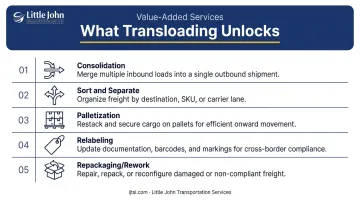
None of these services are possible during drayage — the container never opens.
Transloading Use Cases
High-fit scenarios where transloading delivers clear value:
- Bulk commodity shippers — Lumber, grain, and chemicals moving from rail to regional trucks for distribution across multiple markets
- Ocean importers splitting to multiple destinations — A single 40-ft container becomes two or three domestic trailer loads bound for different DCs
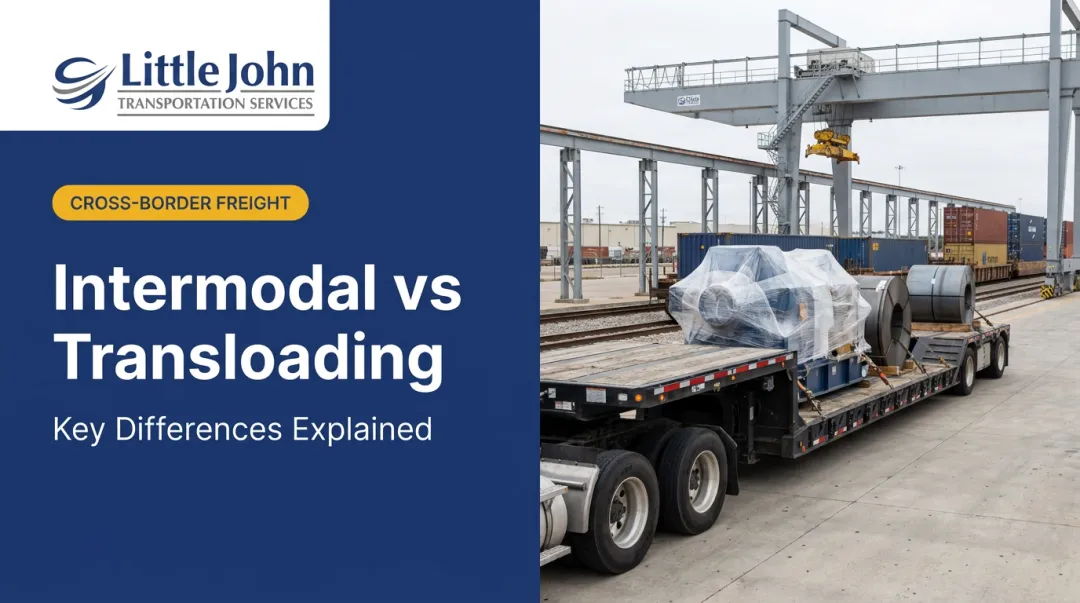
- Industrial machinery importers — Oversized equipment arriving on ocean flat-rack containers transferred to flatbed or RGN configurations for inland delivery
- Chemical and petrochemical — Liquid bulk transferred between tank cars and tanker trucks, with certified handlers managing the transfer
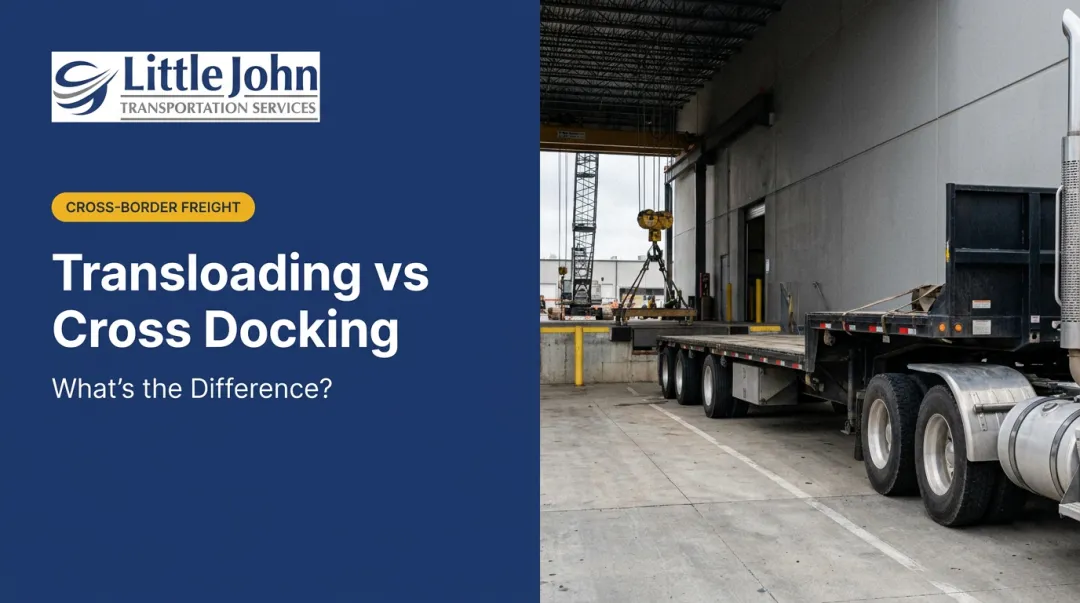
The last use case — oversized cross-border equipment — illustrates how specialized infrastructure shapes transloading outcomes. At Little John Transportation Services' 50-acre CTPAT-validated facility in Laredo, a custom-built 120-ton bridge crane handles superload transloading (oversized and overweight cross-border cargo) in under two hours. The 30-bay cross-dock supports consolidation across 1,200 trailer-space staging capacity, with bonded cargo handling for duty-deferred shipments.
Which Does Your Shipment Need?
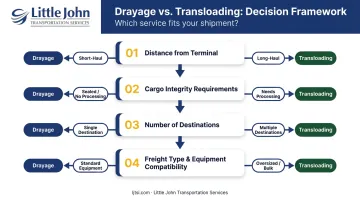
The answer comes down to four variables.
The Decision Framework
1. Distance from the terminal Drayage is the right call for short moves between a port, rail ramp, or border crossing and a nearby facility. Once the routing involves long-haul domestic legs or mode switches, transloading enters the picture.
2. Cargo integrity requirements If the container can travel sealed to a single receiving facility, drayage is simpler and lower-cost. If freight needs to be sorted, consolidated, repackaged, or adapted for domestic equipment, transloading is the only option that works.
3. Number of destinations Single destination — drayage. Multiple delivery points — transloading with deconsolidation, because one container can't serve multiple destinations without being unloaded first.
4. Freight type and equipment compatibility Standard containerized cargo moves via drayage without issue. Non-containerized freight, bulk commodities, oversized loads, or cargo that simply won't fit a domestic trailer without transfer requires transloading.
Situational Recommendations
| Scenario | Recommended Service |
|---|---|
| Port container to single nearby DC | Drayage |
| Ocean container splitting to 3 retail destinations | Transloading |
| Rail ramp to inland warehouse | Drayage |
| International freight shifting to domestic 53-ft trailer | Transloading |
| Cross-border container clearing customs, then redistributed | Drayage first, then transloading |
The Hazmat Dimension
Regulated cargo adds a compliance layer to both services. For cross-border hazmat drayage, carriers need an FMCSA Hazardous Materials Safety Permit — a credential held by fewer than 1% of U.S. carriers. The maximum civil penalty for a knowing hazmat transportation violation is $102,348 per violation, rising to $238,809 when the violation results in death, serious injury, or property destruction. At those penalty levels, carrier selection is a risk management decision, not just a logistics one.
For transloading of hazmat freight, the facility itself must have certified handlers, proper documentation protocols, and equipment suited to the hazard class. BTS reported 27,314 hazardous-material incidents across all modes in 2024, with highway incidents alone accounting for $49.8 million in property damage. Most highway hazmat incidents trace back to handling conditions during loading and transfer — exactly the moments transloading facilities control.
For shippers moving complex freight through the U.S.–Mexico corridor — hazmat loads, heavy equipment, cross-border shipments requiring both drayage and transloading — Little John Transportation Services operates specialized teams at Laredo, Calexico, and Houston. With CTPAT validation, TWIC certification, and FMCSA HMSP authorization covering all 9 hazmat classes, we coordinate both services on the same shipment — eliminating the handoff failures that come from splitting the work across separate vendors.
Reach us at quotes@ljtsi.com or +1 (479) 264-6501 for a quote.
Conclusion
Drayage and transloading solve fundamentally different problems. Choosing between them isn't a matter of preference — it's a matter of understanding what your freight actually needs. Drayage moves containers intact through the first or last mile. Transloading adapts freight for what comes next.
The right choice depends on destination, final-mile format, distribution split, and compliance requirements. Get that analysis right and you eliminate demurrage fees, prevent handling damage, and avoid the customs and documentation delays that stall cross-border and regulated freight.
For shipments that involve hazmat classifications, U.S.–México border crossings, or oversized cargo that doesn't fit standard container specs, the stakes are higher — and the margin for a wrong call is smaller. That's where working with a carrier experienced in both drayage and transloading operations makes a measurable difference.
Frequently Asked Questions
What is the difference between drayage and transloading?
Drayage moves a sealed container short distances between transport nodes — port, rail terminal, or border crossing — without touching the freight inside. Transloading physically unloads and reloads cargo between containers or transport modes, typically to switch from international to domestic equipment or split freight for multiple destinations.
What does drayage mean in transportation?
Drayage is the short-haul truck movement of a shipping container between a port, rail yard, border crossing, or warehouse, serving as the connector between major transport legs. The container stays sealed throughout — no freight handling occurs.
What does transloading mean in logistics?
Transloading is the process of transferring freight from one container or transport mode to another at an intermediate facility. A common example is moving goods from a 40-ft ocean container into a domestic 53-ft dry van, enabling multi-modal routing and cargo redistribution.
What is the difference between intermodal and transloading?
Intermodal shipping moves freight in the same container across multiple transport modes — ship, rail, truck — without opening it. Transloading breaks the container open and physically transfers cargo between modes or equipment. Intermodal preserves the container; transloading changes it.
Can drayage and transloading be used together on the same shipment?
Yes — this is a common workflow. Drayage moves a sealed container from a port or border crossing to a nearby facility; transloading then transfers the freight into a domestic trailer or splits it for multiple destinations. The two sequence naturally, combining terminal speed with distribution flexibility.
Which is more cost-effective: drayage or transloading?
Drayage is typically lower-cost for short, single-destination moves. Transloading costs more upfront but often reduces total spend by enabling cheaper long-haul rail legs or consolidating multiple deliveries — making downstream fees and inefficiencies the real measure of value.