Introduction
A single temperature excursion during transit can invalidate an entire batch of investigational medicinal products (IMPs). For biologics, mRNA therapies, and cell and gene therapy materials, that means weeks of timeline delays, costly QA investigations, and replacement shipments — all avoidable. Unlike commercial pharmaceuticals, IMPs have no approved stability data justifying any deviation from specification. The margin for error is zero.
Temperature-controlled clinical trial logistics covers every step required to move IMPs and biological specimens within defined temperature ranges from manufacturer to investigator sites.
Getting it right demands coordinated compliance across multiple regulatory frameworks, validated packaging, and carriers who can demonstrate an unbroken audit trail.
This guide covers temperature requirements by product type, the regulatory frameworks that govern shipments, passive versus active packaging options, cross-border considerations for U.S.–Mexico corridors, and what to look for when qualifying a logistics carrier.
Key Takeaways
- Any temperature excursion outside specification may invalidate trial data and require costly IMP replacement
- Clinical trial cold chains must satisfy overlapping frameworks: FDA 21 CFR Part 11, EU GDP, IATA DGR, and ICH GCP E6(R3)
- Packaging must be thermally validated for worst-case transit conditions, not average ones
- Chain-of-custody records form the audit trail regulators examine during inspections
- Carriers must hold GDP compliance, FMCSA HMSP, and CTPAT validation credentials before you engage them
Temperature Requirements for Clinical Trial Materials
The Four Primary Classifications
Temperature requirements for IMPs and biological specimens fall into four practical bands, though only the refrigerated and standard frozen ranges correspond directly to ICH Q1A(R2) regulatory definitions. The ultra-cold and cryogenic classifications are product-specific, determined by each material's stability data and labeling.
| Classification | Range | Typical Products |
|---|---|---|
| Refrigerated | 2°C to 8°C (ICH: 5 ±3°C) | Monoclonal antibodies, serological kits, most IMPs |
| Standard Frozen | −20°C (ICH: −20 ±5°C) | Vaccine components, DNA samples |
| Ultra-Cold | ~−80°C (product-specific) | mRNA products, certain biologics |
| Cryogenic | ≤−150°C (product-specific) | Cell and gene therapies in liquid nitrogen |
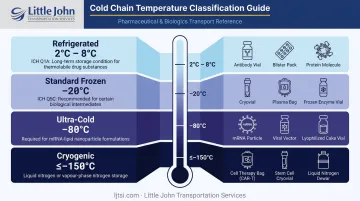
The required range is always dictated by the product's stability data, protocol, or label — not by a universal logistics classification system.
Why Biologics Are Uniquely Vulnerable
Large-molecule drugs behave very differently from small-molecule pharmaceuticals when temperatures drift. Research on monoclonal antibodies documents freezing-induced tertiary structure perturbation, freeze concentration of proteins and salts, and ice-induced partial unfolding and aggregation. Once that molecular structure is compromised, the effect on target-binding ability can be permanent.
The stakes are even higher for mRNA lipid nanoparticles. A 2022 stability study found that at −80°C without cryoprotectants, mean particle size increased to 904.6 ±107.7 nm and mRNA retention dropped to just 50.51 ±10.37%. That's half the therapeutic payload lost to a single failure in cold chain integrity.
Temperature Excursions: Consequences Beyond the Shipment
Those molecular vulnerabilities translate directly into operational risk when a shipment deviates from its required range. A temperature excursion is any deviation outside the specified range during transport or storage. For commercial pharmaceuticals, approved stability data often allows sponsors to assess whether a product remains viable after a minor deviation. For IMPs, no such approved allowance exists.
When an excursion occurs:
- The affected batch may be quarantined pending QA investigation
- Replacement manufacturing and re-shipment timelines add weeks or months to trial schedules
- Regulatory reporting obligations may be triggered depending on jurisdiction
- Downstream patient safety risk must be formally evaluated and documented
- The excursion event and response actions become part of the trial record
Regulatory Compliance and Documentation Standards
The Governing Frameworks
Clinical trial shipments must satisfy multiple frameworks simultaneously. For multi-country trials, that means all relevant jurisdictions at once — there's no hierarchy that lets one set of rules override another.
| Framework | Scope |
|---|---|
| FDA 21 CFR Part 11 | Electronic records required by FDA predicate rules and maintained or submitted electronically |
| EU GDP (2013/C 343/01) | Transport conditions, equipment calibration, deviation management, and records for medicinal products |
| ICH E6(R3) | Good Clinical Practice; EMA identifies this as the current version effective July 23, 2025 |
| IATA DGR (67th edition, 2026) | Air classification, packing, marking, labeling, and documentation for dangerous goods |
| U.S. DOT 49 CFR Parts 171–180 | Hazardous material transport in U.S. commerce, including highway |
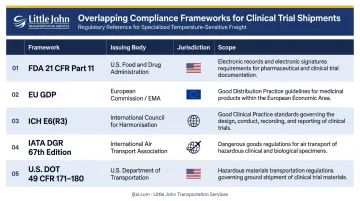
A common misread on 21 CFR Part 11: a temperature record isn't automatically Part 11-regulated simply because a data logger created it. The regulation applies to electronic records required by FDA predicate rules and maintained or submitted electronically — the predicate rule determines applicability.
Chain-of-Custody Documentation Requirements
Under 21 CFR 312.57, sponsors must maintain receipt, shipment, and disposition records showing investigator name, date, quantity, and batch or code mark. Investigators face parallel obligations under 21 CFR 312.62. EMA holds sponsors responsible for IMP integrity during shipment until acceptance by the trial site.
In practice, a compliant shipment record set should include:
- Certificate of analysis and material safety documentation
- Temperature monitoring data for the full transit duration
- GPS tracking logs showing location history
- Delivery confirmations from the receiving site
- Import/export permits and dangerous goods declarations
- Deviation reports if any excursion occurred
These records belong in the sponsor's trial master file and must be retrievable without gaps during regulatory inspections.
Biological Substance Classification
Correct classification under dangerous goods regulations is not optional — misclassification causes customs seizures, transit delays, and temperature compromise that can void an entire shipment. Three categories apply to most clinical biological materials:
- UN 2814 (Category A): Infectious substances affecting humans, capable upon exposure of causing permanent disability, life-threatening, or fatal disease in otherwise healthy individuals. Requires Category A packaging under 49 CFR 173.196.
- UN 3373 (Category B): Infectious substances that don't meet Category A criteria. Requires triple packaging and UN3373 marking under 49 CFR 173.199 (WHO packing instruction P650).
- Exempt specimen: Patient specimens with minimal likelihood of pathogen presence based on professional judgment — not automatically classified as UN 3373.
Cold Chain Packaging Solutions: Active vs. Passive
Passive Systems
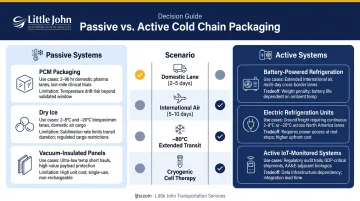
Passive packaging relies on pre-conditioned thermal mass — phase-change materials (PCMs), dry ice, or vacuum-insulated panels — rather than powered refrigeration. The thermal mass maintains the specified range for a defined window without any external energy input.
PCM packaging works by absorbing or releasing energy at a fixed temperature as the material changes state. PCMs can be engineered across a range of temperatures: Peli BioThermal's Crēdo ProMed, for example, covers 2–8°C and 15–25°C ranges, while va-Q-tec announced a PCM system capable of −70°C transport without dry ice in 2023.
All PCM-based packaging used for IMP transport should undergo ISTA 7D qualification testing, which evaluates external temperature exposures on packaged products, including simulated summer desert and winter freezing profiles.
Dry ice passive shipping handles frozen products in the −20°C to −80°C range but comes with operational constraints:
- IATA DGR (67th edition) governs dry ice quantities and documentation for air shipments
- Sublimation over time makes endurance package-specific and profile-dependent — ISTA treats duration as a function of the specific container, ambient temperature, air circulation, and payload, not a universal number
- Remote international routes where transit windows are unpredictable may outrun dry ice capacity
Active Systems
Where passive systems reach their limits — unpredictable transit windows, ultra-cold setpoints, remote routes — active containers take over. Battery-powered or electric refrigeration maintains temperature independently of ambient conditions, eliminating the sublimation problem and extending reach to investigator sites in Africa, South America, and Australia.
The tradeoff is operational cost. Active container rental rates vary by setpoint, payload size, qualified duration, lane, and return logistics. No public rate card exists from major providers, so obtaining a quote for your specific lane and requirements is the only reliable approach.
Choosing between passive and active:
- Short, well-characterized domestic lanes → validated PCM passive systems
- Air-connected international routes where dry ice restrictions apply → active containers or specialized PCM systems
- Ultra-cold (−80°C) with extended transit → active systems designed for that setpoint
- Cryogenic cell/gene therapy → purpose-built cryogenic shippers, not standard cold chain
Cross-Border Clinical Trial Logistics: The U.S.–Mexico Corridor
Why Cross-Border Shipments Demand More
Customs delays are among the most common causes of temperature excursions for IMPs crossing international borders. Unlike standard commercial freight, pharmaceutical and biological shipments cannot simply wait in an inspection queue — time spent without guaranteed temperature control translates directly into product risk.
Documentation failures compound the problem. Missing or incorrect paperwork doesn't just slow clearance; it can trigger secondary inspections where customs officials may open packaging or remove temperature monitors, directly breaking the cold chain.
Required Documentation for U.S.–Mexico IMP Shipments
Getting the documentation right before the shipment crosses eliminates the most common causes of delay. Key requirements include:
- COFEPRIS-01-010-A: Covers importing unregistered medicines and raw materials for human research protocols — required for any IMP crossing into Mexico
- Pro forma invoices with accurate valuation and harmonized commodity codes
- Certificates of analysis for each product lot
- Dangerous goods declarations matching the correct UN classification
- Bilingual documentation — CBP and Mexican customs authorities require documentation readable on both sides of the border
On CTPAT and FAST: CBP describes CTPAT benefits as fewer examinations, front-of-line inspections, and shorter border waits. FAST clearance provides dedicated lanes for pre-approved, low-risk commercial shipments. These are real advantages — but not guaranteed inspection exemptions. FAST requires the manufacturer, carrier, driver, and importer to all qualify under applicable CTPAT/FAST requirements.
What Little John Transportation Services Brings to This Corridor
Little John Transportation Services maintains dedicated cross-border operations with facilities in Laredo, TX, Monterrey, and Guadalajara. The Laredo hub is a 50-acre, CTPAT-validated facility with restricted access, full-coverage surveillance, 24/7 monitored entrances, and in-house U.S. and Mexican customs brokerage — handling both sides of the documentation without handoff risk.
Specific capabilities relevant to clinical trial supply chains include:
- CTPAT validation and FAST certification — both held, not just applied for
- GDP-compliant cold chain transport with 2,400+ thermally mapped reefer trailers covering −20°F to +75°F
- Continuous temperature monitoring with audit-ready chain-of-custody documentation
- Bilingual dispatch operating across all border gateways
- Bonded and in-bond cargo management — directly applicable to IMPs moving under customs bond prior to formal entry

That infrastructure is what separates a qualified carrier from a standard freight provider on this corridor — particularly when trial timelines leave no room for re-qualification delays.
What to Look for in a Clinical Trial Logistics Carrier
Not every carrier with reefer equipment can handle IMP shipments. The compliance bar is meaningfully higher, and the documentation requirements make that gap visible during audits.
Credentials to Verify
| Credential | Why It Matters |
|---|---|
| ISO 9001:2015 | Quality management system with consistent process control and continual improvement |
| GDP compliance | Confirms transport conditions, deviation management, and record-keeping meet medicinal product standards |
| FMCSA HMSP | Required for certain high-hazard hazmat transport; indicates serious compliance infrastructure |
| CTPAT validation | CBP-audited security practices; enables FAST lane access for cross-border routes |
| IATA DGR certification | Required for handling air-connected dangerous goods including dry ice shipments |
| TWIC certification | Necessary for port-adjacent delivery at MTSA-regulated facilities |
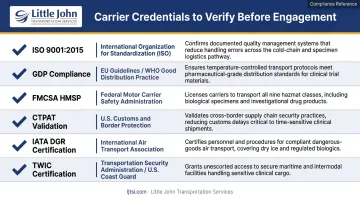
ISO 9001:2015 certifies quality management system requirements — process control, performance evaluation, and regulatory compliance — but doesn't certify pharmaceutical cold chain capability on its own. Treat it as a baseline, not a standalone pharmaceutical credential.
Audit-Ready Documentation in Practice
A carrier that operates on manual or paper-only systems creates compliance risk regardless of their physical capabilities. Audit-ready documentation means:
- Timestamped, electronic chain-of-custody records for every transit leg
- GPS tracking logs that can demonstrate the shipment was never in an unauthorized location — including customs staging areas
- Temperature data that can be pulled without gaps for regulatory submissions or inspections
- Excursion reporting workflows that notify sponsor quality teams automatically and document response actions
Operational Differentiators
Beyond credentials, the operational details separate capable carriers from compliant-on-paper ones:
- 24/7 live dispatch — someone answers at 2 a.m., not a voicemail queue
- Dedicated account management with direct contact for clinical site coordinators managing tight delivery windows
- In-transit excursion response protocols that go beyond detection and logging to active remediation
- Bilingual operations on U.S.–Mexico routes where documentation issues surface in two languages simultaneously
Frequently Asked Questions
What temperature ranges are required for clinical trial shipments?
The four main classifications are refrigerated (2°C–8°C), standard frozen (−20°C), ultra-cold (~−80°C), and cryogenic (≤−150°C). The required range is determined by each material's stability data, protocol, or label — only the refrigerated and standard frozen ranges correspond to ICH Q1A(R2) regulatory definitions.
What is a temperature excursion and what happens if one occurs during a trial?
A temperature excursion is any deviation outside a product's specified range. For investigational medicinal products, an excursion may invalidate the batch, trigger a mandatory QA investigation, and require replacement shipment manufacturing — adding weeks to trial timelines.
What regulations govern temperature-controlled clinical trial logistics in the United States?
Primary frameworks include FDA 21 CFR Part 11 for electronic records required by predicate rules, U.S. DOT 49 CFR Parts 171–180 for ground transport, IATA DGR (67th edition, 2026) for air-connected dangerous goods, and ICH E6(R3) Good Clinical Practice standards effective July 2025.
How does ground transport compare to air freight for temperature-controlled IMP shipments?
Ground transport offers fewer handling transfers and greater loading control, but requires carriers with validated temperature-controlled equipment and cross-border documentation capability. Air freight reaches international sites faster, though IATA dry ice restrictions and multiple handler touchpoints increase excursion exposure.
What certifications should a clinical trial logistics carrier hold?
Key credentials to verify:
- ISO 9001:2015
- GDP compliance
- FMCSA HMSP
- CTPAT validation (cross-border routes)
- IATA Dangerous Goods handling certification
- TWIC certification (port-adjacent delivery)
How are cross-border clinical trial shipments handled between the U.S. and Mexico?
U.S.–Mexico IMP shipments require COFEPRIS import authorization, bilingual documentation, and dangerous goods declarations matching the correct UN classification. Carriers holding CTPAT and FAST certification can use expedited border lanes, reducing dwell time that can compromise temperature integrity.