Introduction
A shipment of hazardous chemicals arrives damaged. The regulator wants a full audit trail. The carrier has no documentation beyond a single bill of lading with one signature. That gap — one undocumented handoff, one missing transfer log — is enough to trigger regulatory penalties, void an insurance claim, or shift liability to the shipper.
Chain of custody (CoC) is the process that prevents this. It creates an unbroken, chronological record of who handled a material, when, where, and under what conditions — from origin through final delivery.
Here's what this guide covers:
- What chain of custody means across legal, forensic, and freight contexts
- Why documentation gaps carry serious legal and financial consequences
- The required elements of a defensible CoC document
- The step-by-step custody process
- How CoC applies specifically to freight, hazmat, and cross-border logistics
Key Takeaways
- Chain of custody is a documented record of every transfer, handling event, and control point a material passes through from origin to final destination.
- A broken chain — even one missing signature — can render evidence inadmissible or expose a shipper to regulatory penalties up to $102,348 per violation.
- Every custody transfer requires date, time, names, signatures, and stated purpose with zero gaps.
- Hazmat, cross-border, and regulated shipments face the strictest CoC requirements.
- Vetting carriers for certified, audit-ready documentation practices is one of the most direct ways to limit compliance liability.
What Is Chain of Custody?
ISO 22095:2020 defines chain of custody as the "process by which inputs and outputs and associated information are transferred, monitored and controlled as they move through each step in the relevant supply chain." Published in October 2020, this standard provides the formal cross-sector framework for CoC terminology and requirements across all materials and products.
In legal and forensic contexts, the same concept is called "chain of evidence" — different name, identical principle.
Where CoC Is Used
Chain of custody applies across a wide range of industries and contexts:
- Criminal justice and forensics — physical evidence from crime scenes
- Drug and workplace testing — biological samples from collection to lab analysis
- Environmental sampling — soil, water, and air samples from field to EPA lab
- Pharmaceutical and clinical trials — FDA-regulated materials and investigational drugs
- Supply chain and freight — goods from shipper to carrier to receiver
The Core Principle
At any given moment, an identifiable, authorized person must have custody of the material, and every handoff must be documented and provable. An unwitnessed transfer, even a brief one, creates a gap that can undermine the entire record.
Why Chain of Custody Matters
Legal Consequences of a Broken Chain
Courts and regulators do not just assess whether evidence or materials exist — they assess whether those materials were handled without interruption or opportunity for tampering. An incomplete CoC weakens credibility and, in many jurisdictions, makes evidence inadmissible entirely.
In freight and regulated industries, the consequences are financial. PHMSA's 2025 civil penalty limits are $102,348 for ordinary violations and $238,809 when a violation causes death, serious injury, or substantial property destruction. In 2023 alone, PHMSA closed 85 enforcement cases and collected $877,013 in civil penalties — with documentation failures appearing across multiple cases.
Real enforcement examples from PHMSA's 2023 Annual Civil Penalty Report:
- Dade Paper & Bag — shipping paper omitted hazard classification and packing group
- Formulated Solutions — no shipping paper and no emergency-response telephone number
- LG Energy Solutions — invalid 24-hour emergency contact and misordered basic description
Integrity and Accountability
CoC prevents tampering, contamination, mix-ups, and falsification by making every person accountable for the material's condition during their specific custody period. When something goes wrong, a complete CoC log identifies exactly when, where, and with whom the problem originated. Without that record, liability becomes disputed and investigations stall.
Regulated Industries with Heightened CoC Requirements
| Industry | Governing Framework | CoC Consequence of Failure |
|---|---|---|
| Hazmat transport | 49 CFR / DOT / FMCSA | Fines up to $238,809; seized shipments |
| Pharmaceutical | FDA / DSCSA | Product detention, warning letters, seizure |
| Food safety | FDA Food Traceability Rule | Mandatory Key Data Elements; 24-hour audit response |
| Defense / AA&E | DoD / DoDM 5100.76 | Two-person integrity breaches; security violations |
The FDA's warning letter to Frozen Wheels, LLC illustrates the import side: the company failed to provide supply chain and custody records for imported hand sanitizers, resulting in product detention and refused admission. On the pharmaceutical manufacturing side, B&B Pharmaceuticals received an FDA warning after repackaged API certificates omitted original manufacturer information, undermining supply-chain traceability and triggering seizure warnings.
Across industries, the pattern is consistent: gaps in custody documentation don't just create compliance risk — they become the primary evidence of negligence when enforcement actions begin.
Key Elements of a Chain of Custody Document
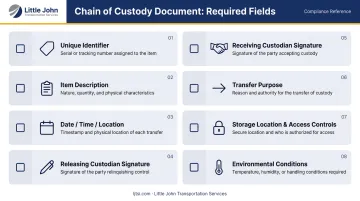
A defensible, audit-ready CoC document must capture the fields listed below — at minimum. Whether each field is legally required or operationally required depends on the governing commodity rule, contract, or security program.
Required Fields
Every CoC document should include:
- Unique identifier — a case number, shipment number, or evidence tag that ties the item, its packaging, and every log entry together
- Item description and condition — physical state at collection or origin
- Date, time, and location of collection or origin
- Name and signature of the releasing custodian
- Name and signature of the receiving custodian
- Purpose of the transfer
- Storage location and access controls between transfers
- Environmental conditions — temperature, humidity, or other relevant factors for sensitive or regulated materials
The Custody Log
These required fields feed directly into the custody log — the operational core of any CoC document. Each transfer generates a new timestamped row: released by / received by / purpose / location / date-time. A gap in this log — even one undocumented handoff — can invalidate the entire record in a regulatory audit or legal proceeding.
Tamper-Evident Packaging
Seal all items in tamper-evident packaging labeled with the unique identifier. Any break in the seal requires:
- A documented reason for the breach
- Confirmation of re-sealing
- Signatures from both the person who broke the seal and the person who re-sealed it
This requirement is critical for hazmat shipments and biological samples, where seal integrity directly supports the chain's credibility.
Storage Condition Documentation
Storage documentation must be precise. "In the office" is not an acceptable location entry — the record must specify the physical location, access control measures (locked cage, secure locker, restricted facility), and any environmental monitoring relevant to the item's condition.
The Chain of Custody Process: Step by Step
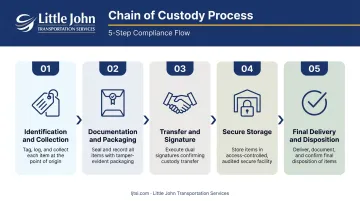
Step 1 — Identification and Collection
The material must be immediately identified and labeled with a unique ID at the point of origin or discovery. Condition is documented at this moment — not later. For freight, this means a drum of hazardous chemicals gets a shipment number, a condition description, and photographic documentation before it moves.
Step 2 — Documentation and Packaging
Before the item moves, it is documented in writing and packaged in tamper-evident materials. The CoC form is attached to or enclosed with the item. Reconstructing documentation after the fact introduces exactly the gap regulators and courts look for.
Step 3 — Transfer and Signature
Both parties sign and date the CoC log at every handoff — the releasing party and the receiving party. Intermediate transfers still require a log entry — transload facilities, relay drivers, and staging yards included. No exceptions.
Step 4 — Secure Storage
Between transfers, materials are stored in access-controlled environments. The CoC log must reflect the specific storage location and identify who holds access. Any change to storage conditions requires a new log entry, including:
- Temperature deviation outside approved range
- Change in storage location
- Access by an unscheduled person
Step 5 — Final Delivery and Disposition
The chain closes with a final signature confirming receipt in expected condition. The CoC document is completed and filed. Any discrepancies between the item's condition at origin and arrival must be formally noted with an explanation — not left blank, not resolved informally.
Chain of Custody in Freight and Logistics
How CoC Works Across a Shipping Network
Freight CoC tracks the movement, condition, and custody of goods from shipper to carrier to receiver. Unlike forensic evidence chains, which involve relatively few custodians, a freight CoC can span multiple carriers, transload facilities, border crossings, and storage events — each requiring its own log entry.
A complete freight CoC protects all parties in the event of:
- Physical damage or loss claims
- Regulatory inspection or customs review
- Insurance disputes
- Cross-border documentation audits
Hazardous Materials: The Strictest CoC Requirements
Under 49 CFR, carriers transporting hazardous materials must maintain shipping papers covering (49 CFR 172.202):
- Proper shipping name and UN identification number
- Hazard class and packing group
- Quantity and package type
An authorized signatory must certify each shipment (49 CFR 172.204). The carrier must keep shipping papers accessible during transport and retain records for two years — three years for hazardous waste — under 49 CFR 172.201.
These provisions set the legal floor. Audit-ready CoC for hazmat goes further, requiring:
- Handler identity at each transfer point
- Seal status and condition records
- Exception documentation for any deviation
Most general freight carriers don't maintain records at this level.
The FMCSA Hazardous Materials Safety Permit (HMSP) identifies carriers authorized to transport the highest-risk hazmat categories. As of December 29, 2023, FMCSA reported 898 active HMSP carriers out of 787,189 active motor carriers — roughly 0.11% of the carrier base. Little John Transportation Services is one of those 898. With 100% hazmat-endorsed drivers and ISO 9001:2015-certified documentation processes, every regulated load carries a complete, auditable CoC record from first transfer to final delivery.
Cross-Border CoC Complexity
U.S.–Mexico truck freight totaled more than $609 billion in 2024, representing 72.5% of all cross-border freight by value. Every one of those shipments generates documentation that must satisfy both U.S. and Mexican regulatory requirements simultaneously.
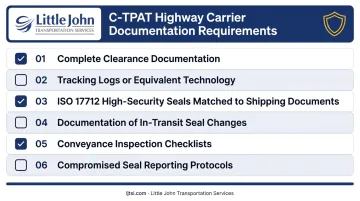
CBP's C-TPAT highway carrier criteria require carriers to maintain:
- Legible, complete, accurate clearance documentation
- Tracking logs or equivalent technology
- ISO 17712 high-security seals with numbers matched to shipping documents
- Documentation of any in-transit seal changes
- Conveyance inspection checklists
- Reporting protocols for compromised seals or suspicious cargo
FAST certification allows pre-vetted carriers to use dedicated lanes at the border. Eligibility requires that every link in the supply chain meets C-TPAT standards — meaning documentation integrity must extend to interchange partners, not just the primary carrier.
What Happens When Freight CoC Breaks Down
Documentation failures in freight generate concrete, measurable consequences:
- Unsigned or missing BOLs — contested liability with no clear chain of responsibility
- Undocumented driver handoffs — gaps that insurers use to deny claims
- Missing customs documentation — delayed or seized shipments at ports of entry
- Incomplete condition records — inability to determine when and where damage occurred
PHMSA enforcement cases consistently cite incomplete shipping papers as the primary documented violation. Those cases end with real financial penalties — and the documentation gap that triggered them was preventable.
Best Practices for Maintaining Chain of Custody
Establish a "No Undocumented Touch" Rule
Every time a shipment changes hands, is accessed, moved to a new location, or re-packaged, a new CoC entry is created. No exceptions for brief transfers, relay drivers, or "it was only a minute." Personnel who treat documentation as optional create the gaps that become disputes.
Use Unique IDs and Digital Tracking
Assign a shipment-specific identifier that appears on every document: the BOL, CoC form, customs paperwork, and condition records. Digital freight management systems and GPS tracking create automated, time-stamped custody logs that supplement paper documentation, but they don't replace it.
A PHMSA pilot study across 21 simulations found that 87% of respondents cited increased operational efficiency with electronic shipping papers, and 67% reported reduced staff time and cost. The same study identified real limitations: connectivity dead zones, after-hours access delays, and small-screen readability issues. The practical conclusion is that digital systems support CoC but require offline backup capability.
Partner with Carriers Who Maintain Certified Processes
A shipper's CoC record is only as strong as the weakest link in the custody chain. When a carrier's documentation is incomplete, that gap becomes part of the shipper's exposure in a regulatory audit or insurance dispute.
Carriers with verifiable credentials operate under documented, auditable processes that hold up under regulatory scrutiny. Look for carriers maintaining:
- ISO 9001 quality management systems
- FMCSA HMSP (held by fewer than 1% of carriers)
- C-TPAT validation
- FAST certification
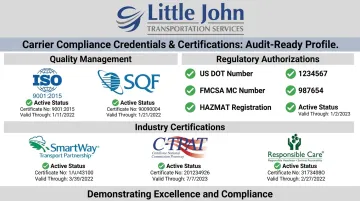
Little John Transportation Services holds all four. Its network of 8,500+ hazmat-endorsed owner-operators and 65,000+ approved carriers across the U.S., Mexico, and Canada operate under audit-ready documentation standards — so gaps in the custody record don't become gaps in your compliance position.
Frequently Asked Questions
What is a chain of custody document?
A chain of custody document is a standardized written record that logs every person who handled a material or piece of evidence, when they handled it, where it was stored, and why it was transferred. It travels with the item from origin to destination and must be completed at every custody handoff without gaps.
How do you prove chain of custody?
Chain of custody is proven through a complete, uninterrupted log of signed entries documenting every transfer (date, time, custodian names, and stated purpose), supported by tamper-evident packaging, secure storage records, and supporting documentation such as photographs, witness signatures, or condition reports.
What happens if the chain of custody is broken?
A broken chain — caused by missing signatures, undocumented transfers, or unexplained gaps — can render evidence inadmissible in court, void insurance claims, trigger regulatory penalties up to $238,809 per violation, or shift liability to the party whose records are incomplete.
What information must be included on a chain of custody form?
At minimum: unique item identifier, item description and condition, collection date/time/location, name and signature of each custodian and recipient at every transfer, purpose of transfer, and storage location between transfers. Commodity-specific rules may add seal numbers, environmental conditions, or additional certifications.
How does chain of custody apply to hazardous materials shipping?
Hazmat shipments require carriers to document shipping papers, shipper certification, emergency contact information, and carrier retention records under 49 CFR. FMCSA HMSP certification is required for the highest-risk hazmat categories (held by fewer than 0.12% of active motor carriers), and all documentation must withstand PHMSA enforcement scrutiny at every transfer point.