Introduction
Production lines don't wait. When a component arrives late — or sits in storage longer than planned — the downstream cost compounds fast. According to Siemens' 2024 research, automotive unplanned downtime costs $2.3 million per hour. That single figure explains why so many manufacturers treat logistics timing as a production variable, not an afterthought.
Cross-docking — routing inbound freight directly to outbound transport at a distribution point with little to no intermediate storage — is one of the tools designed to close that timing gap. It's also one of the most operationally misunderstood.
Manufacturers implement it without the right freight profile. Carriers advertise it without the facility infrastructure to back it up. Operations teams discover too late that without precise carrier coordination, cross-docking adds handoffs without removing the delays.
This guide covers how cross-docking actually works in manufacturing environments, what drives its effectiveness, and how to recognize when it's the wrong call.
Key Takeaways
- Cross-docking eliminates storage delays by routing inbound freight directly to outbound transport, keeping just-in-time manufacturing on schedule
- Timing precision is non-negotiable: inbound and outbound schedules must be synchronized or the model breaks down
- Not all manufacturing freight qualifies — oversized components, hazmat, and inspection-required goods need specialized handling protocols
- When goods dwell at a cross-dock beyond 24–48 hours, it's no longer cross-docking — it's warehousing
- Cross-border manufacturing corridors require carriers with bilingual operations, customs expertise, and physical presence at border hubs
What Is Cross-Docking?
Cross-docking is a logistics process where inbound goods are unloaded at a facility, sorted and/or consolidated, and immediately loaded onto outbound vehicles — skipping long-term storage entirely. Maersk describes the standard dwell time as under 24 hours, with some operations completing transfers in under an hour.
The result: goods reach the production line faster, with fewer handling steps, lower labor costs, and less damage exposure along the way.
How Cross-Docking Differs from Alternatives
| Method | What Happens | Storage Involved? |
|---|---|---|
| Cross-docking | Goods transfer from inbound to outbound at a hub | Minimal (under 24 hours) |
| Traditional warehousing | Goods held until demand signals trigger outbound shipment | Days, weeks, or months |
| Dropshipping | Supplier ships direct to customer, no hub involved | None — but no consolidation either |
| Direct shipment | Supplier bypasses all distribution points | None — but no sorting or sequencing |
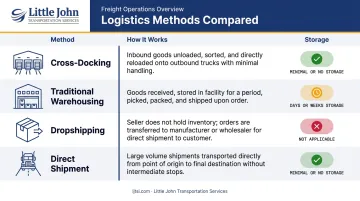
That distinction matters for manufacturing applications. In cross-docking, the hub's job is transfer — not storage. That changes how facilities are designed, staffed, and scheduled.
Why Cross-Docking Is Used in Manufacturing
Manufacturing — especially lean and just-in-time production — creates exactly the conditions where cross-docking delivers its clearest value. Assembly lines run on precise timing. Components must arrive in the right sequence, not just on time. Any delay in retrieval from storage is a delay to production.
Three Primary Manufacturing Applications
1. Automotive and industrial assembly Supplier components are routed directly to the production floor, often sequenced to match the build order. Toyota and Honda have both built named cross-dock operations around this model — Toyota North America named Ryder its 2024 "Cross Dock Supplier of the Year" for its San Luis Potosí operation, while Honda operated five North American cross-docks to manage inbound transport efficiency.
2. Chemical and petrochemical Hazardous materials with short safe-storage windows benefit from minimal dwell time. Reducing time between inbound receipt and outbound dispatch cuts compliance exposure — though this requires certified carriers and documented handling protocols, not just speed.
3. Cross-border manufacturing corridors For U.S.–Mexico supply chains, cross-docking at border hubs like Laredo compresses the handoff between U.S. and Mexican carriers. The Laredo region processed $380.3 billion in trade in 2024, with trucks representing 78.5% of that value — the most critical physical node in North American manufacturing freight flows.
Coordinating timing on both sides of the border requires teams physically stationed at Laredo, Monterrey, and Guadalajara simultaneously. That operational presence — not just proximity — is what separates reliable cross-docking from missed production windows.
What Manufacturing Demands That Cross-Docking Addresses
- Predictable, high-frequency component flows where production schedules don't flex
- Combines multiple inbound supplier loads into a single sequenced outbound stream
- Keeps time-sensitive materials — adhesives, chemicals, pharmaceuticals — moving before storage duration creates risk
- Removes excess floor inventory that creates both safety hazards and congestion
Compliance vs. Strategy
The distinction matters: in some manufacturing environments, minimizing storage time is a regulatory requirement, not just an efficiency play. Under 49 CFR 171.8, transportation includes loading, unloading, and storage incidental to movement; extended dwell can shift a shipment out of "in-transit" status and into storage classification with different compliance obligations. In automotive and industrial manufacturing, cross-docking is primarily a lean production strategy, not a regulatory mandate.
How Cross-Docking Works: The Step-by-Step Process
Cross-docking functions as a timed transfer system. Freight arrives from multiple inbound carriers, is sorted at the dock by destination or production sequence, and departs on outbound vehicles within a defined window — typically the same day. Timing synchronization across inbound scheduling, dock operations, and outbound dispatch drives the entire model.
Pre-Distribution vs. Post-Distribution
Pre-distribution assigns destinations or assembly sequences before goods leave the origin. When freight arrives, dock workers execute the transfer directly — no allocation decisions needed. This is standard in automotive just-in-sequence delivery where the build order is known in advance.
Post-distribution sorts and allocates goods after arrival, based on live production demand signals. It's more flexible, but adds sorting time and coordination overhead. Better suited to environments with variable output schedules or multiple simultaneous production lines.
Facility Design
Cross-dock facilities in manufacturing logistics are typically I-shaped or U-shaped to minimize travel distance between receiving and shipping docks. Research published in Transportation Science finds that I-shaped layouts are optimal below 150 dock doors, T-shaped from 150–200, and H-shaped above 200 — the shape choice is driven by internal freight-handling travel cost, not aesthetics.
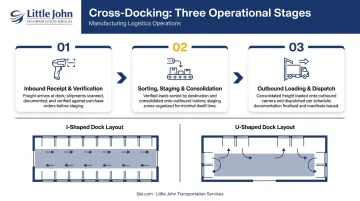
With the physical layout calibrated for throughput, the operational sequence follows three defined stages.
Step 1: Inbound Receipt and Verification
Inbound trucks arrive on pre-scheduled appointments. Goods are unloaded and immediately scanned — barcode or RFID — against the bill of lading. For hazmat or regulated materials, this step also includes a compliance check: documentation, labeling, and condition verification before any transfer proceeds.
Step 2: Sorting, Staging, and Consolidation
Verified goods move into outbound lanes sorted by destination, production line, or sequence order. In consolidation cross-docking, smaller loads from multiple suppliers merge into a single full outbound load. In deconsolidation, a large inbound shipment breaks into smaller batches for multiple production points. Dwell time is tracked against the facility's target window from the moment goods hit the staging area.
Step 3: Outbound Loading and Dispatch
Staged goods load onto outbound vehicles aligned with production arrival windows. In JIT manufacturing, sequenced delivery matters as much as timing — components must arrive in the order they'll be used on the line, not just within the delivery window. Dispatch documentation (BOL, hazmat placarding if applicable, customs paperwork for cross-border loads) is completed before the outbound vehicle departs.
Key Factors That Affect Cross-Docking Effectiveness in Manufacturing
Freight Characteristics
Pre-packaged, pre-labeled, palletized goods move fastest through a cross-dock. Freight that slows the process:
- Oversized or heavy-haul components requiring crane transfer rather than standard dock equipment
- Loose or bulk materials needing repackaging before outbound loading
- Items requiring post-receipt inspection or quality testing before transfer can occur
- Temperature-sensitive goods needing controlled staging environments
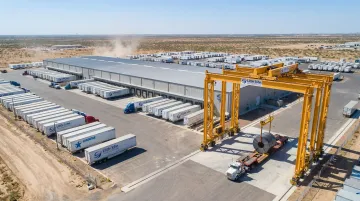
For operations like Little John Transportation Services' 50-acre Laredo facility — which includes a 30-bay cross-dock, 1,200 trailer-space staging capacity, and a 120-ton bridge crane capable of completing superload transfers in under two hours — oversized manufacturing components that would bottleneck a standard cross-dock can still move on schedule.
Carrier Network Depth
Cross-docking fails when inbound trucks arrive late or outbound capacity isn't staged. In manufacturing, a single missed delivery can halt a line. The carrier network must maintain schedule reliability across multiple lanes simultaneously.
For cross-border operations, this means carriers need:
- Bilingual dispatch teams with physical operations on both sides of the border
- Boots on the ground at key border hubs — not just paper capacity
- In-house customs documentation to eliminate third-party handoff delays
- Pre-established carrier interchange agreements that allow rapid trailer deployment
Technology and Systems Integration
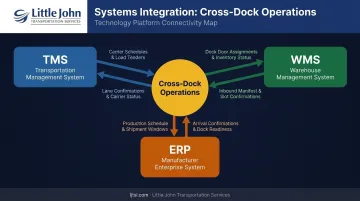
Real-time visibility across the full dock is the baseline requirement: inbound ETAs, dock door assignment, outbound departure windows, and inventory status must all be visible simultaneously. The standard configuration integrates:
- TMS (Transportation Management System) for carrier coordination and lane management
- WMS (Warehouse Management System) for dock door assignment and inventory status
- ERP (manufacturer's enterprise system) for production schedule alignment
Without this integration, coordination breaks down across multiple lanes as throughput increases.
Compliance and Safety Constraints
In chemical, pharmaceutical, and energy manufacturing, cross-docking adds regulatory complexity that can't be treated as an operational afterthought:
- Hazardous materials require FMCSA HMSP-certified carriers and Hazmat-endorsed drivers
- Staging areas must segregate incompatible materials correctly
- Chain-of-custody documentation must be accurate and complete
- Temperature-sensitive goods need controlled transfer environments throughout
FMCSA's HMSP program applies to motor carriers transporting specified hazmat classes and quantities — fewer than 1% of U.S. carriers hold this permit, which narrows the qualified carrier pool considerably for manufacturers shipping regulated freight.
Volume and Frequency
Cross-docking delivers its strongest ROI at high throughput and consistent frequency. Low-volume, irregular shipments rarely justify the coordination overhead. The more predictable the production schedule, the more efficiently the cross-dock model can be built around it.
Common Misconceptions and When Cross-Docking Isn't the Right Fit
Three Misconceptions Worth Correcting
| Misconception | Reality |
|---|---|
| Cross-docking is a universal cost-cutter | Without the right freight profile and scheduling infrastructure, coordination costs can exceed warehousing savings. The math only works when freight, facility, and carrier align. |
| Cross-docking eliminates inventory risk | It shifts risk upstream. Supply chain reliability becomes more critical, not less — a disruption to inbound delivery hits the production line directly, with no buffer. |
| Any facility can function as a cross-dock | Dock door count, staging capacity, layout, and systems integration determine operational viability. A standard warehouse with a fast turnaround isn't a cross-dock. |
Understanding these limits makes the go/no-go decision cleaner. Here's when a different approach makes more sense.
When to Choose a Different Approach
Cross-docking is the wrong call when:
- Products require post-receipt inspection or quality testing before transfer
- Production demand is highly irregular or unpredictable, making scheduling unreliable
- Shipment volume is low and non-recurring — coordination overhead outweighs speed benefit
- Freight requires environmental storage conditions the facility cannot maintain during staging
The Warning Signal to Watch For
If goods consistently dwell at the cross-dock for more than 24–48 hours, the operation has functionally become a warehouse — with the cost structure of both and the optimization of neither. Regular dwell time audits are the clearest way to catch this drift before it becomes embedded in the operation.
Conclusion
When cross-docking works, it eliminates storage delays, compresses lead times, and keeps production lines moving without buffer stock. Getting there requires freight profile, carrier coordination, facility infrastructure, and compliance requirements to be fully aligned. For manufacturers running cross-border supply chains or handling regulated freight, those alignment requirements are more demanding — not less.
The value of cross-docking comes from disciplined execution. Manufacturers evaluating it should audit their freight characteristics, carrier network reliability, and systems integration capabilities before committing.
For operations involving heavy-haul components, hazardous materials, or U.S.–Mexico cross-border flows, the carrier partnership is what makes timing precision achievable. Little John Transportation Services operates a 30-bay cross-dock at its CTPAT-validated 50-acre Laredo facility, holds an FMCSA HMSP — a certification fewer than 1% of carriers carry — and runs bilingual teams across Laredo, Monterrey, and Guadalajara. That's built specifically for the compliance-sensitive freight coordination that cross-docking in manufacturing requires.
Frequently Asked Questions
What does cross-docking mean?
Cross-docking is a logistics process where inbound freight is transferred directly to outbound transport at a distribution hub with minimal or no storage time. Goods "cross the dock" — unloaded from inbound vehicles and loaded onto outbound vehicles, typically within 24 hours or less.
What is an example of cross-docking in manufacturing?
An automotive plant receives components from multiple suppliers at a cross-dock facility. Parts are sorted by build sequence and loaded directly onto delivery trucks for just-in-time arrival at the assembly line — in the exact order the line will use them.
What companies use cross-docking?
Toyota, Honda, large grocery chains, pharmaceutical distributors, and manufacturers with JIT production requirements all use cross-docking. Essentially any operation where speed and inventory minimization outweigh the need for a storage buffer.
How is cross-docking different from traditional warehousing?
Warehousing holds goods for days, weeks, or months until demand triggers outbound shipment. Cross-docking transfers goods within hours, bypassing storage — the tradeoff is lower holding costs and faster delivery versus reduced flexibility to absorb demand fluctuations.
What skills are needed for cross-docking?
Core competencies include dock scheduling, WMS/TMS proficiency, and accurate load scanning. Manufacturing environments add compliance requirements specific to the freight type:
- Hazmat handling certifications
- Chain-of-custody documentation
- Temperature control protocols for cold chain freight
Is cross-docking suitable for hazardous materials in manufacturing?
Yes, but the process must meet strict requirements:
- FMCSA HMSP-certified carriers and Hazmat-endorsed drivers
- Correct material segregation during staging
- Compliant labeling and shipment documentation trail
Minimizing dwell time is actually a compliance advantage for hazmat — provided execution is handled by qualified personnel.