According to Accenture's research on oil and gas supply chain resilience, supply chain challenges can add $10–$15+ per barrel to a new well's breakeven cost. At any meaningful production volume, that number compounds fast.
This guide covers everything operators need to understand about oil and gas supply chain management: what it is, how it's structured, the stages involved, the challenges that trip up even experienced teams, and the practices that separate high-performing operations from those constantly reacting to the last crisis.
Key Takeaways
- Oil and gas SCM spans the full flow of goods, services, and logistics across upstream, midstream, and downstream sectors
- The supply chain runs on three pillars: supplies, services, and transportation and logistics — each carrying distinct risks
- Price volatility, compliance complexity, data silos, and supplier management are the most persistent operational challenges
- Unified procurement, real-time visibility, and expanded vendor competition define best-in-class supply chains
- Transportation is the highest-risk link in the chain, requiring hazmat, heavy-haul, and cross-border credentials that most carriers don't hold
What Is Oil & Gas Supply Chain Management?
Oil and gas supply chain management (SCM) is the coordinated process of planning, sourcing, procuring, transporting, and delivering the goods and services required to sustain operations across all three sectors of the energy industry — from the wellhead through refining to the end user.
What sets this supply chain apart from most industries is the combination of four factors operating simultaneously:
- Hazardous materials — crude oil, compressed gases, corrosive chemicals, and drilling fluids require specialized handling and carrier credentials at every stage
- Geographic remoteness — offshore rigs, desert basins, and cross-border facilities sit far outside standard freight networks
- Regulatory complexity — OSHA, EPA, DOT, FMCSA, and international equivalents all impose overlapping requirements
- Zero tolerance for downtime — a delayed part or late delivery doesn't slow operations; it stops them
The Three Sectors and Their Distinct Demands
Oil and gas SCM spans three distinct operating environments, and the supply chain looks distinct across each:
| Sector | What It Covers | Key Supply Chain Demands |
|---|---|---|
| Upstream | Exploration and production — drilling, extraction | Drill bits, casing, chemicals, wellhead equipment, water hauling |
| Midstream | Transportation and storage — pipelines, terminals | Construction materials, inspection services, compression equipment |
| Downstream | Refining and distribution | Structural components, catalysts, maintenance services, disposal |
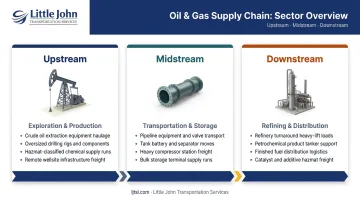
Accenture reports that supplies can represent 80% of upstream CAPEX — placing supply chain decisions at the center of production economics, not on the periphery of operations.
The Three Pillars of the Oil & Gas Supply Chain
Supplies
Thousands of distinct supply types move through the oil and gas supply chain daily. They fall into several broad categories:
- Parts — drill bits, valves, casing, gaskets, OCTG pipe
- Materials — sand, water, fuel, wire, cement
- Operational equipment — generators, blowout preventers, cranes, storage tanks
- Safety equipment — PPE, H2S detectors, spill containment systems
- Chemicals — drilling mud, hydraulic fluids, biocides, anti-corrosion agents
- Technology — satellite communications, GPS systems, wellhead control electronics
Lead times vary widely: long-lead items like specialty drilling equipment can take 12–18 months to procure, while short-lead consumables turn in 2–6 weeks. That spread makes inventory accuracy and supplier redundancy critical levers for uptime — especially on remote or offshore sites where storage is limited and restocking isn't simple.
Services
Service procurement is often more complex than physical goods, because it involves workforce certification requirements that must be actively maintained — not just verified at onboarding.
Across the three sectors, service categories include:
- Upstream: Land surveying, engineering, water hauling, equipment rental, well control training
- Midstream: Pipeline construction, inspection services, right-of-way clearing
- Downstream: Structural engineering, simulation modeling, maintenance contracts, waste disposal
Service providers must hold current certifications — the IADC WellSharp program, for example, operates on a two-year recertification cycle with role-specific competency requirements. Managing these renewal schedules across dozens of vendors, across multiple geographies, is a persistent administrative burden.
Transportation and Logistics
Transportation is the connective tissue of the entire supply chain — physically moving supplies, equipment, chemicals, and personnel from point of origin to operational site. Where services and supplies create complexity upstream, transportation is where that complexity becomes exposure.
This pillar is distinctly vulnerable to external disruption. When Red Sea shipping routes were threatened in late 2023, EIA data showed tanker freight rates jumped roughly 20% month-over-month, and a Persian Gulf-to-Europe voyage expanded from 19 to 35 days.
Those kinds of shocks cascade immediately into project timelines — and they hit hardest when contingency plans don't exist.
Oil and gas logistics demands more than standard freight capacity. Most moves involve at least one of the following:
- Hazardous materials requiring HMSP-certified carriers
- Oversized or overweight equipment needing permit routing
- Remote or offshore delivery windows with zero tolerance for delay
- Cross-border coordination with customs documentation
Carrier selection, in this context, is an operational risk decision. Cost matters, but so does the carrier's ability to execute when conditions change.
Key Stages of Oil & Gas Supply Chain Management
Planning and Demand Forecasting
Every supply chain starts with a forecast. Operators must project the quantities, types, and timing of supplies and services needed across active and upcoming projects — before procurement begins.
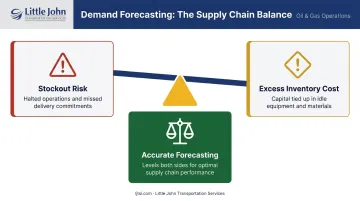
Poor forecasting creates two expensive problems at once: stockout risk that halts operations, and excess inventory cost that ties up capital on remote sites where storage space is at a premium. Offshore platforms have almost no room for error on either side.
Supplier Sourcing and Qualification
Supplier qualification is the process of identifying, evaluating, and onboarding vendors to an approved vendor list (AVL). It involves collecting and verifying:
- Safety certifications and training records
- Insurance coverage and limits
- Geographic licensing and regional permits
- Ongoing compliance documentation as regulations change
The challenge is that maintaining a current, complete AVL is resource-intensive — and the temptation to consolidate to a short list of familiar vendors is constant. That consolidation reduces administrative burden in the short term but eliminates competitive leverage and often inflates costs over time.
Procurement and Contracting
This is where purchase orders, work orders, and contracts get executed. The Source-to-Pay (S2P) process is the backbone here — connecting vendor discovery through payment in a single workflow.
When procurement is fragmented across multiple disconnected systems, the downstream effects are predictable: duplicate entries, invoice mismatches, delayed approvals, and payment disputes. One documented case from the Permian Basin involved an operator processing 25,000 invoices monthly — peaking at 60,000 — where automating field-ticket matching and invoice approval resolved the majority of those disputes systematically.
Transportation, Storage, and Delivery
With contracts executed and materials ordered, the next challenge is getting them there on time. Coordinating multi-modal transportation (truck, rail, marine, air), intermediary storage, and time-sensitive delivery to site requires tightly sequenced coordination. On offshore platforms especially, materials must arrive within narrow delivery windows tied to vessel schedules — a missed window can set a project back by days.
Monitoring, Measurement, and Continuous Improvement
KPIs that matter in oil and gas SCM:
- On-time delivery rate
- Inventory turnover
- Supplier performance scores
- Cost-per-delivery
- Invoice cycle time
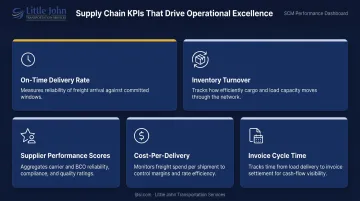
Continuous improvement cycles — adjusting the vendor mix, renegotiating contracts, tightening logistics partnerships — are what separate reactive operators from proactive ones. Operators who track these metrics consistently tend to catch supplier performance degradation early — before it becomes a cost or safety event.
Major Challenges in Oil & Gas Supply Chain Management
Price Volatility and Geopolitical Risk
Oil and gas input costs are directly tied to commodity markets and geopolitical stability. McKinsey data shows oil and gas costs rose 7–15% in 2022, with maintenance labor up 9%, steel casing and tubing up 5%, and logistics fuel up 20%. Further increases of 6–10% were projected for 2023.
Multi-year fixed contracts attempt to hedge against this volatility, but they often bake in inflated pricing to protect suppliers — shifting cost rather than eliminating it.
Compliance and Regulatory Complexity
Safety compliance varies by geography, service category, and regulatory body. Key U.S. frameworks include:
- OSHA — drilling and extraction operations under 29 CFR 1910 and 1926
- DOT / FMCSA — hazardous materials transport
- EPA — emissions and waste management
- International bodies — entirely separate frameworks for cross-border operations
Maintaining current documentation for hundreds of vendors across all these requirements is an operational burden. It's one reason operators tend to shrink their vendor lists — but that consolidation has a cost.
Data Silos and Limited Real-Time Visibility
Most operators manage supply chain activity across multiple disconnected systems. The result is data fragmentation that makes it nearly impossible to get a real-time view of spend, vendor status, or delivery progress. McKinsey has documented the need to exchange oil and gas data across traditional organizational silos as a prerequisite for effective decision-making. The problem persists because these systems are rarely built to communicate with each other.
Without that visibility, decisions get made on stale data or gut instinct rather than current operational reality.
Supplier Management at Scale
Managing an approved vendor list across dozens of service categories and multiple geographies — especially when entering new operating regions — is genuinely difficult. Without competitive vendor data, operators default to familiar suppliers. That eliminates negotiating leverage and steadily inflates costs across every category where competition has been removed.
Cross-Border and Remote Logistics Complexity
U.S.–Mexico oil and gas corridors introduce documentation requirements, carrier qualification standards, and customs coordination that standard domestic freight simply doesn't face. Gaps in any of these areas — missing paperwork, an unqualified carrier, a customs hold — cause delays that cascade upstream through entire project timelines.
Best Practices for Effective Oil & Gas Supply Chain Management
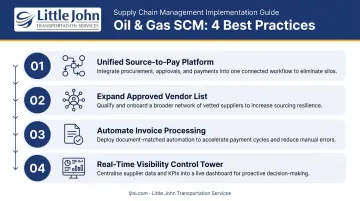
1. Consolidate procurement on a unified Source-to-Pay platform.
A single end-to-end S2P system connects vendor discovery through invoice payment, eliminates manual entry errors, and builds the historical pricing data needed to benchmark incoming bids against actual market rates.
2. Expand the approved vendor list while maintaining compliance discipline.
Proactively growing the AVL with pre-vetted suppliers in each service category enables competitive bidding and reduces the cost inflation that comes from single-source dependency. Digital compliance tracking manages certification renewals without requiring additional headcount.
3. Automate field ticket verification and invoice processing.
When invoice generation and approval are based on pre-agreed pricing with automatic field ticket matching, disputes drop and payment cycles accelerate — in some cases cutting net payment terms from 45 days to under two weeks. Faster payment improves supplier relationships and reduces the risk of priority being redirected to better-paying operators.
4. Build real-time visibility into every stage.
Leadership needs live access to spend data, supplier performance scores, and delivery status across all active projects. Control tower capabilities — where a centralized operations function monitors the full chain — have been associated with roughly 20% lower operating costs and 2–5% higher asset uptime per Accenture's supply chain research.
Transportation & Logistics: Why the Right Carrier Partner Matters
Of all the pillars in the oil and gas supply chain, transportation carries the highest concentration of operational risk. A compliance failure, a delayed hazmat shipment, or an oversized load without proper permitting doesn't create a paperwork problem. It can shut down a rig.
Oil and gas transportation demands carriers with purpose-built certifications. The credentials that matter:
| Credential | What It Covers |
|---|---|
| FMCSA HMSP | Authority to move the most dangerous hazmat classes — held by fewer than 0.1% of active U.S. carriers |
| TWIC | Required for unescorted access to maritime facilities, refineries, and petrochemical terminals |
| Hazmat Endorsement | CDL endorsement for all regulated material transport, required of 100% of drivers |
| CTPAT / C-TPAT Validated | Secure cross-border operations, U.S.–Mexico and Canada |
| FAST Certified | Expedited border processing for time-sensitive loads |
| ISO 9001:2015 | Audited quality management system with documented accountability |
Most carriers hold one or two of these credentials. Very few hold all of them.
Little John Transportation Services holds the full complement. Their FMCSA Hazardous Materials Safety Permit places them among fewer than 900 carriers in the U.S. with that authorization, and every BCO in their network carries a hazmat endorsement, TWIC credentials, and tanker certification covering all nine hazard classes.
Their fleet spans RGN, multi-axle lowboy, double drop, flatbed, step-deck, and extendable configurations: the equipment specifically required for drilling rig components, frac tanks, BOP stacks, mud pumps, and pipe and casing that define oilfield freight.
Cross-Border Operations
U.S.–Mexico oil and gas supply chains require more than a truck and a driver. Carriers need:
- Bilingual operations teams on both sides of the border
- FAST and C-TPAT validation
- In-house customs documentation capability
- Physical presence at key crossings
Little John's 50-acre Laredo facility (CTPAT-validated, with a 120-ton bridge crane for transloading superloads) anchors their cross-border operation. Their Monterrey and Guadalajara offices extend that reach into northern and western Mexico, with 24/7 bilingual dispatch and 250+ Mexican interchange agreements supporting continuous cross-border freight movement.
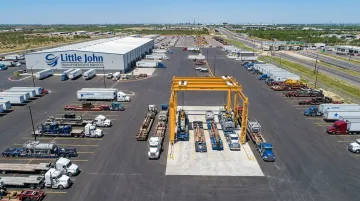
Carrier qualification gaps and documentation errors cause cross-border delays that ripple directly back through project timelines. The right carrier eliminates that exposure before it reaches the border.
Frequently Asked Questions
What is supply chain management in oil and gas?
Oil and gas SCM covers the end-to-end process of planning, sourcing, procuring, transporting, and delivering everything needed to sustain upstream, midstream, and downstream operations. What sets it apart from other industries: hazardous materials, remote operating environments, strict regulatory requirements, and zero tolerance for downtime.
What are the biggest challenges in oil and gas supply chain management?
The most persistent challenges are price volatility tied to commodity markets, compliance management across multi-vendor and multi-geography operations, and data silos that block real-time visibility into spend and delivery status. Managing supplier networks across remote and cross-border environments compounds all three.
What is the difference between upstream, midstream, and downstream supply chains?
Upstream covers exploration and production — drilling, extraction, wellhead operations. Midstream covers transportation and storage — pipelines, terminals, compression. Downstream covers refining and distribution to end users. Each sector has distinct supply, service, and logistics requirements that operators must plan for separately.
What certifications should an oil and gas logistics carrier have?
Key credentials include the FMCSA Hazardous Materials Safety Permit, TWIC certification, hazmat endorsements for all drivers, CTPAT/C-TPAT validation for cross-border loads, and ISO 9001:2015. Fewer than 1% of U.S. carriers hold the HMSP alone — finding a carrier with the full stack requires active vetting, not assumptions.
How does cross-border logistics affect the oil and gas supply chain?
U.S.–Mexico oil and gas freight requires customs documentation, C-TPAT and FAST carrier qualifications, and bilingual operations teams on both sides of the border. Any gap in these areas can trigger border holds that cascade into significant project cost overruns.