Introduction
Someone in the United States needs blood or platelets every 2 seconds. That pace — roughly 29,000 red blood cell units needed daily — makes blood one of the most time-critical and volume-demanding biological products in modern healthcare.
But skilled clinicians and willing donors only solve part of the problem. Between donation and transfusion, blood must travel through a tightly controlled system where temperature deviations don't just waste product — they can kill patients.
That system is the blood cold chain.
Unlike pharmaceutical cold chains for drugs or vaccines, blood involves multiple components with incompatible temperature requirements, extremely short shelf lives, and zero tolerance for error.
The WHO defines it simply: the complete system for storing and transporting blood and blood products within correct temperature ranges, from donor collection through to patient transfusion.
Storage standards for blood products are well-established. Transportation is where most failures actually occur — ambient temperature swings, mishandled transfer points, routing delays, and undertrained couriers introduce risks that controlled storage environments never face.
What follows covers the temperature standards each blood product requires, the operational failures that compromise them, and what competent cold chain logistics actually demands.
Key Takeaways
- Each blood component requires a distinct temperature range — deviations render products unsafe, not just suboptimal
- Transportation is the highest-risk cold chain stage, exposing blood to uncontrolled environmental conditions
- Cold chain failures cause both product waste and direct patient harm, including fatal septic shock
- 21 CFR Parts 606, 610, and 640, AABB, and WHO standards govern every blood shipment
- Carriers must bring hazmat-trained drivers, continuous temperature monitoring, and audit-ready documentation to every shipment
Temperature Requirements for Each Blood Component
Different blood components don't just prefer different temperatures — they require them. These aren't guidelines. They're the scientific constraints that every blood bank, courier, and receiving facility must treat as non-negotiable.
Red Blood Cells
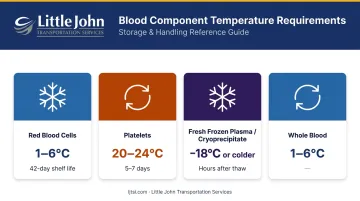
Red blood cells must be stored and transported at 1–6°C. Above this range, accelerated metabolic activity increases acidosis and hemolysis, reducing oxygen-carrying capacity. Below freezing, cell membranes rupture.
Shelf life extends to 42 days under proper conditions — but that window depends entirely on consistent temperature maintenance across every leg of the journey, from the collection facility to the hospital blood bank.
Platelets
Platelets present a unique challenge: they're stored at 20–24°C with continuous gentle agitation. That room-temperature requirement sounds manageable until you consider what it means for bacterial risk.
FDA guidance explicitly identifies platelets as carrying a higher risk of sepsis and related fatality than any other transfusable component, because room temperature supports bacterial proliferation when controls slip. The standard dating period is 5 days, extendable to 7 days only under FDA-approved bacterial-risk-control strategies. That compressed timeline leaves almost no margin for transport delays or re-handling.
Plasma and Cryoprecipitate
Fresh frozen plasma (FFP) and cryoprecipitate must be stored and transported at -18°C or colder. Freezing preserves the labile clotting factors, particularly factors V and VIII, that make these products therapeutically effective.
Once FFP is thawed, the clock restarts immediately. Usage windows are tight and non-negotiable:
- Standard thawed plasma: 24-hour window
- Relabeled "Thawed Plasma" stored at 1–6°C: up to 5 days
- Cryoprecipitate in a closed system: use within 6 hours of thawing
- Cryoprecipitate after pooling: use within 4 hours
Any temperature excursion or repeated freeze-thaw cycle degrades clotting factor content and compromises patient outcomes.
Whole Blood
Whole blood is stored and transported at 1–6°C. FDA requires immediate controlled storage unless the blood is actively being processed or transported; transport to a processing laboratory must cool continuously toward the acceptable range.
Improper temperature control at collection cascades through the entire supply chain. Every derived component — red cells, platelets, plasma — starts degrading before separation even begins.
The Biggest Challenges in Blood Cold Chain Management
Meeting temperature standards on paper is straightforward. Maintaining them across hundreds of facilities, carriers, and handoff points — under time pressure, in variable conditions — is where most supply chains break down.
Temperature Excursions
Temperature excursions (periods when a product moves outside its required range) are the leading cause of blood product waste. They come from multiple directions:
- Power failures in storage units
- Refrigerator door openings during high-traffic periods
- Incorrect packaging selection for expected ambient conditions
- Transit delays extending shipment duration beyond packaging validation windows
- Improper loading or handling by untrained personnel
What makes excursions particularly dangerous is that they're often invisible without continuous monitoring. A product can exceed its temperature ceiling and return to range before arrival, leaving no visible sign of compromise — but rendering the unit potentially unsafe.
Short Shelf Lives and Time Pressure
The 2023 NBCUS data shows outdated whole blood and RBC units increased 13.8% from 2021, and outdated apheresis platelets were 3.6% higher. Both figures reflect the relentless pressure of managing products with shrinking windows.
For platelets at 5–7 days and thawed plasma measured in hours, there's no room for routing inefficiency, re-handling, or failed first-attempt deliveries. A single missed delivery attempt can render a unit unusable by the time it reaches the recipient facility.
That same time pressure makes compliance documentation harder — every delay forces staff to make judgment calls under urgency, which is exactly when procedural errors occur.
Regulatory Compliance
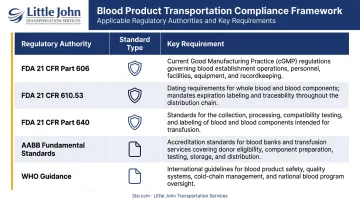
Blood cold chain compliance isn't a single standard — it's a layered framework:
| Authority | Key Requirement |
|---|---|
| FDA 21 CFR Part 606 | CGMP framework; Section 606.160 mandates storage/distribution temperature records and periodic shipping-container validation |
| FDA 21 CFR 610.53 | Dating periods and temperature conditions for whole blood and components |
| FDA 21 CFR Part 640 | Product-specific rules for whole blood, platelets, plasma, and cryoprecipitate |
| AABB Fundamental Standards | Pre-shipment inspection, validated containers, temperature records |
| WHO Guidance | Equipment selection, cold chain management, and maintenance protocols |
Every shipment must be documented and audit-ready. That burden doesn't fall only on blood banks — it falls on every carrier and courier that handles the product.
Geographic and Infrastructure Gaps
Blood supply chains must reach hospitals across both dense urban corridors and rural areas with limited cold storage infrastructure. Cross-border transport between the U.S. and Mexico adds further complexity: customs clearance timelines create dwell risk, regulatory frameworks differ, and ambient temperature extremes in border regions stress packaging systems.
Human Error
No monitoring technology fully eliminates the human factor. Peer-reviewed literature identifies procedural handling and negligence as consistent contributors to temperature excursions — from incorrect packaging at the blood bank to improper product placement by an untrained courier. The most effective mitigation combines written SOPs with verified, documented training — so every handler understands the stakes before touching a unit.
The High-Risk Window: Transporting Blood Products
Storage is a controlled environment. Transit is not. Vehicle temperature variations, transfer point handling, ambient conditions, and unpredictable delays all create exposure that no blood bank refrigerator ever faces.
Validated Packaging
AABB's shipping container validation guidance requires a documented validation plan covering:
- The specific packing scheme and container configuration
- Thermal materials used (ice, dry ice, or phase change materials)
- Representative worst-case environmental conditions
- A traceable data logger throughout the shipment
Packaging must be validated — not just functional, but documented — for the expected shipment duration and environmental exposure.
Phase change materials (PCMs) calibrated to a product's required temperature range provide controlled, power-free thermal protection, well-suited for ground transport across variable climates.
Continuous Temperature Monitoring
FDA's 21 CFR 606.160 requires documented storage-temperature records and periodic testing of shipping containers' capacity to maintain proper transit temperature. AABB guidance calls for traceable data loggers during validation.
Continuous monitoring serves two distinct purposes in practice:
- Product protection: catches excursions the moment they occur, not after the fact
- Audit documentation: creates the traceable record regulatory reviews require
A snapshot at departure and arrival isn't enough. Excursions can occur and self-correct mid-transit, remaining undetected without continuous logging.
The 30-Minute Rule
The "30-minute rule" isn't a universal FDA regulation — it originated in AABB standards addressing whether whole blood and red blood cell units could be reissued after removal from controlled storage while remaining within acceptable return temperature criteria.
The underlying principle still governs every handoff: once a blood product leaves a validated storage or transport container, a strict time window determines whether it can be returned to storage or must be discarded.
That makes handoff moments between carriers and receiving facilities among the most risk-prone points in the entire chain. Delays, miscommunication, or slow receiving-department processing can cost a usable unit.
Route Planning
Pre-planned, optimized routes aren't optional for blood transport. Three factors can push transit times beyond packaging validation windows:
- Traffic delays on high-volume corridors
- Weather disruptions affecting road conditions or access
- Unplanned stops that accumulate into critical time overruns
Carriers must have contingency protocols and responsive dispatch support to reroute in real time when conditions shift.
How Specialized Freight Carriers Support the Blood Cold Chain
Blood logistics cannot be treated like standard temperature-controlled freight. The stakes, the regulatory burden, and the clinical consequences of failure require carriers built specifically for high-compliance, time-critical biological shipments.
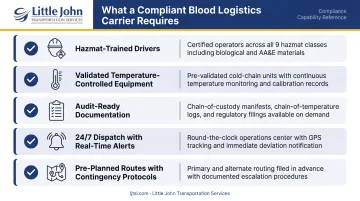
A capable blood logistics carrier brings specific operational capabilities:
- Hazmat-trained drivers with documented, current certification across all relevant hazard classes
- Validated temperature-controlled equipment with continuous monitoring and pre-cool confirmation before loading
- Audit-ready documentation covering every leg of the shipment — temperature records, chain-of-custody handoffs, and distribution records aligned with 21 CFR 606.160
- 24/7 dispatch with real-time exception alerts for temperature deviations
- Pre-planned routes with contingency protocols for traffic, weather, or delay scenarios
For health systems operating across state lines or moving product across the U.S.–Mexico border, geographic reach matters as much as equipment. Cross-border blood transport requires carriers experienced in customs documentation requirements, bilingual dispatch operations, and the regulatory differences between U.S. FDA jurisdiction and Mexican COFEPRIS oversight — where clearance delays directly threaten cold chain integrity.
Little John Transportation Services carries the compliance infrastructure this freight demands: FMCSA HMSP certification (held by fewer than 1% of carriers), 8,000+ hazmat-endorsed owner-operators across all nine hazard classes, GDP-compliant cold chain operations with continuous temperature logging, CTPAT-validated facilities, and 24/7 bilingual dispatch across U.S. and Mexico operations. Their 50-acre Laredo facility sits at the busiest U.S.–Mexico commercial crossing, supporting cross-border cold chain continuity with uninterrupted temperature monitoring through transloading.
When the cargo is blood, carrier selection is a patient safety decision. Every documented handoff has to meet the regulatory standards that protect both the product and the person receiving it — and that starts with a carrier whose compliance infrastructure was built for this type of freight, not adapted from it.
Frequently Asked Questions
What is blood cold chain transportation?
Blood cold chain transportation is the controlled movement of blood and blood components within validated temperature ranges — from donor collection to patient transfusion — using specialized insulated containers, continuous temperature monitoring, and trained handlers to prevent temperature excursions.
How should blood be transported in the cold chain?
Blood should be transported in validated insulated containers using appropriate refrigerants or phase change materials, with continuous temperature monitoring, sealed packaging, and pre-planned routes. Blood should be transported in validated insulated containers using appropriate refrigerants or phase change materials, with continuous temperature monitoring, sealed packaging, and pre-planned routes. Complete documentation is required throughout, per AABB, WHO, and FDA 21 CFR Parts 606, 610, and 640.
What temperature should blood be transported at during cold chain transportation?
Temperature requirements vary by component: red blood cells and whole blood require 1–6°C; platelets require 20–24°C with continuous agitation; fresh frozen plasma and cryoprecipitate require -18°C or colder. Each range is non-negotiable — deviation can render the product unsafe for transfusion.
What is the 30-minute rule for blood transfer in cold chain transportation?
The 30-minute rule originated in AABB standards governing whether red blood cells and whole blood removed from storage could be returned and reissued — based on product temperature, not elapsed time alone. It applies most critically at handoff moments, where delays between carriers and receiving facilities determine whether a unit is usable or discarded.
What happens if the blood cold chain is broken?
A cold chain break can cause hemolysis in red blood cells, bacterial proliferation in platelets, reduced clotting factor activity in plasma, and product discard. At the patient level, consequences include supply shortages and potentially fatal transfusion reactions, including septic shock.
What regulations govern blood cold chain transportation?
Blood cold chain transportation is governed by FDA regulations under 21 CFR Parts 606, 610, and 640; AABB Fundamental Standards; WHO guidance documents; and applicable state health authority requirements. All mandate validated storage, documented temperature monitoring, and audit-ready chain-of-custody records.