Introduction
Picture this: a chemical manufacturer needs to move a Division 1.3 explosive shipment from Texas to a facility in Monterrey, Mexico. They call their usual carrier. The carrier declines — no hazmat permit, no cross-border capability, no certified drivers. Now they're scrambling.
This scenario plays out constantly across North American supply chains. It illustrates why understanding transportation and logistics management isn't just academic — it has direct operational and financial consequences.
Two terms sit at the center of every freight decision:
- Transportation management — the planning and execution of physically moving goods from one location to another
- Logistics management — the broader system coordinating the entire supply chain, from sourcing and inventory to warehousing, order fulfillment, and distribution
The two are deeply intertwined and typically managed together.
This guide covers both: how they're defined, where they differ, the core components, the challenges businesses face, and what effective management looks like in practice — including for the complex, specialized freight that most carriers aren't equipped to handle.
Key Takeaways
- Transportation management is a subset of logistics, focused on the physical movement of goods
- Logistics management coordinates the full supply chain: sourcing, inventory, warehousing, and distribution
- Done well, logistics management cuts costs, tightens delivery windows, and reduces exposure to supply chain disruptions
- Specialized freight — heavy-haul, hazmat, cross-border — requires a higher tier of expertise and compliance than standard shipping
- The right transportation partner directly affects operational risk, cost, and your ability to meet commitments
What Is Transportation and Logistics Management?
Transportation Management Defined
Transportation management covers the planning, execution, and optimization of physically moving goods between locations. In practice, that means:
- Route planning and mode selection (road, rail, air, ocean)
- Carrier selection and freight cost management
- Shipment tracking and real-time visibility
- Regulatory compliance and documentation
For standard freight, these decisions are straightforward. For specialized cargo — oversized machinery, hazardous materials, cross-border shipments — each of these functions becomes dramatically more complex.
Logistics Management Defined
Logistics management, as defined by CSCMP, is the part of supply chain management that plans, implements, and controls the efficient forward and reverse flow and storage of goods between origin and consumption. It includes transportation, but also:
- Procurement and sourcing coordination
- Inventory management and demand forecasting
- Warehousing and order fulfillment
- Reverse logistics
The combined term "transportation and logistics management" reflects how these two functions operate in practice: as an integrated system. When transportation decisions aren't coordinated with inventory positioning and warehousing strategy, the whole chain suffers.
Why This Discipline Matters at Scale
The global freight and logistics market is valued at $6.37 trillion in 2025, projected to reach $8.49 trillion by 2031 at a 4.91% CAGR. Road freight alone holds nearly 64% of freight transport revenue. At that scale, even incremental inefficiencies compound into enormous costs, which is why this discipline sits at the center of competitive supply chain strategy.
Why Transportation and Logistics Management Matters for Business
Those market-scale numbers translate directly to firm-level risk. Poor transportation and logistics management doesn't stay contained to the shipping department. Failures ripple outward:
- Customer satisfaction drops when delivery reliability falls
- Inventory health deteriorates through stockouts or excess carrying costs
- Production schedules slip when inbound materials arrive late
- Costs escalate through emergency re-routing, detention fees, and compliance penalties
Businesses that manage these functions well — coordinating carrier selection, route planning, and inventory positioning as one system — build genuine competitive advantages in cost efficiency and service reliability.
Transportation vs. Logistics: Key Differences Explained
The two terms get used interchangeably in business conversations, but they operate at fundamentally different scopes.
Transportation management zooms in: it asks how do we move this shipment efficiently? Its activities include mode selection, route optimization, carrier management, freight documentation, and tracking.
Logistics management zooms out: it asks how do we design the system so the right goods reach the right place at the right time, at the lowest cost? Its activities span the entire flow of goods, information, and resources across the supply chain.
Here's a practical way to think about the relationship:
| Dimension | Transportation Management | Logistics Management |
|---|---|---|
| Focus | Movement of goods | End-to-end supply chain flow |
| Activities | Routing, carrier selection, freight docs, tracking | Inventory, warehousing, fulfillment, distribution |
| Decision level | Tactical | Strategic |
| Scope | One function within logistics | The broader coordinating system |
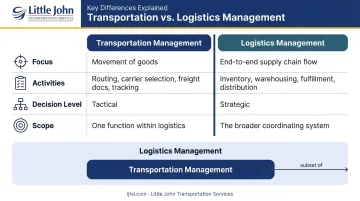
Transportation is one function within logistics — an important one, but not the whole picture.
A company can optimize its carrier network perfectly and still face chronic delays if inventory is positioned in the wrong distribution centers. The freight moves efficiently, but it starts from the wrong place. Getting that right requires logistics decisions made upstream: where to position stock, how to structure distribution, and how to align inventory levels with demand. Transportation executes the plan; logistics designs it.
Core Components of Transportation and Logistics Management
Transportation Planning and Route Optimization
Effective transportation management starts before a truck rolls. Route planning involves determining optimal paths, modes of transport, and delivery schedules — accounting for fuel costs, transit time, carrier capacity, and regulatory constraints.
Route optimization technology, real-time traffic data, and GPS tracking have made this more precise. According to Verizon Connect's fleet data, connected fleet technology delivers average reductions of 12% in fuel costs and 12% in labor costs among users — vendor-reported figures, but directionally consistent with the financial case for systematic route planning.
Carrier Selection and Management
Carrier selection goes beyond finding the cheapest rate. Businesses evaluate:
- Capacity and equipment availability
- On-time performance and reliability
- Safety ratings and compliance credentials
- Service quality across specific lanes
For specialized freight — hazmat, oversized loads, cross-border shipments — vetting goes deeper. Carriers must hold specific endorsements, permits, and certifications. An FMCSA Hazardous Materials Safety Permit (HMSP), for example, is required for the highest-hazard material categories and is held by fewer than 1% of U.S. interstate carriers.
Inventory Management and Demand Forecasting
Logistics management uses demand data to set inventory levels that balance availability with carrying cost. Techniques like Just-In-Time (JIT) inventory and Economic Order Quantity (EOQ) help operations strike this balance.
The cost of miscalculation is concrete: IHL Group's research puts global retail inventory distortion — stockouts plus overstock — at $1.77 trillion in 2023, equal to 7.2% of retail sales. That's a retail-specific figure, but the financial exposure from inventory misalignment runs across every supply chain.
Warehousing and Order Fulfillment
The logistics layer governing how goods are stored, picked, packed, and shipped shapes lead times and order accuracy. Efficient warehousing reduces dwell time and improves the customer experience — especially in high-velocity operations like automotive JIT or pharmaceutical distribution.
Key factors that determine warehousing efficiency:
- Location relative to demand centers and transportation nodes
- Slotting strategy (positioning high-velocity SKUs for faster pick paths)
- WMS integration for real-time inventory visibility
- Cross-docking capability to minimize dwell time on time-sensitive freight
Freight Compliance and Documentation
Every shipment requires accurate documentation. For regulated or cross-border freight, the requirements are detailed:
- Standard freight: Bill of lading, shipping manifest, proof of delivery
- Hazmat freight: Identification number, proper shipping name, hazard class, packing group, emergency-response phone number, shipper certification
- Cross-border freight (U.S.–Mexico): Customs declarations, CTPAT compliance documentation, USMCA trade classification
- AA&E (Arms, Ammunition & Explosives): Chain-of-custody records, TPS authorization documentation
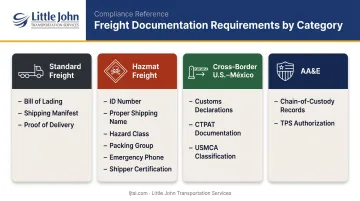
The numbers make the stakes clear. Federal civil penalties for hazardous materials violations reached $99,756 per violation in 2024, rising to $232,762 when a violation caused death, serious injury, or substantial property damage. Documentation isn't a formality — it's a financial and legal risk control.
Top Challenges in Transportation and Logistics Management
Rising Operational Costs
Fuel remains the largest variable cost in trucking. ATRI's 2025 data puts average truck operating costs at $2.336 per mile, with non-fuel costs at $1.854 per mile — up 4.2% year-over-year. Fuel savings from route optimization don't eliminate cost pressure from other categories.
Effective management mitigates this through load consolidation, smart carrier contracts, and route efficiency — but none of it works without active, ongoing oversight. Costs don't stay controlled on their own.
Regulatory Complexity and Compliance
Cost pressure is only one dimension of the challenge. Compliance requirements vary by freight type, geography, and mode — and the stakes are highest in cross-border operations. For U.S.–Mexico shipments, that means managing:
- CBP customs regulations and CTPAT validation requirements
- FAST program eligibility for expedited border processing
- FMCSA cross-border operating authority for Mexico-domiciled carriers
- Hazmat-specific HMSP permits and PHMSA documentation standards
Non-compliance creates costly delays and exposes shippers to fines, cargo holds, and permit revocation. For businesses moving regulated materials across international borders, compliance is a baseline requirement — not an afterthought.
Supply Chain Disruptions and Risk Management
Resilinc recorded 22,522 supply chain disruption notifications in 2024 — up 38% year-over-year, with extreme weather alerts rising 119% and flood alerts up 214%. 59% of these events triggered supplier-collaboration escalations.
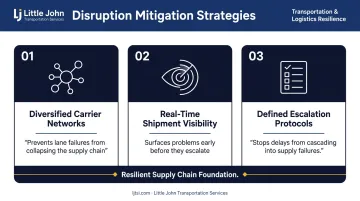
Effective transportation and logistics management builds contingency into the system before disruptions hit. That means:
- Diversified carrier networks that don't collapse when one lane goes down
- Real-time shipment visibility so problems surface early
- Defined escalation protocols that prevent delays from cascading into supply failures
Strategies for Effective Transportation and Logistics Management
Three strategies separate high-performing logistics operations from those that constantly react to problems:
Integrate transportation and logistics planning. Businesses that manage transportation in isolation from inventory and warehousing consistently underperform. Carrier selection, route planning, inventory positioning, and order fulfillment need to function as one coordinated system — not separate departments solving separate problems.
Invest in visibility technology. Transportation Management Systems (TMS), GPS tracking, and supply chain analytics give managers end-to-end visibility across the network. The global TMS market is valued at $18.6 billion in 2025 and projected to grow at a 17.8% CAGR through 2033 — a signal of where operational investment is heading at scale. Shippers who haven't yet adopted real-time tracking tools are now operating at a structural disadvantage.
Treat compliance as a foundation, not a cost center. For businesses moving complex freight — especially in regulated industries or across borders — compliance credentials should be a baseline screening criterion when evaluating partners. A carrier without the right permits, safety ratings, or certifications isn't a cheaper option; it's a liability that shows up in claims, delays, and audit failures.
Choosing the Right Transportation and Logistics Partner
What to Look For
For most standard freight, the carrier selection criteria are straightforward: price, capacity, and basic reliability. For complex or high-stakes freight, the requirements are different:
- Industry expertise in the specific freight type (not just general trucking experience)
- Compliance credentials — verified safety ratings, HMSP for hazmat, CTPAT for cross-border, TPS for government/military
- Real-time tracking with human dispatch support, not just automated portals
- Flexibility to handle non-standard freight and solve problems when they arise
- A human-first service model — someone who picks up the phone and owns the outcome
Generalist Carrier vs. Specialized Transportation Partner
Most standard carriers can handle dry van freight within legal dimensions. They cannot legally or operationally handle:
- High-hazard materials requiring FMCSA HMSP authorization
- Superloads that need route engineering, multi-state permitting, and escort coordination
- Cross-border shipments requiring CTPAT validation, customs brokerage, and bilingual logistics teams
- AA&E cargo requiring TPS approval and DoD-compliant chain-of-custody documentation
Little John Transportation Services is built specifically for this tier. Operating since the mid-1990s, they've spent 30+ years moving the freight most carriers decline: heavy-haul, all 9 hazmat classes including AA&E, and U.S.–Mexico cross-border freight.
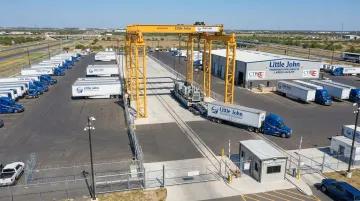
Their credentials include FMCSA HMSP, CTPAT validation, FAST certification, TPS approval, and AA&E authorization. Their 50-acre CTPAT-compliant Laredo facility, which includes a custom 120-ton bridge crane for cross-border superload transloading, is a concrete example of the infrastructure this freight actually demands.
The Cost of Getting This Decision Wrong
McKinsey estimates that inefficient logistics handoffs cost the U.S. economy $65 to $95 billion annually — equal to 13–19% of total logistics costs. Carrier failures, compliance lapses, and documentation errors contribute directly to that figure through delays, fines, shipment seizures, and lost customer trust.
Evaluating a partner purely on rate ignores every factor in that list above. When the wrong carrier takes on freight they're not credentialed or equipped to handle, the cost isn't just the shipment — it's the delay, the fine, and the customer relationship that follows.
Frequently Asked Questions
What does a transportation and logistics manager do?
A transportation and logistics manager oversees the movement of goods through the supply chain: planning routes, selecting carriers, managing compliance documentation, coordinating with warehouses, and ensuring on-time delivery. In specialized freight environments, this also means managing permits, regulatory compliance, and cross-border logistics coordination.
What is the difference between transportation management and logistics?
Transportation management focuses on the physical movement of goods — route planning, carrier selection, and freight tracking. Logistics management encompasses the broader supply chain system, including inventory, warehousing, order fulfillment, and distribution. Transportation is one function within logistics, not a synonym for it.
What are the main modes of transportation used in logistics?
The four primary modes are road (trucking), rail, air freight, and ocean shipping. Mode selection depends on cargo type, distance, urgency, and cost. Complex freight — oversized loads, hazmat — typically requires specialized road transport with specific permits, equipment, and certified drivers.
What is a Transportation Management System (TMS)?
A TMS is software that helps businesses plan, execute, and optimize freight movement. Core functions typically include route optimization, carrier selection, freight cost tracking, and real-time shipment visibility.
What makes specialized freight different from standard freight transportation?
Specialized freight involves cargo that exceeds standard weight or dimension limits, contains regulated materials, or crosses international borders. These shipments require additional permits, certified drivers, compliance documentation, and carrier expertise that standard carriers don't possess and often can't legally obtain.
How do rising fuel costs affect transportation and logistics management?
Fuel is one of the largest variable costs in transportation. Logistics managers mitigate volatility through route optimization, load consolidation, and carrier contract structures. Even when fuel costs dip, as they did in 2024, total operating costs remain under pressure from labor, equipment, and compliance expenses.