The transportation leg is where the cold chain breaks most often. Unlike controlled storage environments, over-the-road movements expose temperature-sensitive freight to mechanical failure, driver error, multi-carrier handoffs, and weather events — all in the same shipment.
This article covers five challenges logistics managers encounter most frequently in cold chain transportation, along with practical solutions that can be applied to the next load.
Key Takeaways
- Temperature excursions start before the truck moves — pre-cooling and pre-trip inspections are non-negotiable
- Multi-leg handoffs require signed temperature documentation at every transfer point, not just the final delivery
- Cross-border shipments demand proactive compliance planning — border delays push freight into dangerous temperature ranges fast
- Carrier vetting never stops — treat it as continuous auditing, not a one-time credential check
- Route disruptions require pre-approved contingency plans, not real-time improvisation
Challenge 1: Temperature Excursions During Transit
What an Excursion Actually Is
Under FDA's FSMA Sanitary Transportation rule (21 CFR 1.908), a temperature excursion occurs when freight deviates from the shipper's written operating-temperature specification during transit — what the regulation calls a "material failure of temperature control."
There's no single universal danger zone for all freight. The applicable range is defined by the product and the shipper's documented requirements.
What makes the transit phase vulnerable is the absence of the controlled conditions a warehouse or cold storage facility provides. A reefer trailer is a mobile refrigeration unit operating in variable ambient conditions, and it has far more failure points than a fixed storage environment.
Common Causes
The GCCA's Cold Chain Best Practices Guide identifies these primary risk mechanisms:
- Failure to pre-cool the trailer to the required setpoint before loading
- Refrigeration unit running while trailer doors are open, causing humid air ingress and coil icing
- Inadequate airflow from improper load placement (GCCA recommends 9 inches between load and ceiling, 3 inches from sidewalls)
- Mechanical failure of the refrigeration unit mid-haul
- Extended dock dwell time with trailer doors open during loading
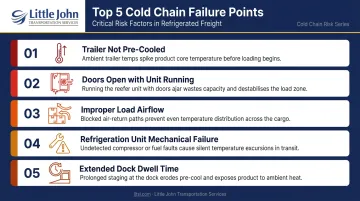
Each of these failure points is preventable. The solutions below address them directly — before departure and during the haul.
Solutions That Actually Work
Before the truck leaves:
- Run an automatic pre-trip test on the reefer unit before loading begins
- Pre-cool the trailer to the required setpoint — not to an approximation of it
- Conduct a door seal inspection as part of the pre-departure checklist
- Turn the refrigeration unit off while doors are open to prevent coil icing and humidity buildup
During transit:
- Deploy cellular or satellite-connected data loggers that send real-time alerts when temperature thresholds are breached
- Require drivers to log temperature readings at each stop
- Establish a response protocol before departure — not after an alert fires
When a material failure may have rendered food unsafe, FDA rules require a qualified determination before the product can be sold or distributed. That determination — involving qualified personnel, lab testing, and documented chain-of-custody review — can take days and delay distribution. The cost of a single compromised load typically exceeds the annual investment in monitoring equipment several times over.
Challenge 2: Multi-Leg Handoffs and Chain-of-Custody Gaps
Cold chain freight rarely moves on a single truck from origin to destination. It passes through consolidation hubs, transfer depots, and relay drivers — and each handoff is a potential gap in both temperature continuity and accountability.
The Core Problem at Every Transfer Point
FSMA assigns distinct responsibilities to four parties: shippers, loaders, carriers, and receivers. Under 21 CFR 1.908, loaders must verify the trailer was adequately pre-cooled before loading begins, and receivers must assess whether the load shows evidence of temperature abuse. But the regulation doesn't mandate a standalone chain-of-custody form at every handoff — that's a contractual gap that shippers need to close themselves.
The practical problem: when freight passes through three carriers and two transfer points, pinpointing where an excursion occurred becomes nearly impossible without documented temperature readings at each transfer.
That risk compounds when brokers sub-contract to carriers you've never vetted — no real-time temperature data, no accountability trail. The solutions below address both problems directly.
Solutions
- Require a signed temperature log at every transfer point — both the releasing and receiving party document the reading at the moment of handoff
- Work with logistics partners who maintain their own vetted carrier networks rather than brokering to unknown parties; this closes accountability gaps before they open
- Use shipment-level GPS and temperature tracking that provides continuous condition data across all legs, not just at origin and destination
- Retain records for at least 12 months — FSMA training and agreement records must be available for audit beyond the shipment date
A rejected load with no paper trail doesn't just cost you the shipment — it costs you the ability to recover from the carrier who caused it. Documentation is what makes accountability enforceable.
Challenge 3: Regulatory Compliance and Cross-Border Documentation
Five Separate Compliance Layers for US-Mexico Shipments
Cross-border shipments — particularly US-Mexico — layer five distinct regulatory systems on top of domestic cold chain requirements. All five must be satisfied simultaneously:
| Requirement | Key Detail |
|---|---|
| FDA Prior Notice | File at least 2 hours before road arrival for imported food |
| CBP ACE Truck Manifest | Separate from FDA prior notice; submitted through ACE system |
| APHIS Permits & Phytosanitary Certs | Required for specific plant-origin commodities; verify by product via ACIR |
| SENASICA Export Certification | Mexico's international phytosanitary certificate for applicable exports |
| FMCSA Carrier Authority | Mexico-domiciled carriers need OP-1MX to operate beyond border zones |
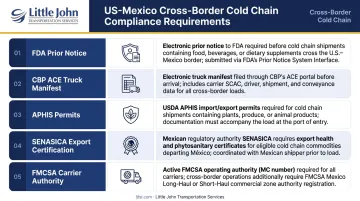
A documentation error in any of these layers can trigger a customs hold. That hold doesn't pause the clock on a temperature-sensitive load — it accelerates the risk.
The Consequence of Getting It Wrong
Under FDA import refusal rules, a final refusal requires export or destruction within 90 days. CBP can demand redelivery and assess bond-related damages if those deadlines aren't met. For perishable freight, the product may already be unsellable long before that 90-day window closes.
Solutions
Preventing compliance failures before they reach the border requires both the right carrier credentials and the right operational setup:
- Engage carriers with C-TPAT validation for front-of-line inspections, reduced examination rates, and FAST-lane access — cutting the dwell time that threatens temperature integrity
- Maintain audit-ready chain-of-custody documentation for every leg, formatted to satisfy both US and Mexican regulatory requirements
- Use pre-cleared customs procedures where available to eliminate preventable border delays
- Staff bilingual operations teams who can resolve documentation issues before they trigger temperature-damaging holds
Little John Transportation Services runs bilingual teams in Laredo, Monterrey, and Guadalajara. The Laredo facility is a CTPAT-validated cross-border hub built around the documentation and coordination requirements of US-Mexico freight — the exact infrastructure these compliance layers demand.
Challenge 4: Carrier Equipment Reliability and Vetting
Not all reefer carriers operate at the same standard. Refrigeration unit age, calibration history, trailer insulation integrity, and driver training on temperature management vary widely — and a poorly maintained reefer unit can fail mid-haul with no warning.
Warning Signs of an Under-Vetted Carrier
- No documented pre-trip inspection process
- Refrigeration units running beyond their useful service life without documented maintenance
- Drivers who can't verify or correctly set reefer setpoints
- No telematics or temperature data available for shipper review post-delivery
- Inability to provide FSMA training records when requested
According to ATA/TMC survey data, responding carriers typically keep refrigerated trailers 7–10 years before aftermarket sale. Age alone isn't disqualifying — but age without documented maintenance absolutely is.
Solutions
Before tendering cold chain freight, verify:
- Equipment inspection records and reefer maintenance logs
- Pre-trip test documentation confirming the refrigeration unit was tested before loading
- Driver training credentials for temperature-sensitive freight handling
- Real-time temperature monitoring capability, including data access during and after transit
- FMCSA safety rating and active DOT compliance status
The most practical solution for most shippers: work with a logistics partner who has already done this vetting — and does it continuously.
Little John Transportation Services maintains a network of 65,000+ approved carriers reviewed nightly against legal, insurance, and performance standards. For cold chain freight, that includes carriers screened for GDP compliance, FSMA alignment, and verified temperature monitoring capability. That ongoing vetting eliminates the carrier-by-carrier qualification burden for every load.
Challenge 5: Route Disruptions, Weather, and Seasonal Demand Surges
When the Route Breaks Down
Weather events — winter storms, extreme heat, hurricanes — and traffic delays extend transit times beyond planned windows. For freight with tight temperature tolerance, even a relatively short unplanned delay can cause an excursion.
A January 2026 winter storm across North and Central Texas documented by NOAA brought freezing conditions lasting 58–74 hours and national tender rejection rates reaching 11.5% according to FreightWaves reporting. Capacity tightened across the network precisely when temperature-sensitive freight needed reliable carriers most.
The Seasonal Demand Problem
USDA data for Q2 2025 recorded 9.33 million tons of fresh produce truck shipments — up 8% from Q1 — with 501–1,500-mile lane rates averaging $2.60/mile, up 13% quarter-over-quarter. Mexico alone supplied 3.55 million tons, representing 38% of the total.
When capacity is short and rates are high, shippers often accept carriers they wouldn't otherwise approve. Peak demand compresses vetting standards at exactly the moment those standards matter most.
Solutions
- Build contingency transit time into the plan for temperature-sensitive freight — don't schedule to the minimum viable window
- Establish pre-approved alternate carriers and routes before disruptions occur, not after a weather event is already affecting the network
- Use dynamic routing tools that factor transit time requirements alongside standard delivery optimization
- Work with carriers who have 24/7 dispatch capability to proactively reroute loads in real time rather than waiting for shipper escalation
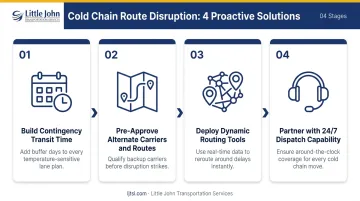
A 24/7 dispatch team that spots a weather event or capacity gap before the load is affected can reroute it. One that waits for the shipper to call is already behind — and for cold chain freight, that lag has a direct product cost.
Frequently Asked Questions
What is a temperature excursion in cold chain transportation?
A temperature excursion occurs when freight moves outside its required temperature range during transit — defined under FSMA as a "material failure of temperature control" relative to the shipper's written specification. Even brief deviations can render product unsellable or unsafe, depending on the commodity and duration.
What makes cross-border cold chain transportation harder than domestic shipments?
On the US-Mexico corridor, every shipment requires FDA prior notice, CBP manifest data, potential APHIS permits, and valid carrier operating authority — all correct before the truck reaches the border. A single documentation error triggers a customs hold, and that delay exposes temperature-sensitive freight to conditions it was never designed to handle.
How do you verify a carrier is qualified to handle temperature-controlled freight?
Request equipment maintenance records, reefer pre-trip test documentation, and proof of real-time monitoring capability. Verify the driver can set and confirm temperature setpoints, check the carrier's FMCSA safety rating and active DOT compliance, and also request FSMA training records for temperature-related duties.
What documentation is required for cold chain shipments?
Domestic shipments require temperature logs, chain-of-custody records signed at each transfer point, and regulatory compliance documentation per FDA/USDA/DOT requirements. Cross-border freight adds CBP ACE manifest data, FDA prior notice, and commodity-specific APHIS permits or phytosanitary certificates where applicable.
How can shippers protect cold chain freight during unexpected route delays?
Build contingency transit time into the original plan, establish pre-approved alternate carriers and routes before disruptions occur, and work with carriers that have 24/7 dispatch teams capable of proactive rerouting. Waiting for the shipper to escalate a problem adds hours you don't have.
What is the biggest mistake shippers make with cold chain transportation?
Treating cold chain freight like standard freight — skipping trailer pre-cooling, accepting carriers without vetting their reefer maintenance records, and failing to require documented temperature sign-offs at each handoff. Those three gaps account for most preventable cold chain failures.