
Introduction
When a standard carrier drops a load at a loading dock and drives away, that works fine for pallets of commodity goods. It does not work for a 200,000-pound drilling rig component, a Class 1 explosive shipment, or a server rack bound for a hyperscale data center. That gap — between "careful delivery" and genuine freight accountability — is where the term "white glove delivery" earns its meaning in specialized freight.
The problem is that "white glove" is unregulated. Any carrier can put it on a website. What separates carriers that use the label from those that actually deliver on it comes down to measurable specifics: claim rates, driver certification levels, documentation standards, and — most telling of all — how long customers actually stay.
This article examines what white glove delivery actually means in B2B specialized freight, what customers report when it's done right, and which industries depend on it most. The feedback patterns referenced throughout come from long-term freight relationships — not one-off consumer deliveries. If you're evaluating a carrier for complex, high-stakes cargo, that context is the whole point.
Key Takeaways
- White glove freight means proactive communication, real-time visibility, and audit-ready documentation — not just careful handling
- Communication responsiveness and damage-free delivery are the top two differentiators customers cite when describing exceptional specialized freight service
- Energy, chemical, defense, and AI infrastructure sectors consistently report the highest value from white glove freight relationships
- Long client tenure, not star ratings, is the most reliable indicator of genuine white glove performance
What White Glove Delivery Actually Means in Specialized Freight
Beyond "Careful" — The B2B Definition
Consumer white glove delivery means a crew assembles your furniture, places it in the room you want, and hauls away the packaging. That's a useful service, but it has almost nothing in common with what industrial shippers need.
In B2B specialized freight, white glove means:
- A named dispatcher owns the load — not a queue, not a ticket number
- Hazmat-endorsed, TWIC-certified, tanker-rated drivers matched to the commodity
- Chain-of-custody documentation with every handoff recorded and audit-ready
- Live tracking with human follow-through, not just a status portal
- Load ownership from pickup through final placement — not drop-and-go dock delivery
In specialized freight, the equivalent of white glove is a carrier who holds the certifications, assigns a named contact, and hands you audit-ready paperwork at delivery — not assembled after the fact.
What Happens Operationally
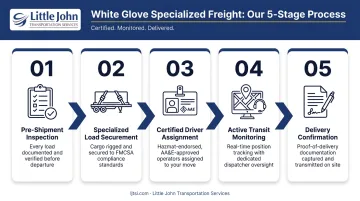
A genuine white glove specialized freight move follows a defined process:
- Pre-shipment inspection — cargo condition documented before loading
- Specialized load securement — correct trailer type, blocking, bracing, and tie-down ratings matched to the freight
- Certified driver assignment — appropriate endorsements for the commodity
- Active transit monitoring — live tracking with human dispatch oversight, not just a GPS ping
- Delivery confirmation — proof of delivery and condition documentation, structured for regulatory or customer audit
Separating Real White Glove from the Label
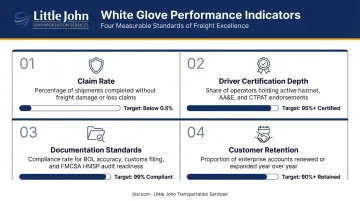
Because "white glove" carries no regulatory definition, the signals that matter are measurable:
- Claim rate: What percentage of loads arrive damaged?
- Driver certification depth: What share of the fleet holds Hazmat, TWIC, or tanker endorsements?
- Documentation standards: Is paperwork ready at delivery, or pieced together afterward?
- Customer retention: How long do clients actually stay — and can the carrier prove it?
A carrier that can't answer these questions with specific numbers is marketing, not operating.
Who Needs It
Knowing how to evaluate a carrier is only half the picture. The other half is recognizing which freight categories make this level of service non-negotiable:
- Oversized industrial equipment — requires specialized rigging, routing permits, and securement expertise
- Hazardous materials — compliance failures carry PHMSA civil penalties up to $102,348 per knowing violation
- Cross-border freight — customs documentation errors cause delays, fines, and supply chain disruption
- Time-critical energy infrastructure — a missing part on an oil rig is never just a logistics problem
- High-value AI and data center hardware — precision placement and damage-free delivery are non-negotiable
For any of these categories, the carrier's certifications, documentation practices, and claim history aren't evaluation criteria — they're minimum requirements.
What Customers Actually Say: Common Themes From Specialized Freight Reviews
Theme 1: Real, Responsive Human Communication
Across long-term specialized freight relationships, the single most cited differentiator is not price or transit time. It's communication — specifically, a named dispatcher or account manager who picks up the phone, provides updates without being chased, and resolves problems before they become incidents.
This is distinct from tracking portals. Customers in regulated industries consistently describe the value as having a person they can reach at any hour who knows their load, their lane, and their specific requirements — not an automated status update.
The frustration in negative reviews follows a predictable pattern: no named point of contact, vague service commitments, and tracking systems that show status without any actual human follow-through when something goes wrong.
Theme 2: Damage-Free, Claim-Free Delivery
For hazardous or high-value cargo, the standard is zero tolerance. Customers who report long-term freight relationships consistently cite low or zero damage claims as the core reason they stay with a carrier. Claim rate is the most concrete measure of white glove performance in specialized freight.
Claim rate is the metric that matters most. A carrier with a strong claim-free record demonstrates consistent load securement, driver training, and process discipline that goes well beyond careful intentions.
According to Logistics Management's 2025 Quest for Quality survey, transportation buyers ranked on-time performance, value, customer service, information technology, and equipment/operations as their primary evaluation dimensions — with performance consistency across all of these, not just one, defining exceptional carriers.
Theme 3: Compliance and Documentation Accuracy
Customers in energy, chemical, defense, and pharmaceutical sectors consistently identify compliance documentation as a trust signal. The carriers they stay with long-term deliver audit-ready paperwork, accurate chain-of-custody records, and correct hazmat documentation every single time — without being reminded.
Documentation errors in regulated industries carry direct operational consequences:
- Failed audits that halt production or procurement
- Delayed shipments pending re-inspection or re-documentation
- Regulatory penalties and potential loss of operating permits
A carrier that treats paperwork as an afterthought is a compliance liability, not a partner.
Theme 4: Consistency Across Volume and Geography
The testimonials that carry the most weight are not about a single impressive shipment. They're about performance holding steady across hundreds of loads, multiple locations, and years of operation.
One excellent delivery proves nothing. Consistent execution across a long relationship proves a carrier's systems actually work.
One-off positive reviews often reflect favorable conditions, an engaged driver, or good fortune. Long client tenure reflects repeatable process — the kind that produces a 33-year average tenure among top customers and 100% retention across a carrier's most demanding accounts.
Why Little John Transportation's White Glove Approach Stands Apart
Human-First Operations as a Business Model
Little John Transportation Services operates on a principle that sounds simple but is increasingly rare: every load is planned, dispatched, and tracked by a named person who owns the outcome. Account managers including Kathleen Stingley, Brandon Potter, Todd Wojtkowski, Robert Wood, Justin James, and Ashlyn Dale each manage client relationships end-to-end — from initial quote through proof of delivery.
There are no rotating call centers, no chatbots, no queue-based support tiers. The same person who quotes a load tracks it to delivery. Operations run 24/6 with bilingual (English/Spanish) dispatch, and expedited freight maintains 24/7 coverage with a guaranteed sub-60-minute response time.
The metric that reflects this model most clearly: 100% retention among Little John's Top 100 customers in FY2024, with Top 25 customer tenure averaging 33 years.
The Certification Infrastructure
Executing white glove service at scale demands a verifiable compliance architecture, not just operational intent. Little John's backbone includes:
- 100% of BCOs are Hazmat-endorsed — a network-wide non-negotiable, not a majority standard
- FMCSA Hazardous Materials Safety Permit (HMSP) — held by fewer than 1% of U.S. hazmat carriers, covering all nine hazard classes including AA&E and TPS-restricted commodities
- ISO 9001:2015 certification — audited quality management systems with documented accountability
- CTPAT validation — CBP-verified cross-border security standards, enabling FAST lane access at the Laredo crossing
- FMCSA Satisfactory safety rating — held by only about 4% of rated carriers; the vast majority of registered U.S. carriers are unrated
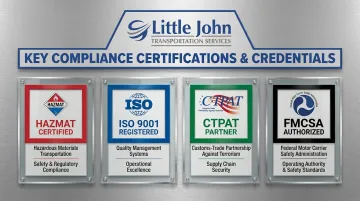
Each credential addresses a different risk dimension. Together, they form the compliance architecture that makes white glove execution possible at scale.
The Numbers Behind the Reviews
Two performance metrics directly explain what customers experience on the ground:
- 99.9% claim-free delivery rate across Landstar network safety performance metrics
- DOT crash frequency approximately half the national average, sustained year-over-year
Both figures trace directly to continuous driver training, 8,500+ hazmat-certified owner-operators, nightly carrier vetting, and an ISO-certified quality management system — each variable controlled, not left to chance.
That performance record extends across every lane, including the most operationally demanding: cross-border specialized freight.
Cross-Border White Glove
Most carriers' white glove service ends at the border. Little John's doesn't. Specialized teams positioned in Laredo, Monterrey, and Guadalajara provide bilingual operations, in-house U.S. and Mexican customs brokerage, and 250+ Mexican interchange agreements. The 50-acre Laredo facility — CTPAT-compliant, with a 120-ton bridge crane for superload transloading — handles the physical complexity that cross-border specialized freight actually requires.
U.S.–México bilateral freight reached $872.8 billion in 2025, with trucks carrying 55.7% of that volume. For shippers moving complex cargo across that corridor, documentation errors, customs delays, or carrier handoffs that don't account for both sides of the border translate directly into missed production windows and six-figure exposure.
Third-Party Validation
Little John holds the #1 North America ranking on the ACT Transport 50 for 16 consecutive years. The company also ranks #1 in Flatbed/Heavy on the TT Top 100 and #5 globally on IC Cranes & Specialized Transport. For a shipper evaluating carriers, that kind of sustained performance record — across 16 years and multiple independent ranking bodies — removes the guesswork from the qualification process.
Industries That Rely on White Glove Specialized Freight Delivery
White glove handling is not a premium option in these sectors — it's a baseline requirement:
- Energy and oil rigs — Equipment failure on an active rig creates catastrophic downstream costs. Delivery precision and timeline reliability are not negotiable.
- Chemical and petrochemical — Hazmat compliance is the floor. PHMSA violations can reach $238,809 for specified severe consequences.
- Military and defense — Chain-of-custody requirements are absolute. AA&E-certified, TPS-approved carriers handle freight that most carriers cannot legally touch.
- AI infrastructure and data centers — McKinsey estimates global data center investment could reach $7 trillion by 2030. Server racks, switchgear, and precision hardware require documented handling and damage-free delivery.
- Industrial machinery — Oversized CNC equipment and plant relocations require specialized rigging, routing engineering, and multi-axle configurations.
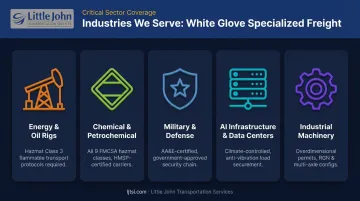
The shared characteristic across all these sectors: the cost of a freight failure — whether from damage, delay, compliance error, or missing documentation — vastly exceeds the premium paid for white glove service. For procurement teams operating at this level, that calculation is never in question.
Little John's network has handled the most complex freight for Oracle, Microsoft, Meta, Caterpillar, Tesla, Honda, and Whirlpool — organizations whose operational standards leave no margin for carrier error. An average customer tenure of 33 years among top clients is the record that backs it up.
Is White Glove Delivery Worth It for Complex, High-Stakes Freight?
The Real Cost Question
White glove specialized freight costs more than standard brokerage. The premium reflects real operational inputs: certified drivers, compliance documentation systems, dedicated dispatch, specialized equipment, and 24/7 tracking with human oversight.
The better question: what does a single freight failure cost compared to the white glove premium? The math shifts fast depending on what you're moving:
- Hazardous materials: PHMSA civil penalties, remediation costs, and supply chain downtime
- Industrial machinery: replacement lead times and production losses
- Cross-border shipments: customs delays and re-documentation costs
When White Glove Is Clearly the Right Call
White glove is the correct choice when freight is:
- Hazardous — any of the nine DOT hazard classes
- Oversized or overweight — requiring permits, specialized trailers, and route engineering
- Cross-border — with customs compliance requirements on both sides
- Time-critical — where a delay has direct downstream operational consequences
- High-value — where a single damage claim is significant
- Subject to regulatory scrutiny — where documentation must be audit-ready
For commodity freight with standard handling requirements and no compliance complexity, a standard carrier is often sufficient.
Long-Term ROI
Customers who commit to white glove specialized freight relationships report lower total cost over time. The sources of that savings are concrete:
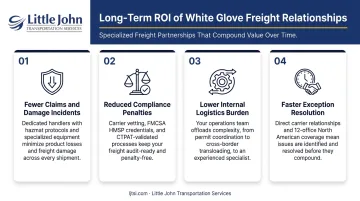
- Fewer claims and damage incidents
- Reduced compliance incidents and penalty exposure
- Less internal logistics management burden per shipment
- Stronger carrier accountability and faster exception resolution
Customers don't stay with a specialized carrier for 33 years because the rate sheet is attractive. They stay because the carrier protects their freight, their compliance record, and their time — every shipment.
Frequently Asked Questions
What happens during white glove delivery?
White glove delivery covers the full move: pre-shipment inspection, secure loading, certified driver transport, active tracking, and delivery with documented proof of condition. For specialized freight, that scope extends to compliance documentation, hazmat chain-of-custody records, and audit-ready delivery confirmation.
Is white glove delivery worth it?
For high-value, hazardous, oversized, or compliance-sensitive freight, yes — one claim, compliance incident, or delivery failure will cost more than the service premium. For standard commodity freight with no special handling requirements, a standard carrier is sufficient.
Are you supposed to tip for white glove furniture delivery?
Tipping is standard practice in consumer furniture and appliance delivery — Consumer Reports recommends $10–$20 per person, more for difficult installs. This doesn't apply to commercial freight, where service terms are defined by contract.
What types of freight benefit most from white glove delivery services?
The clearest beneficiaries are freight categories where a handling failure carries direct financial or regulatory consequences:
- Hazardous materials (all classes)
- Oversized industrial equipment
- Cross-border shipments with customs compliance requirements
- High-value electronics or machinery
- Time-critical energy and infrastructure components
How is white glove delivery different for specialized freight versus consumer goods?
Consumer white glove covers in-home placement, assembly, and debris removal. Specialized freight white glove centers on certified driver handling, compliance documentation, hazmat safety, chain-of-custody accountability, and real-time load visibility. The scope and accountability model are fundamentally different.