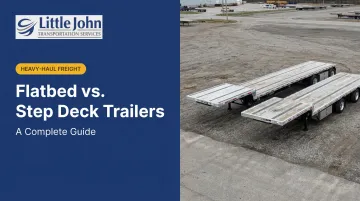
The core differentiator is deck height. That single measurement determines your cargo clearance, your permit exposure, your route options, and ultimately your total shipping cost. This guide cuts through the specs and gives you a practical framework for making the right call before the freight moves.
Key Takeaways
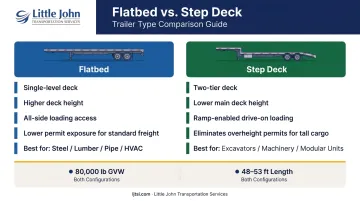
- Flatbeds carry a single-level deck; step decks drop lower with a two-tier design that provides more vertical clearance for taller cargo.
- The FHWA confirms there is no federal CMV height limit — most states enforce limits between 13'6" and 14', with allowances varying by loaded deck height and route.
- Both trailer types share the same federal gross weight ceiling: 80,000 lbs on interstate highways.
- Choose a flatbed for standard-height freight that needs maximum loading flexibility from any side.
- Choose a step deck when cargo height would exceed permit-free limits on a flatbed.
- Borderline loads that could fit either trailer still require a route, loading equipment, and permit tradeoff analysis before committing.
Flatbed vs. Step Deck: Quick Comparison
| Factor | Flatbed | Step Deck |
|---|---|---|
| Deck Height | Single level; deck sits higher off the ground | Two-tier; lower main deck reduces cargo height above road |
| Max Cargo Height | State-dependent; lower than step deck due to higher deck | State-dependent; greater clearance due to dropped lower deck |
| Trailer Length | 48–53 ft (Federal minimum access: 48 ft) | 48–53 ft; extendable variants available |
| Width | 102 in (8.5 ft) on the National Network | 102 in (8.5 ft) on the National Network |
| Federal GVW Limit | 80,000 lbs gross; 20,000 lb single axle; 34,000 lb tandem | Same federal limits apply |
| Permit Exposure | Higher for taller cargo; standard freight stays clean | Lower for loads that exceed flatbed clearance but stay within step deck limits |
| Best-Fit Cargo | Steel, lumber, pipe, HVAC, vehicles, palletized goods | Excavators, agricultural equipment, modular units, tall machinery |
| Loading Access | Unrestricted side, top, and end access | Side and end access; ramp-equipped models allow drive-on loading |
Note: Legal height and weight limits vary by state and route. Cargo allowances depend on actual loaded deck height and the states your shipment crosses. Always verify requirements before moving any load that approaches dimensional thresholds.
What Is a Flatbed Trailer?
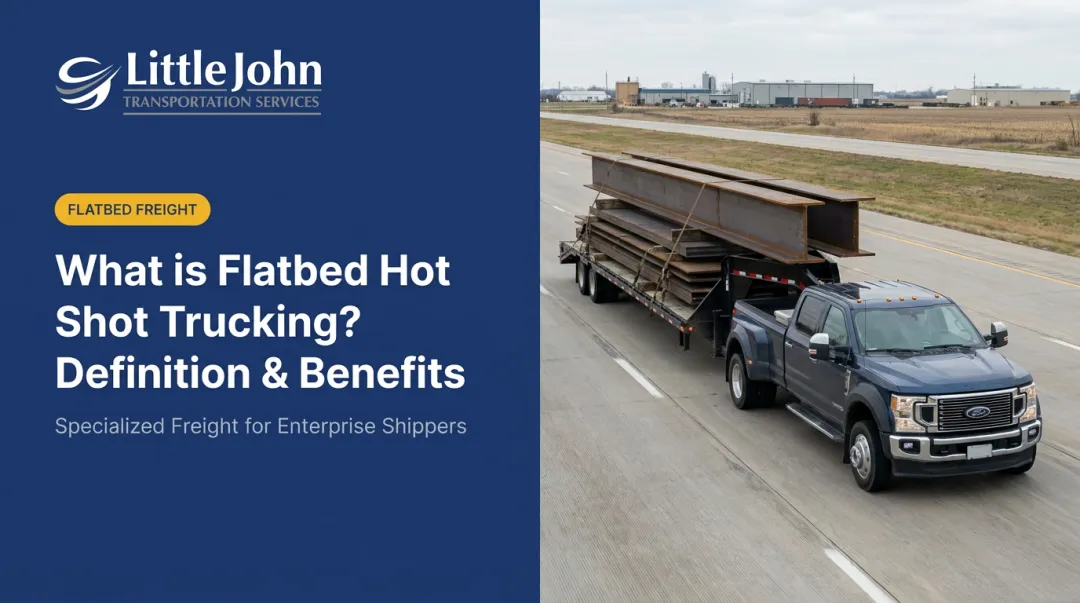
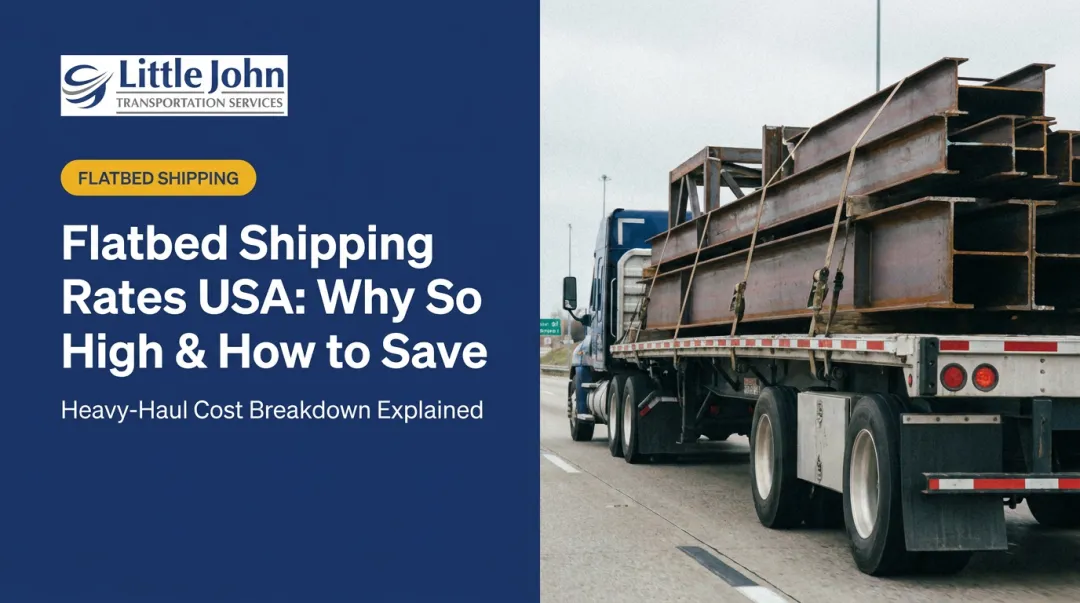
A flatbed trailer is an open platform with no sides, no walls, and no roof. That simplicity is exactly why it's the most widely used open-deck trailer in North America for industrial and commercial freight.
Standard flatbeds run 48–53 feet in length and 8.5 feet wide. The deck sits at a fixed height above the ground, with the exact measurement varying by model and manufacturer.
Great Dane, Wabash, and Fontaine each produce flatbed configurations in steel, aluminum, and hybrid materials. Great Dane's Freedom platform line, for example, spans all-steel, steel-aluminum, and all-aluminum deck options depending on weight and durability requirements.
Core Operational Advantages
- Unrestricted loading access from all sides — cranes, forklifts, and side-loaders can approach from any angle
- No enclosure means no height constraints on loading equipment itself
- Lower permit exposure when cargo stays within the height clearance for the route's states
- Extendable variants (such as the Evans 53–90 ft stretch flatbed) handle extra-long self-supporting loads
- Axle flexibility — additional axles distribute weight to stay within federal Bridge Formula requirements
Flatbed Use Cases
Flatbeds are the right call for freight that fits within the height clearance a fixed-height deck allows. Typical cargo includes:
- Structural steel, rebar, and metal fabrications
- Lumber, plywood, and engineered wood products
- Concrete forms and building materials
- Large HVAC units and rooftop equipment
- Pipes and tubular goods
- Vehicles and automotive components
- Palletized industrial goods and machinery within standard height
The industries that depend most heavily on flatbeds — construction, energy infrastructure, HVAC, lumber, and automotive — reflect exactly this profile. Little John Transportation Services operates 990+ flatbed configurations across standard, extendable, and multi-axle variants, a fleet scale that mirrors where industrial demand is concentrated. Their #1 Flatbed/Heavy ranking on the Transport Topics Top 100 is built directly on serving these sectors across the U.S. and Mexico.
What Is a Step Deck Trailer?
A step deck trailer (also called a drop deck) adds a second deck level to the flatbed concept. The shorter upper deck sits over the gooseneck, and the longer lower main deck drops significantly closer to the ground. That drop gives taller cargo the vertical clearance to stay within most states' legal height limits without a permit.
According to Great Dane's Freedom platform specifications, their drop deck option features a 34–40 inch rear deck height. Wabash offers its Combo Drop Deck with 10- or 11-foot upper deck options. These model-specific dimensions illustrate that no universal spec applies, but the principle holds: the lower deck keeps tall cargo closer to the road surface, reducing the total loaded height.
Core Operational Advantages
- Clears most state height limits for tall cargo without triggering overheight permits
- Ramp-equipped models allow drive-on/drive-off loading for wheeled equipment, no crane needed
- Lower deck height makes forklift access on the main deck straightforward
- Sits between a standard flatbed and heavy-haul equipment like an RGN or lowboy in both cost and capability
Step Deck Configuration Variants
| Type | Key Feature |
|---|---|
| Fixed-neck | Standard configuration; permanent upper and lower deck |
| Gooseneck | Integrated neck connecting tractor to upper deck |
| Removable Gooseneck (RGN-style) | Neck detaches for front-loading of wheeled equipment |
| Double-drop | Additional drop for even greater height clearance on extreme loads |
Step Deck Use Cases
Step decks handle freight that simply won't fit on a flatbed without a permit. Common cargo types include:
- Excavators, skid steers, and other tracked construction equipment
- Agricultural machinery and large tractors
- Tall industrial machinery and manufacturing components
- Modular building units and large HVAC systems
- Wind turbine nacelles and energy components
- Oversized loads that exceed standard flatbed clearance limits
On U.S.–Mexico cross-border routes, step decks are particularly valuable for tall industrial equipment moving out of manufacturing facilities along the Monterrey and Guadalajara corridors. Little John's 50-acre Laredo facility is built specifically for this work: a 120-ton bridge crane and 30-bay cross-dock enable transloading between U.S. and Mexican trailers, with step deck-sized superloads turned around in under two hours.
Which Trailer Is Right for Your Freight?
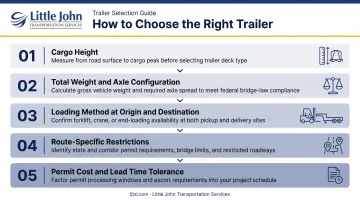
This comes down to five factors evaluated in order:
- Cargo height — the primary differentiator
- Total weight and axle configuration — affects payload distribution and compliance
- Loading method at origin and destination — crane, forklift, ramp, or drive-on
- Route-specific restrictions — bridge clearances, low overpasses, state height limits
- Permit cost and lead time tolerance — versus using a higher-clearance trailer from the start
Clear Decision Rules
Choose a flatbed when:
- Cargo height fits within the legal clearance for your specific route states
- Maximum side and end loading access is required
- Moving high-volume standard freight where simplicity and cost matter
- The shipper wants to avoid the slightly reduced payload capacity of a step deck
Choose a step deck when:
- Cargo height exceeds what a flatbed allows without a permit on your route
- The freight benefits from ramp-enabled drive-on loading
- Overheight permits would add cost, lead time, or escort requirements
- The load sits between flatbed legal limits and heavy-haul territory
The Gray Area: When Either Trailer Could Work
Some freight technically fits on both trailer types. When that happens, secondary factors determine the call:
- Cargo fragility — a step deck's lower deck height can reduce loading shock on sensitive equipment
- Loading equipment at the site — not every origin has a crane; ramp-access on a step deck may be the only practical option
- Bridge heights on the specific route — a load that clears on a flatbed by an inch is one low bridge away from a compliance problem
- Transit urgency — waiting for an overheight permit adds days; a step deck eliminates the wait
The Cost Impact of Getting It Wrong
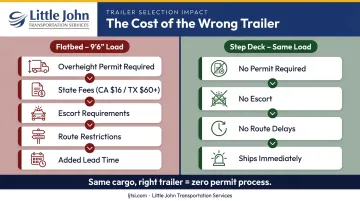
Consider a shipper moving industrial equipment at 9'6" tall. On a flatbed, that load exceeds the height clearance on most routes — triggering an overheight permit. Permit costs vary significantly by state: California's single-trip permit runs $16, while Texas charges $60 for a general single-trip permit plus weight-based fees above 80,000 lbs. Texas also requires a front escort with a nonconductive height pole for loads above 17 feet. Multi-state moves compound these costs across every jurisdiction.
A step deck eliminates that entire process for the same 9'6" load: no permit filing, no route restriction, no escort coordination, no lead time.
For borderline freight specs, the trailer decision has real cost consequences. Little John Transportation Services has spent 30+ years matching complex freight to the right open-deck equipment, with teams positioned across the U.S. and Mexico where freight actually moves. Little John's in-house permitting operation processes over 100,000 oversize and overweight permits annually — the cost-benefit calculation between trailers is something their team runs every day.
Conclusion
Flatbeds and step decks are both purpose-built tools. Neither is universally superior — the freight determines the fit. A flatbed is the right choice when cargo stays within height clearance for your route and you need maximum loading flexibility. A step deck is the right choice when taller cargo would otherwise require a permit, or when the loading setup demands a lower deck.
Getting this decision right from the start avoids permit delays, reduces cost overruns, and keeps shipments compliant across multi-state or cross-border routes where dimensional regulations vary by jurisdiction. Match the trailer to the freight before the load is booked — everything else follows from that.
If you're coordinating a flatbed or step deck shipment and need a carrier with the equipment and expertise to match, Little John Transportation Services runs both configurations across the U.S., México, and Canada with 30+ years of specialized freight experience behind every move.
Frequently Asked Questions
Is a step deck better than a flatbed?
Neither is universally better. A step deck is the right choice when cargo height exceeds what a flatbed allows without triggering overheight permits on your route. A flatbed is simpler and more cost-effective for standard-height loads that stay within legal clearance limits.
Is a step deck considered a flatbed?
Step decks belong to the broader open-deck trailer family and share the flatbed's lack of sides and roof. Their two-tier deck design makes them a distinct trailer type with greater height capacity and different permit implications for tall cargo.
What is the weight limit for a step deck trailer vs. a flatbed?
Both trailer types are subject to the same federal interstate ceiling: 80,000 lbs gross vehicle weight, with 20,000 lbs per single axle and 34,000 lbs per tandem axle. Axle configuration determines how much net cargo weight each trailer can legally carry on a given route.
Do step deck trailers require special permits?
Step decks typically eliminate overheight permits for loads that flatbeds couldn't carry without one. Overwidth, overweight, or extra-long loads may still require state-specific permits regardless of trailer type. Confirm permit requirements with your carrier before the load moves.
What types of freight are best suited for a flatbed trailer?
Flatbeds handle structural steel, lumber, pipe, HVAC units, vehicles, concrete forms, construction materials, and machinery — provided the load fits within the height clearance for the route states involved.
Can a step deck trailer handle oversize loads?
Step decks handle moderately tall and heavy freight effectively. Loads that exceed the step deck's height capacity or require extreme weight distribution typically need more specialized equipment — an RGN, lowboy, or multi-axle heavy-haul configuration.