Introduction
Picture this: you need to move a 40-foot steel bridge section. You call a dry van carrier — they can't load it from the side. You try an enclosed trailer — the crane can't reach the cargo. The freight won't fit through any rear dock on earth.
Flatbed shipping exists to solve exactly that problem. It's specialized freight transportation for cargo that's oversized, irregularly shaped, or too heavy for a standard enclosed trailer.
That sounds simple enough. But the discipline behind it isn't. Trailer selection, load securement compliance, permit coordination, and carrier expertise each play a direct role in whether your shipment arrives intact — or triggers a roadside inspection, a fine, or worse.
This guide covers everything a logistics manager needs: how flatbed shipping works, the six trailer types and when to use each, which industries depend on it, what drives cost, FMCSA compliance requirements, and how to evaluate a carrier worth trusting with your freight.
Key Takeaways
- Flatbed trailers have no walls or roof, enabling top, side, and rear loading for oversized or heavy freight
- Six primary trailer types serve different cargo heights, weights, and loading requirements
- DAT reported June 2026 flatbed spot rates at $3.69/mile versus $3.00/mile for dry van
- Load securement is federally regulated under 49 CFR Part 393 — non-compliance carries civil penalties and out-of-service orders
- Carrier selection goes beyond price — safety ratings, equipment range, and permit experience are equally critical
What Is Flatbed Shipping and How Does It Work?
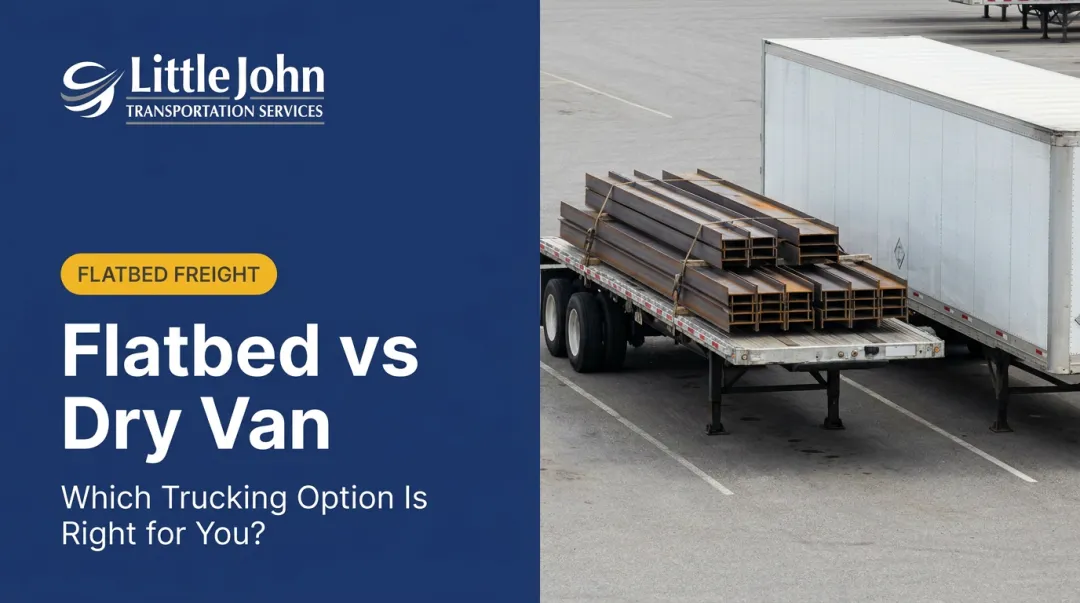
Flatbed shipping is the transportation of cargo on an open, flat platform trailer with no walls, sides, or roof. That open deck is precisely what makes it useful. Cargo that can't fit through a rear dock, exceeds enclosed trailer dimensions, or requires crane or forklift loading from the side needs this kind of platform.
The Open-Deck Advantage
Because there's nothing in the way, flatbed trailers can be loaded from the top, sides, and rear simultaneously. A crane can set a steel beam directly onto the deck. A forklift can approach from either side. Heavy equipment that would destroy a dry van's floor can be positioned and balanced precisely across axles. None of that is possible with an enclosed trailer.
How a Flatbed Shipment Actually Moves
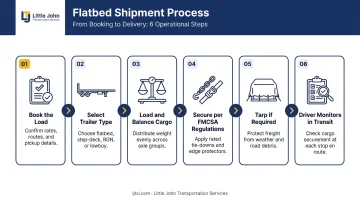
- Shipper books the load — specifying cargo dimensions, weight, and any special requirements
- Carrier selects the trailer type — standard flatbed, step deck, RGN, or other configuration based on cargo specs
- Cargo is loaded and balanced — weight distributed across axles to meet legal limits
- Load is secured per USDOT regulations — tie-downs, chains, and blocking as required by 49 CFR Part 393
- Tarped if required — weather-sensitive cargo covered before departure
- Driver monitors throughout transit — inspections required before driving, within the first 50 miles, and at subsequent intervals per 49 CFR 392.9
Standard Flatbed Dimensions and Weight Limits
Federal law sets the outer boundaries for what's legal on U.S. interstates:
| Specification | Federal Standard |
|---|---|
| Maximum width | 102 inches (8 ft 6 in) |
| Trailer length | States must allow at least 48 ft on National Network; 53 ft common |
| Gross vehicle weight | 80,000 lbs (GVW) |
| Single axle limit | 20,000 lbs |
| Tandem axle limit | 34,000 lbs |
There is no universal federal height limit — states set their own, typically ranging from 13 ft 6 in to 14 ft 6 in. Loads exceeding width, weight, or height thresholds require state-issued oversize or overweight permits, designated routes, and sometimes escort vehicles.
Types of Flatbed Trailers Explained
Choosing the wrong trailer type is one of the most common and costly mistakes in flatbed shipping. The right match depends on cargo height, weight, length, and how it needs to be loaded. Here's how each type differs.
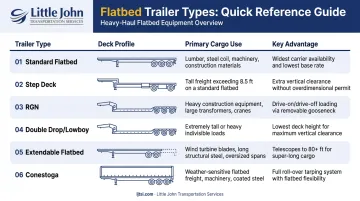
Standard Flatbed
A flat, open deck with no sides or roof — typically 48 or 53 feet long and 102 inches wide. It's the default starting point for general oversized freight that fits within standard legal height limits: lumber, steel coils, machinery, and building materials. No unusual height or loading requirements? Start here.
Step Deck (Drop Deck)
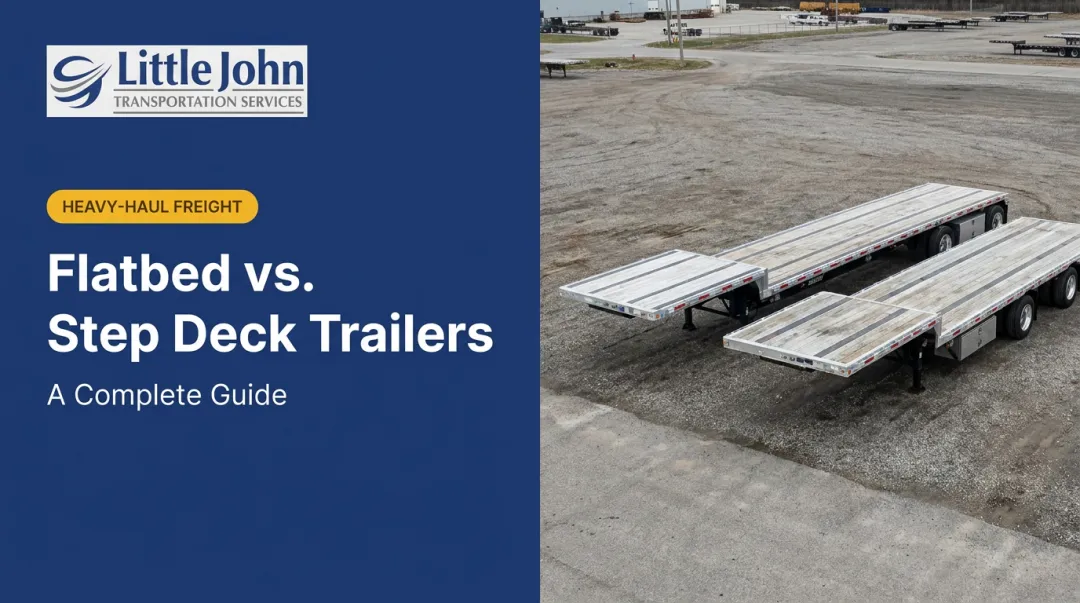
When height clearance is the constraint, a step deck solves it without a permit. The lower rear deck sits closer to the ground than a standard flatbed, creating additional vertical clearance for taller freight. Construction equipment, large HVAC units, and industrial machinery that would breach legal height limits on a standard flatbed move routinely on a step deck.
Removable Gooseneck (RGN)
The RGN's front section detaches completely, creating a ground-level ramp. Wheeled or tracked equipment — bulldozers, military vehicles, large generators — drives directly onto the deck rather than requiring a crane lift. For cargo that physically cannot be lifted, the RGN is the only practical loading method.
Double Drop (Lowboy)
The lowest deck height of any common flatbed type. The well between the front and rear axle sections allows extremely tall cargo — industrial transformers, large cranes, oversized components — to ride within legal height clearances that no other trailer configuration could accommodate.
Extendable Flatbed and Specialty Variants
Some loads fall outside what any standard trailer can handle. These variants exist for exactly those situations:
- Extendable flatbeds stretch from 48 to 80+ feet, purpose-built for cargo like wind turbine blades. The U.S. Department of Energy notes that turbine blades can reach hundreds of feet in length and cannot be bent after manufacture, making standard trailers simply unusable
- Conestoga trailers feature a retractable tarp system that rolls along the trailer frame, providing weather protection without blocking side or overhead access during loading
- Hot shot trailers use a pickup-and-gooseneck configuration for smaller, time-sensitive loads that don't require a full semi
Specialty variants require advance booking and a carrier with the specific equipment available. Once you've identified the right trailer type, the next question is whether your cargo's dimensions and weight require permits — covered in the next section.
What Industries and Cargo Types Use Flatbed Shipping?
Cargo That Requires Flatbed
Flatbed is appropriate when freight meets one or more of these conditions:
- Exceeds standard trailer dimensions in length, height, or width
- Cannot be loaded through a rear dock
- Requires crane or forklift access from the side or top
- Is too heavy for an enclosed trailer's structural limits
The most common flatbed cargo categories:
- Heavy machinery and industrial equipment (forklifts, cranes, generators)
- Construction materials (steel beams, precast concrete, lumber)
- Energy sector components (wind turbine blades, pipeline sections, oilfield equipment)
- Agricultural equipment (tractors, combines, harvesting machinery)
- Automotive components (vehicle frames, large assemblies)
- Military and defense cargo (armored vehicles, equipment trailers)
Industries With Consistent Flatbed Demand
The industries with the heaviest, most consistent flatbed volume:
- Construction and infrastructure development
- Energy and oil and gas
- Manufacturing
- Agriculture
- Military and defense
FreightWaves identifies manufacturing, energy, and construction as the sectors most closely tied to flatbed demand. Flatbed tender rejection exceeded 10% in 2023 — well above the 6% figure for van freight — reflecting how consistently tight capacity runs in this segment.
Demand climbs sharply during infrastructure build-outs, active construction seasons, and large energy projects. In peak periods (typically Q2 and Q3), shippers in these sectors often face 4–6 week lead times to secure equipment.
What Flatbed Is NOT Right For
Knowing when flatbed fits also means knowing when it doesn't. Avoid flatbed for:
- Temperature-sensitive cargo that requires refrigeration
- Fragile goods sensitive to weather or vibration (without special protective measures)
- Small shipments that move more cost-effectively via LTL or dry van
Flatbed Shipping Rates: What Drives the Cost
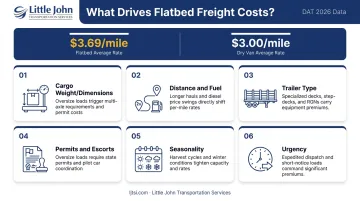
Flatbed consistently runs higher than dry van — and the gap is real. According to DAT's July 2026 data, the national spot average was $3.69/mile for flatbed versus $3.00/mile for dry van, including fuel surcharges. That $0.69/mile premium reflects the additional skill, equipment, and compliance demands of open-deck freight.
Primary Cost Factors
| Factor | Impact on Rate |
|---|---|
| Cargo weight and dimensions | Heavier and wider loads cost more |
| Distance and fuel surcharges | Standard linehaul calculation |
| Trailer type required | RGN and specialty trailers command premiums |
| Permits and escort vehicles | State-specific, route-specific costs |
| Seasonality | Rates spike during construction and energy project seasons |
| Urgency | Expedited flatbed commands significantly higher rates |
A Note on Permits
Permit costs vary considerably by state. Georgia lists standard single-trip permits at $30, with superload permits reaching $500 or more. New York escort fees run $100–$800 per move.
For multi-state oversize corridors, permit coordination across several jurisdictions can add days of lead time and hundreds of dollars in coordination fees. Shippers should account for this early in load planning.
That complexity is exactly where an experienced flatbed carrier or broker earns their keep. The right partner brings:
- Established permit relationships across multiple state jurisdictions
- Route engineering that avoids costly detours or weight-restricted roads
- Negotiated rate structures for shippers with consistent volume
Load Securement, Safety Standards, and Compliance Requirements
FMCSA Securement Rules
Flatbed load securement is governed by 49 CFR Part 393, Subpart I. The rules are specific and non-negotiable:
- Aggregate working load limit of all tie-downs must equal at least 50% of cargo weight
- Minimum tie-down counts depend on cargo length and weight (for example, an article longer than 10 feet that isn't blocked from forward movement requires at least 2 tie-downs for the first 10 feet, plus 1 per additional 10 feet)
- Drivers must inspect loads before departure, within the first 50 miles, and after any duty-status change or every 3 hours or 150 miles, whichever comes first
Cargo securement violations rank among the most common out-of-service findings during commercial vehicle inspections. Under FMCSA's Safety Measurement System, load securement violations are tracked within the Vehicle Maintenance BASIC, and patterns of violations affect a carrier's safety scores.
Tarping Requirements
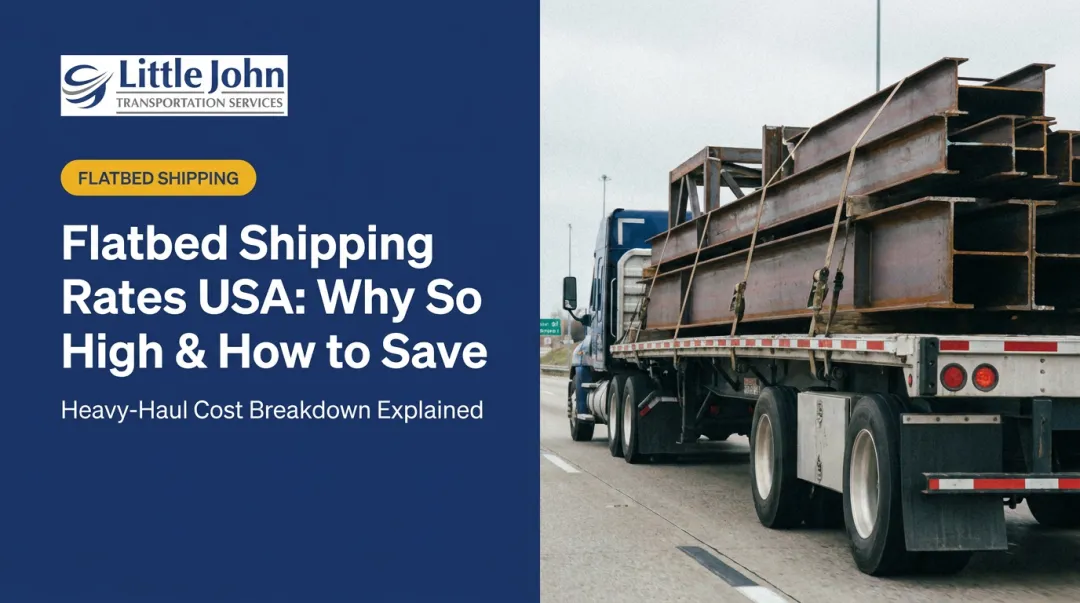
Not every flatbed load requires a tarp, but weather- or debris-sensitive cargo typically must be covered. Tarps are heavy — often 80+ lbs each — and must be properly anchored to prevent road hazards. Drivers who tarp loads manually face physical risk.
Conestoga trailers sidestep this issue with a rolling tarp system that deploys without climbing on the load, while still allowing side and overhead loading access.
Oversize and Overweight Compliance
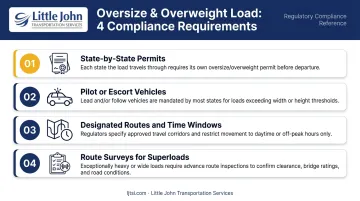
For oversized or overweight freight, compliance extends well beyond tie-downs and tarps — permits, routing, and escort requirements all come into play before a wheel turns:
- Oversize and overweight loads require state-by-state permits before movement
- Some loads require pilot or escort vehicles for portions of the route
- Permitted moves often have designated routes and time windows (no night travel, no weekend movement in certain jurisdictions)
- Superloads may require route surveys before the move is approved
Carriers moving complex permitted loads need established permit-coordination processes and clean CSA scores. A Satisfactory FMCSA safety rating — meaning zero acute or critical violations — is the minimum standard; anything below it is a disqualifying flag for permitted moves.
How to Choose the Right Flatbed Carrier for Your Freight
Evaluation Criteria That Actually Matter
Most shippers focus on rate. The ones who've had a load damaged or delayed focus on these:
- FMCSA safety rating — Satisfactory is the minimum; verify through FMCSA's public Company Snapshot
- Claims history — low claim rates indicate consistent load securement practices, not just luck
- Equipment breadth — a carrier with only standard flatbeds cannot handle an RGN or extendable load when your freight requires it
- Permit experience — carriers moving complex oversize freight should have established relationships with state permitting authorities
- Driver credentials — hazmat endorsements, TWIC certification, and tanker ratings matter for specific cargo types
Cross-Border Capability
If your supply chain touches Mexico or Canada, most domestic flatbed carriers will fall short. Cross-border flatbed moves require bilingual operations, CTPAT validation, established Mexican carrier interchange agreements, and physical infrastructure at key border crossings.
Little John Transportation Services offers a useful benchmark for what a credentialed flatbed carrier looks like in practice. Ranked #1 on the TT Top 100 Flatbed/Heavy and operating for 30+ years, Little John brings over 7,000 specialized trailers, a 99.9% claim-free delivery rate, and DOT crash frequency near half the national average.
For cross-border moves, their 50-acre CTPAT-validated facility in Laredo — with a 120-ton bridge crane built for superload transloading — handles what most carriers aren't equipped to touch. Bilingual teams stationed in Laredo, Monterrey, and Guadalajara are positioned where complex freight actually moves, not just where it's dispatched from.
Equipment range, compliance depth, and border infrastructure together: those are the criteria that separate a capable flatbed carrier from one that works until the freight gets complicated.
Frequently Asked Questions
What is flatbed shipping?
Flatbed shipping is the transportation of oversized, heavy, or irregularly shaped cargo on an open platform trailer with no walls, sides, or roof. The open-deck design enables loading from multiple directions, making it the right choice for freight that cannot be enclosed in a standard dry van or loaded through a rear dock.
What is the difference between tanker and flatbed?
Tanker trailers are enclosed, cylindrical vessels designed to carry liquids, gases, or dry bulk materials in contained form. Flatbed trailers are open platforms for solid, oversized, or heavy cargo. They're fundamentally different equipment categories serving different freight types.
Why does flatbed pay more?
Flatbed rates are higher because the work demands more from drivers (load securement, tarping, physical load monitoring) and more from carriers, who need specialized equipment, permitting know-how, and compliance expertise — on cargo that's typically high-value and hard to replace.
What are the standard weight and dimension limits for flatbed shipping?
Federal limits set the baseline: 102 inches wide, 80,000 lbs gross vehicle weight, 20,000 lbs per single axle, and 34,000 lbs per tandem axle. There is no universal federal height limit — states govern this individually, typically between 13 ft 6 in and 14 ft 6 in. Loads exceeding these limits require oversize or overweight permits and may need escort vehicles.
What types of cargo are best suited for flatbed shipping?
Heavy machinery, construction materials (steel beams, lumber, precast concrete), energy equipment (wind turbine components, transformers), agricultural machinery, and any freight that is too large, too heavy, or too awkwardly shaped for enclosed trailer transport. If it can't fit in a box or go through a dock, flatbed is likely the answer.
How do I choose the right flatbed trailer type for my shipment?
Start with cargo height, weight, and loading method. Use a standard flatbed for legal-dimension loads, a step deck for taller items that need extra clearance, an RGN for equipment that must be driven on rather than lifted, a double drop for extremely tall cargo, and an extendable flatbed for long items like turbine blades or large pipes. When in doubt, share your dimensions with a carrier's operations team before booking.