Introduction
Picture this: your warehouse has six loaded trailers staged and ready to ship, but no truck is available to move them. Your production schedule doesn't care about your carrier's equipment shortage — freight needs to move.
Power-only trucking was built for exactly this problem.
Rather than waiting on a carrier to supply both a truck and a trailer, power-only flips the arrangement: you own the trailer, the carrier provides the tractor and driver. That single distinction gives shippers more control over capacity, cost, and scheduling — without the overhead of running their own tractor fleet.
This model isn't a workaround used by small operators. Large retailers, manufacturers, and industrial shippers rely on it as a core capacity strategy — because it separates the "power unit" (the tractor and driver) from the trailer asset, giving shippers more control without the overhead of running their own tractor fleet.
This article covers:
- What power-only trucking is and how it works
- Its real benefits and limitations
- How it compares to drop trailer and standard FTL
- When it actually makes sense for your operation
Key Takeaways
- Power-only = carrier provides tractor + driver; shipper owns the trailer
- Pre-loading trailers before truck arrival reduces costly detention and dock delays
- A Trailer Interchange Agreement is legally required before any carrier can haul a non-owned trailer
- Power-only reduces capital exposure — no tractor ownership, no tractor insurance
- Best fit for shippers with consistent lanes, yard space, and an existing trailer fleet
What Is Power-Only Trucking?
Power-only trucking is a full-truckload capacity arrangement in which the carrier provides only the tractor (semi-truck) and a qualified driver — referred to as the power unit — to haul a trailer owned or leased by the shipper or a third-party logistics provider (3PL). The carrier brings the horsepower. The shipper keeps the trailer.
The ownership structure this creates is fundamentally different from standard full-truckload shipping:
- Standard FTL: The carrier supplies both tractor and trailer. The shipper supplies only the freight.
- Power-only: The shipper owns the trailer. The carrier supplies only the tractor and driver.
Shippers retain full control of their trailer fleet while outsourcing the transportation labor and equipment they don't want to own — the tractor.
Key Terms Every Shipper Should Know
Before using power-only services, get familiar with these terms:
- Power Unit — The tractor (semi-truck) plus driver provided by the carrier.
- Trailer Interchange Agreement (TIA) — A written contract required under 49 CFR 376.31 that governs the use of non-owned trailers, identifying the equipment, interchange points, use terms, and compensation.
- Drop-and-Hook — The driver drops one trailer at a location and hooks to another already staged and ready to go. No waiting at the dock.
- Trailer Pool — A group of drop trailers maintained at a shipper's facility for staged loading and flexible dispatch.
Of these terms, the TIA carries the most legal weight. It defines liability allocation, insurance responsibilities, and the condition the trailer must meet at pickup.
Without a TIA executed before the move, a carrier cannot legally haul a shipper's trailer. The agreement protects both sides: the shipper from an uninsured carrier pulling their equipment, and the carrier from inheriting liability for pre-existing trailer damage.
How Power-Only Trucking Works
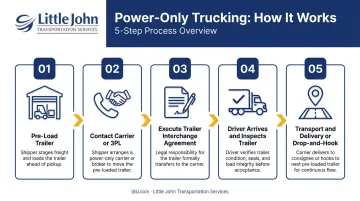
The process follows a logical sequence that separates loading from transportation:
- Pre-load the trailer at your facility on your schedule — before any truck is booked
- Contact a carrier, broker, or 3PL to source a power unit for your lane and load
- Execute a Trailer Interchange Agreement — this happens before the driver arrives
- Driver arrives, inspects the trailer under 49 CFR 396.13, confirms it meets roadworthiness standards, and connects via the fifth-wheel hitch
- Driver transports freight to destination, then either returns an empty trailer or performs a drop-and-hook
The fifth-wheel connection is governed by 49 CFR 393.70, which requires the lower half of the fifth wheel to be securely attached with a lock that prevents separation without manual release.
Before booking, confirm your trailer's kingpin condition and load weight with the carrier. Different truck classes have different towing capacities, and mismatches cause delays at pickup.
Because trailers are pre-loaded before the driver arrives, the shipper completes loading work before on-duty time begins for that driver. This staging efficiency makes power-only loads attractive to drivers — and translates to better availability and more competitive rates for shippers with well-organized yards.
Compatible Trailer Types
The trailer type affects driver credential requirements and pre-trip verification steps. Power-only carriers can haul a range of configurations:
| Trailer Type | Common Freight | Special Requirements |
|---|---|---|
| Dry Van | General freight, packaged goods | None standard |
| Refrigerated (Reefer) | Temperature-sensitive goods | Verify refrigeration unit is functional |
| Flatbed / Open-Deck | Oversized or irregularly shaped cargo | Securement plan; driver experience |
| Intermodal Container | Port/rail freight | Chassis compatibility confirmation |
For flatbed, hazmat, or regulated freight, driver credentials matter. Transporting placarded hazardous materials requires a CDL Hazmat (H) endorsement under 49 CFR 383.93. Tank vehicles may require an (N) endorsement. TWIC cards are required for access to MTSA-regulated maritime facilities. Confirm driver credentials before pickup — not after.
Key Benefits of Power-Only Trucking for Shippers
Lower Capital Costs
ATRI's 2026 operational cost report places the average cost of operating a truck in 2025 at $2.336 per mile, with repair and maintenance costs up 8.6% that year alone. Power-only eliminates these tractor-related costs entirely: fuel, driver payroll, licensing, tractor maintenance, and tractor insurance all transfer to the carrier. Shippers redirect that capital toward warehousing upgrades, technology investments, or additional trailer capacity instead.
Scheduling Flexibility and Detention Reduction
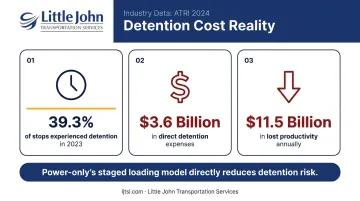
Because trailers are pre-loaded and staged at your dock, you're never rushing to finish loading when the truck arrives. This reduces detention risk significantly. ATRI's 2024 research found that detention occurred at 39.3% of stops in 2023, generating $3.6 billion in direct expenses and $11.5 billion in lost productivity annually. Power-only's staged loading model directly attacks that problem — freight is ready before the driver's clock starts running.
Scalability During Peak Demand
When volume spikes — Q4 retail, automotive changeovers, energy project surges — power-only lets you scale by sourcing additional power units rather than buying tractors or hiring drivers. The trailer fleet you already own becomes the fixed capacity base. Sourcing power units on demand keeps fixed costs flat while throughput scales.
Reduced Insurance Exposure
In a power-only arrangement, shippers carry coverage only for their trailer fleet — not the tractor. That scope is narrower than combined tractor-trailer coverage and generally runs at a lower premium. The Trailer Interchange Agreement specifies exactly who holds liability for the trailer while it's in the carrier's possession, with defined coverage limits that both parties agree to upfront.
Greater Control Over Freight Assets
Shippers set the loading schedule, trailer positioning, and dispatch timing — not the carrier. That means no dependence on a single provider's equipment availability. For operations managing multiple lanes or navigating regional capacity imbalances, that level of control creates meaningful supply chain resilience.
Limitations to Consider Before Choosing Power-Only
Power-only is a strong model, but it comes with real operational responsibilities.
Trailer maintenance is your responsibility. Under 49 CFR 392.7, drivers must confirm a vehicle is in safe operating condition before moving it — and a driver can (and should) refuse a trailer that fails inspection. Landing gear, brake lights, kingpin condition, and tire health fall on you. Budget for routine maintenance as a fixed cost of this model.
Last-minute capacity costs more. Power-only is most cost-effective with 24–72 hours of advance notice. Urgent or same-day requests often require the driver to deadhead (drive empty) to your location — and ATRI reports empty mileage averaged 16.7% in 2024. That deadhead cost gets passed to you.
Shippers with unpredictable shipping windows should discuss contracted rates with their carrier to limit exposure to spot volatility.
Not every supply chain fits this model. Power-only performs best on direct A-to-B or cyclical routes where trailers reload or reposition efficiently. If every delivery requires an empty trailer to return to origin before it can be reused, repositioning costs eat into your savings. Map your freight lanes before committing.
Power-Only vs. Drop Trailer vs. Regular Truckload
The three models serve different situations. Here's how they compare:
| Power-Only | Drop Trailer | Regular FTL | |
|---|---|---|---|
| Who owns the trailer? | Shipper / 3PL | Carrier | Carrier |
| Who owns the tractor? | Carrier | Carrier | Carrier |
| Loading flexibility | High — shipper loads on own schedule | High — carrier drops trailer for loading | Low — live load or carrier-controlled |
| Cost structure | No tractor costs; shipper bears trailer ownership + maintenance | No equipment ownership; carrier manages fleet | Simplest — pay per load, no asset responsibility |
| Best use case | Shippers who own trailers, want tractor cost savings | Shippers who want loading flexibility without owning equipment | Speed and simplicity over cost optimization |
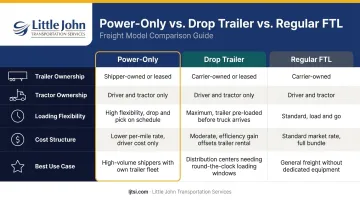
The simplest way to choose: Already own trailers? Power-only is worth evaluating. Want loading flexibility without owning equipment? Drop trailer fits. If simplicity is the priority, Regular FTL is the path of least resistance.
The table above makes one distinction easy to miss: drop trailer and power-only look similar on the surface, but the asset ownership line separates them. In drop trailer, the carrier owns both the tractor and the trailer — they're lending you a container temporarily. In power-only, the trailer is yours from the start.
Who Uses Power-Only Trucking — And When Does It Make Sense?
The Right Shipper Profile
Power-only fits best when several conditions align:
- You own or lease a trailer fleet but run no tractors
- You have consistent, high-volume outbound freight
- Your facility has yard space to stage pre-loaded trailers
- You operate in sectors with seasonal demand swings: retail, manufacturing, automotive, energy, e-commerce, or industrial machinery
Two Common Use-Case Scenarios
1. Private fleet supplement. A shipper with their own tractors brings in external power units during volume surges or when their fleet can't cover all lanes at once. This model avoids buying additional tractors to handle peaks that only last a few weeks.
2. 3PL-managed trailer program. A 3PL leases trailers on the shipper's behalf, drops them at the facility for loading, then sources power-only capacity to haul them out. This works well for temporary projects, peak seasons, or facility consolidations where owning trailers long-term doesn't make sense.
Specialized and Cross-Border Moves
For shippers moving oversized equipment, hazardous materials, or freight crossing into Mexico or Canada, the power carrier's compliance credentials are as important as the equipment. The carrier must hold the correct CDL endorsements, and for cross-border moves, CTPAT validation directly affects customs clearance speed and security compliance.
Key credentials to verify before tendering a complex power-only move:
- Hazmat endorsement and applicable CDL class for the freight type
- TWIC certification for port-adjacent or restricted-access facilities
- FMCSA Satisfactory safety rating
- CTPAT validation for U.S.–Mexico or U.S.–Canada corridors
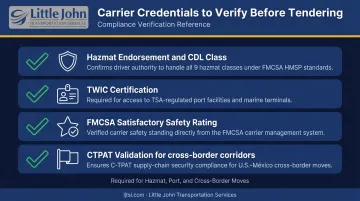
Little John Transportation Services operates a network of 8,500+ owner-operators, all Hazmat-endorsed, TWIC-certified, and operating under FMCSA Satisfactory ratings, with active CTPAT validation across U.S., Mexico, and Canada corridors. For complex power-only moves involving specialized freight or cross-border lanes, working with a partner whose compliance infrastructure matches the freight complexity keeps those loads moving and claim-free.
Frequently Asked Questions
What is the difference between power-only and drop trailer?
In power-only trucking, the shipper owns the trailer and the carrier provides only the truck and driver. In drop trailer service, the carrier owns both — they drop an empty trailer at your facility, you load it, and they (or another driver) pick it up later. The core difference is who holds the trailer asset, which determines cost structure, insurance responsibility, and how loading flexibility is structured.
Is power-only trucking worth it?
For shippers who own or lease trailers, run consistent lanes, and have yard space to stage freight, power-only typically delivers real savings on tractor ownership and insurance. Shippers with unpredictable lanes or single-point deliveries should calculate total lane economics first — including trailer repositioning costs and any deadhead exposure.
What types of trailers can be used in power-only trucking?
Power-only carriers can haul dry vans, refrigerated/reefer trailers, flatbeds and open-deck trailers, and intermodal shipping containers. The trailer type determines what driver certifications are required — flatbed loads, hazmat freight, and oversized cargo each carry distinct permit and endorsement requirements.
How much does power-only trucking cost?
Rates vary based on lane, region, trailer type, lead time, and whether a deadhead move is required. Shippers with consistent volume should ask carriers about contracted rates to reduce exposure to spot market swings. Providing 24–72 hours of advance notice generally produces the most competitive pricing.
Do I need a Trailer Interchange Agreement for power-only trucking?
Yes. A Trailer Interchange Agreement is required whenever a carrier hauls a trailer they don't own, per 49 CFR 376.31. It defines liability allocation, insurance responsibilities, and the condition standards the trailer must meet at pickup.