That scale means border inefficiency has real costs. The Texas Transportation Institute modeled nearly $146 million in direct delay costs at Laredo's World Trade Bridge in 2019 alone, with per-truck shipper costs reaching $119 at that crossing. Add missed delivery windows, spoiled temperature-sensitive cargo, regulatory penalties, and driver detention — the exposure is significant.
Most crossing failures are preventable. The majority trace back to documentation errors, compliance gaps, or poor pre-crossing coordination — problems that exist before the truck ever reaches the port of entry. This guide covers what carriers, shippers, and logistics managers need to understand: how the crossing system actually works, what documents are required, where compliance risk is highest, and what experienced operators do differently.
Key Takeaways
- U.S. trucks stop at the border — freight transfers to Mexican-authorized carriers for delivery into Mexico
- Complete, accurate documentation is the most controllable factor in crossing speed
- Cabotage violations carry severe consequences, including visa revocation and vehicle seizure
- C-TPAT certification provides expedited lane access and reduced inspection frequency
- Hazmat cross-border moves require specialized carrier credentials — not all carriers qualify
- Border teams on both sides catch problems before they become holds
How U.S.-Mexico Commercial Truck Border Crossings Actually Work
Many shippers new to the corridor assume a U.S. driver can simply cross into Mexico and deliver. That's not how it works.
U.S. tractors operating on Mexico's federal road network require a permit issued under Mexico's federal roads and motor transport law (SICT authorization). The standard commercial model involves a carrier handoff at the border: the U.S. long-haul carrier brings freight to the crossing, and a Mexico-authorized carrier takes over for final delivery.
The Drayage and Handoff Model
The most common northbound and southbound process uses a drayage or transfer tractor — a short-haul unit dedicated to moving the trailer through the crossing compound while long-haul equipment waits at staging. This matters because customs processing can take anywhere from under an hour to several hours, and tying up a long-haul tractor during that window is expensive.
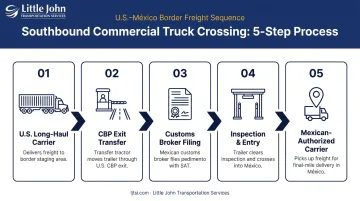
The typical southbound sequence:
- U.S. long-haul carrier delivers freight or trailer to the border staging area
- A transfer tractor moves the trailer through U.S. CBP exit processing
- The Mexican customs broker files the pedimento with SAT (Mexico's tax authority / customs system)
- The trailer moves through inspection and, if cleared, enters Mexico
- A Mexican-authorized carrier picks up freight for final-mile delivery
Through-Trailer Service as an Alternative
Through-trailer service keeps the freight in the same trailer across the border. Only the power unit is exchanged; the trailer and its contents move through intact. This reduces handling risk and speeds throughput for freight that can't tolerate multiple load/unload cycles — machinery, breakbulk, and fragile industrial cargo.
Not every crossing supports through-trailer operations. Before dispatching, confirm:
- The crossing facility accommodates through-trailer movements
- The freight type qualifies under applicable regulations
- Both the U.S. and Mexican carriers have coordinated handoff logistics in advance
The Role of the Customs Broker
That carrier handoff is also the moment the customs broker's role becomes critical. Mexico's Customs Law (Article 40) allows importers to use either a licensed customs agent (agente aduanal) or an accredited representative to manage clearance. In commercial trucking practice, the vast majority of shipments use a customs broker or a logistics provider with in-house brokerage capability.
The broker or authorized representative files the pedimento electronically with Mexico's SAT/Aduana system, manages duty payment, and ensures the declared value and classification match supporting documents. All of this happens before the truck reaches the crossing window — delays at the gate almost always trace back to paperwork that wasn't completed upstream.
Required Documentation for Truck Border Crossings into Mexico
Documentation errors are the most controllable cause of crossing delays. Every document in the set needs to be consistent — the same values, the same item descriptions, the same HS codes — across all forms.
U.S.-Side Documents (Required Before Departure)
- Commercial invoice — must include accurate declared value, country of origin, and complete item descriptions
- Bill of lading — carrier document covering the shipment from origin to handoff
- Packing list — supports the invoice and customs declaration
- USMCA certification of origin — required if claiming preferential tariff treatment; CBP requires nine specific data elements, but no prescribed form; can appear on the invoice itself
Mexico-Entry Documents
- Pedimento — the Mexican customs entry declaration, filed electronically by the customs broker or authorized representative; it records the trade regime, HS classification, declared value, applicable duties, and compliance evidence
- Import permits — required for regulated goods; COFEPRIS covers health-regulated categories (medicines, medical devices, food products, pesticides, certain chemicals); SEMARNAT governs hazardous waste, wildlife, and specific environmental goods; SICT issues the federal cargo permit for transport on Mexican federal roads
Important timing note: SEMARNAT permit processing benchmarks run 10 to 30 business days for hazardous waste authorizations. These are not 24-hour approvals. For regulated cargo, permit coordination must begin well before the shipment date.
Mexican Carrier Compliance Documents
Before handing off freight, verify the Mexican carrier holds:
- SICT permit (Permiso SCT) — federal cargo authorization for Mexico's road network
- Mexican civil liability insurance — required for operation on federal roads
- Current vehicle registration
Verify these before handoff — not after. A carrier missing any of these documents can be turned away at the port of entry, leaving your load stranded and your schedule at risk.
Driver Requirements
For Mexican commercial drivers operating in the U.S. commercial zone (approximately 3–20 miles inside the U.S. border, per 49 CFR Part 372):
- Valid Mexican commercial driver's license
- Drug testing compliance
- Hours-of-service records under FMCSA rules
- English language proficiency sufficient to communicate with officials and read road signs (49 CFR 391.11)
- 2026 enforcement note: FMCSA policy allows citation for English proficiency non-compliance but does not require placing a border-zone-only driver out of service solely for this failure
The Border Crossing Process: Before, At, and After
Before the Crossing
The work that determines crossing speed happens 24–72 hours before the truck arrives at the port — not at the crossing window.
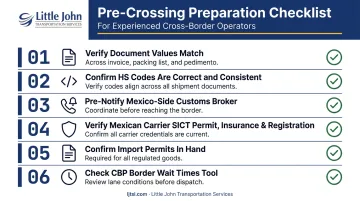
Pre-crossing checklist for experienced operators:
- Verify all document values match exactly across invoice, packing list, and pedimento
- Confirm HS codes are correct and consistent
- Pre-notify the customs broker on the Mexico side — they need time to prepare the pedimento
- Verify the Mexican carrier's SICT permit, insurance, and registration are current
- Confirm any required import permits are in hand for regulated goods
- Check the CBP Border Wait Times tool for current lane conditions at your intended crossing
C-TPAT and FAST lane access meaningfully affect processing times. CBP reports more than 11,400 C-TPAT partners covering over 52% of U.S. import value. The FAST program provides dedicated lane access for known low-risk shipments.
TTI research recorded average crossing times of roughly 36 minutes in FAST lanes versus 49 minutes in standard lanes at Ysleta-Zaragoza, though shared approach infrastructure can narrow that gap during high-volume periods. For shippers where those minutes compound across dozens of weekly crossings, carrier certification matters. Little John Transportation Services holds both C-TPAT validation and FAST certification through their Laredo hub, giving clients expedited lane access that uncertified carriers cannot provide.
At the Border
At the port of entry, U.S. CBP processes outbound cargo. Simultaneously, the Mexico-side customs broker files the pedimento electronically with SAT. Mexico's automated selection mechanism (Article 43 of Mexico's Customs Law) then determines whether the shipment receives:
- Green light — automatic clearance, no physical inspection
- Red light — cargo flagged for documentary review or physical inspection
Physical inspection adds time: typically several hours depending on cargo type, volume, and the inspection facility's workload. There is no publicly available official rate for how frequently shipments are flagged; the process is risk-based, not random.
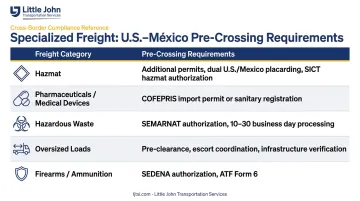
Specialized freight requires additional preparation:
| Freight Category | Pre-Crossing Requirement |
|---|---|
| Hazmat | Additional permits, dual placarding (U.S. DOT + NOM-004-SCT/2008), carrier SICT hazmat authorization |
| Pharmaceuticals / medical devices | COFEPRIS import permit or sanitary registration |
| Hazardous waste | SEMARNAT authorization (10–30 business days processing) |
| Oversized loads | Pre-clearance, escort coordination, verify crossing infrastructure before dispatch |
| Firearms / ammunition | SEDENA authorization; U.S. side requires ATF Form 6 |
After Clearance Into Mexico
Once SAT releases the shipment, the Mexican carrier receives freight and proceeds to the final consignee. The U.S. carrier's obligation typically ends at the handoff point, but chain-of-custody documentation should be maintained across that transition.
At minimum, document the handoff with:
- Interchange receipts
- Customs release confirmation from SAT
- Signed proof of delivery from the Mexican carrier
Without a documented transfer record, cargo condition disputes and missing-item claims become far harder to resolve.
Compliance Risks That Can Ground Your Shipment
Cabotage
Cabotage is the illegal practice of a foreign-licensed driver hauling domestic cargo between two points within the same country. For U.S.-Mexico operations: a Mexican driver holding a B-1 visa cannot pick up a load in Dallas and deliver it to Houston. That is a domestic U.S. move — it requires a U.S.-authorized carrier.
FMCSA defines this under 49 CFR 392.9a(b). Violations result in visa revocation, vehicle seizure, and enforcement action. CBP Border Patrol units are actively targeting cabotage violations at U.S. border corridors, and enforcement frequency is rising.
Carriers operating on the corridor need explicit operational controls to prevent exposure: pre-screened loads, driver briefings, and load assignment audits.
Prohibited and Restricted Goods
Some goods cannot legally cross the Mexico border. Others require advance import permits. Key categories:
- Firearms, cartridges, and explosives — regulated by SEDENA; require special authorization
- Health-regulated goods (pharmaceuticals, medical devices, food products, pesticides) — COFEPRIS permit or prior sanitary registration
- Hazardous waste and environmental goods — SEMARNAT authorization
- Electronic cigarettes — currently prohibited entry
- Used clothing or footwear outside personal baggage — restricted under certain conditions
- Goods failing NOM standards — Mexico's official product standards apply to a wide range of consumer and industrial goods; non-compliant products are turned back at the border
Treat prohibited/restricted item verification as a pre-shipment step, not a border surprise. A load that gets turned back costs more than the permit would have.
Hazmat-Specific Compliance
Crossing hazmat freight requires both U.S. DOT compliance and Mexican SCT compliance. Mexico's NOM-004-SCT/2008 governs vehicle identification and placarding for hazardous materials — units and trailers must carry the corresponding placards under Mexican regulation as well.
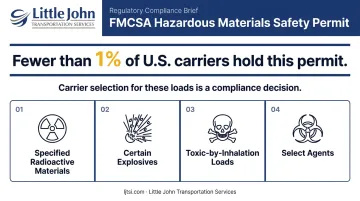
On the U.S. side, the FMCSA Hazardous Materials Safety Permit (HMSP) applies to high-consequence hazmat categories:
- Specified radioactive materials
- Certain explosives
- Toxic-by-inhalation loads
- Select agents
Fewer than 1% of U.S. carriers hold this permit, which makes carrier selection for these loads a compliance decision, not a procurement one.
Little John Transportation Services holds FMCSA HMSP certification and maintains 100% Hazmat-endorsed BCO drivers across its 8,500+ owner-operator network, including drivers operating in the U.S.-Mexico border commercial zone. All nine hazmat classes are covered, including AA&E.
For complex cross-border hazmat moves, that certification is what separates a carrier that can legally execute the shipment from one that can't.
Common Mistakes to Avoid at the Mexico Border
1. Mismatched values between invoice and pedimento Mexico's SAT uses risk profiling. When declared values or item descriptions on the commercial invoice don't match the pedimento exactly — even minor discrepancies — the system flags the shipment for mandatory physical inspection. Every line item must match. Review this before the truck leaves the origin facility.
2. Last-minute customs broker engagement The broker needs time to prepare the pedimento, verify classification, and identify any permit requirements. For regulated goods, permit processing alone can span multiple weeks (SEMARNAT). Experienced cross-border shippers engage their broker when the shipment is confirmed, not when the truck is loaded.
3. Assuming all border crossings are equivalent They aren't. Each port has distinct infrastructure, enforcement priorities, and cargo capabilities:
- Laredo World Trade Bridge — commercial-only, 8-lane facility with 15 primary inspection lanes and FAST access
- Nogales Mariposa — dedicated cargo facility with an on-site FAST enrollment center
- Calexico East — includes a California Highway Patrol commercial enforcement facility
An oversized load routed to a crossing without the right infrastructure adds cost and delay that's entirely avoidable.
Little John Transportation Services maintains permanently stationed teams in Laredo and along the western crossings, with direct knowledge of each port's capabilities. Routing decisions are made before dispatch, not after the truck is already in the queue.
Frequently Asked Questions
Do U.S. truck companies cross the Mexican border?
U.S. carriers cannot freely operate tractors on Mexico's federal road network without Mexican authority. The standard model stops U.S. equipment at the border; a Mexico-authorized carrier completes delivery into Mexico. Coordination happens either through a transload handoff or a through-trailer arrangement where the trailer crosses but the tractor does not.
What do truck drivers need to cross the Mexican border?
Mexican commercial drivers operating in the U.S. border zone need a valid commercial driver's license, drug testing compliance, hours-of-service records, and sufficient English proficiency for official communication. On the carrier side, a current SICT permit (formerly Permiso SCT) and Mexican-issued civil liability insurance are required before accepting a cross-border handoff.
What items are not allowed to cross the Mexican border?
Prohibited or restricted categories include firearms and ammunition (SEDENA authorization required), electronic cigarettes, used clothing outside personal baggage, and goods failing Mexican NOM standards. Health-regulated products need COFEPRIS permits; hazardous materials and waste require SEMARNAT authorization.
What is cabotage and why does it matter for cross-border trucking?
Cabotage means hauling domestic cargo between two domestic points with a foreign-licensed carrier, which is illegal under FMCSA regulations. A Mexican B-1 driver cannot haul a load between two U.S. cities. Violations result in visa revocation and vehicle seizure, and enforcement at U.S. border corridors is increasing.
How long does it take for a commercial truck to cross the Mexico border?
BTS reports a 40-minute average peak-hour wait for Mexico-border truck crossings in 2025. During enforcement operations — such as Texas's April 2022 enhanced state inspections — wait times at some crossings spiked to over 300 minutes. C-TPAT/FAST enrollment and complete pre-crossing documentation are the most effective tools for minimizing time at the border.
What is C-TPAT and how does it help with Mexico border crossings?
C-TPAT (Customs-Trade Partnership Against Terrorism) is a CBP voluntary program that validates supply chain security practices. Certified carriers and their trading partners receive dedicated FAST lane access and reduced inspection rates — and with over 11,400 certified partners covering more than half of U.S. import value, enrollment is standard practice for high-volume cross-border operators.