The gap between expectation and reality usually comes down to three things: not knowing what makes up the rate, not choosing the right pricing structure, and getting blindsided by accessorials.
This guide breaks down all of it — how intermodal rates are structured, what moves them up or down, the three pricing types every shipper should understand, and how to get a quote that holds up.
Key Takeaways
- Intermodal rates consist of three components: origin drayage, rail linehaul, and destination drayage, all bundled into a single door-to-door quote
- Spot, contract (SPQ), and project rates each fit different volume levels and planning timelines — picking the wrong structure adds avoidable cost
- Per diem, detention, chassis splits, and redelivery are the accessorials most likely to inflate your final bill
- Intermodal wins on lanes where rail efficiency offsets drayage on both ends; the lane you choose matters as much as the rate type
What Are Intermodal Freight Rates and How Are They Structured?
Intermodal freight rates are the total price charged to move a shipment using two or more modes of transportation — most commonly truck to rail to truck — billed as a single door-to-door rate by the intermodal provider.
What shippers don't always realize: you're not just paying for the train. You're paying for three separate legs, each with its own cost driver, bundled into one quoted number.
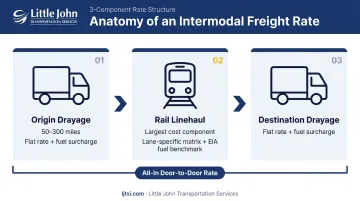
The 3-Part Anatomy of an Intermodal Rate
1. Origin Drayage
The truck leg from the shipper's facility to the rail ramp. Priced as a flat rate plus fuel surcharge, typically based on a point-to-point rate matrix covering a metro region. Most drayage hauls fall in the 50–100 mile range; some extend to 300 miles.
2. Rail Linehaul
This is the largest cost component — covering the actual train movement between origin and destination ramps, priced by the railroad using lane-specific matrices. The fuel surcharge on this leg is typically benchmarked against EIA national on-highway diesel averages — though each carrier applies its own formula, so the EIA data is a reference point, not a universal billing standard.
3. Destination Drayage
The final truck leg from the destination ramp to the receiver. Structured similarly to origin drayage: flat rate plus fuel surcharge.
Most shippers access these bundled rates through an intermodal provider — either asset-based (owns containers, may control drayage operations) or non-asset (uses railroad equipment and third-party draymen). Both models deliver the same three-part rate structure.
Some large-volume shippers work directly with Class I railroads like Union Pacific or BNSF, which publish shipper-direct contract templates. For most shippers, though, the intermodal provider or 3PL route is the practical path.
Key Factors That Drive Intermodal Freight Rates
Supply, Demand, and Market Conditions
Rate levels tighten when freight volumes rise relative to available rail capacity and driver pools, and soften when capacity exceeds demand. According to IANA, North American intermodal volume grew 8.5% in 2024 to 18.1 million moves, with an additional 2.4% YoY increase in Q2 2025.
Despite that demand growth, rates remained soft. FreightWaves reported domestic intermodal spot linehaul (excluding fuel) at $1.39/mile in February 2026, down roughly 5% year-over-year, even as truckload spot pricing strengthened.
Fuel Costs
Fuel surcharges apply to both drayage legs and the rail linehaul. Freight rail moves one ton of freight nearly 500 miles per gallon on average — roughly 3–4x more fuel-efficient than truck, per the Association of American Railroads — so sustained diesel price increases actually widen intermodal's cost advantage over OTR. When diesel spikes hard, that math shifts fast.
Lane and Distance
Intermodal favors long hauls. Shorter lanes (under 400 miles) rarely produce savings because drayage costs on both ends consume what rail would save. Cross-border corridors (particularly U.S.–México lanes through hubs like Laredo) carry additional pricing factors:
- Border crossing fees and customs coordination
- Interline charges between U.S. and Mexican railroads (CPKC operates single-line service on some corridors, avoiding interchange on those lanes)
- Drayage availability on the Mexican side
Freight Characteristics
Not all freight prices the same way in intermodal:
- Weight and density affect container utilization and rail pricing
- Hazmat, temperature-controlled, or oversize cargo can trigger surcharges or move entirely outside standard intermodal pricing
- Commodity type matters — some goods have specific handling requirements that add cost
Seasonality
The West Coast import peak (roughly September through November, with some providers extending through December) is the single biggest seasonal rate driver, when Union Pacific and BNSF lanes tighten sharply. Year-end inventory pushes and agricultural cycles create secondary peaks in other corridors. Timing an annual RFP outside these windows produces better contract pricing.
The 3 Types of Intermodal Freight Pricing
Spot Rates
Spot rates — also called FAK (Freight All Kinds) rates — are the standard market-priced rate available for a given lane at any time, quoted based on current railroad pricing matrices.
Spot rates fluctuate with market conditions, but intermodal spot pricing tends to be considerably more stable week-to-week than truckload spot rates. Good for occasional or ad hoc shipments where a committed rate isn't worth pursuing.
Contract Rates
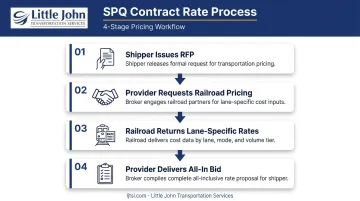
Also called SPQs — Special Price Quotes. These are shipper-specific rates negotiated during annual bid processes, locked in for the contract term. The process works like this:
- Shipper issues an RFP to intermodal providers
- Providers request special pricing from the railroad on the shipper's behalf
- Railroad returns lane-specific rates tied to that shipper's volume commitment
- Provider layers in drayage costs and margin, then delivers an all-in bid
You don't need enormous volume to qualify. Even a few loads per month on a consistent lane can be enough to secure a contract rate on that lane. The value is predictability: locked pricing enables accurate transportation budgeting and protects against spot market swings.
Project Rates
A hybrid between spot and contract. Project rates are fixed prices assigned for a defined short-term period — weeks to months — typically secured when a shipper has a large, time-bounded volume opportunity: a facility move, a product launch, a seasonal surge that falls outside normal patterns.
Project rates are an underused tool for shippers considering intermodal conversion. They let you test the mode on a specific lane without committing to a full annual bid cycle — a low-risk way to build operational confidence before going to contract.
Intermodal Accessorials: The Costs Most Shippers Don't See Coming
Intermodal's core rates are priced lean. The mode depends on precision timing across multiple handoffs — ramp arrivals, container availability, driver pickups, delivery windows. When those handoffs break down, fees are generated. Accessorials exist to maintain network efficiency. The base rate assumes everything goes smoothly — when it doesn't, you pay.
Here are the four that most often inflate final bills:
| Accessorial | What Triggers It | Why It Matters |
|---|---|---|
| Per Diem / Demurrage | Container sits beyond free-time window at destination ramp | Daily fees stack fast — some railroads allow as little as 24 hours |
| Detention | Driver waits beyond allowed time at pickup or delivery | Hits when facility scheduling and driver arrival don't sync |
| Redelivery | Consignee unavailable when delivery is attempted | A second delivery attempt charge on top of the first |
| Chassis Split | Container and chassis stored at separate locations | Requires an extra move before the load dispatches |
What to ask before signing any intermodal agreement:
- How many days of free time are included before per diem begins?
- Which accessorials are capped vs. passed through at cost?
- Is chassis availability at the destination ramp a known issue on this lane?
Asking these questions upfront prevents billing surprises that erase the cost savings intermodal was supposed to deliver. There's no universal standard across railroads, terminals, or equipment types — get the specifics for your lanes before you commit.
Intermodal vs. OTR: When the Rate Math Works in Your Favor
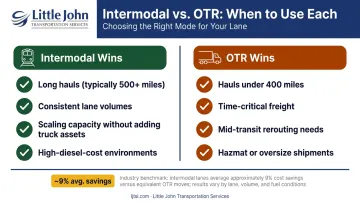
When Intermodal Wins
- Long hauls where rail efficiency outpaces the fixed cost of two drayage legs
- Consistent lane volumes that qualify for contract pricing — stability compounds the savings
- Scaling freight volume without proportionally adding truck capacity
- High-diesel-cost environments where rail's fuel efficiency advantage is most pronounced
The SONAR Intermodal Savings Index, launched in mid-2025 with data across 63 national lanes, reported approximately 9% average savings for intermodal versus comparable truckload at that time. That figure reflects a specific market moment, not a guaranteed outcome — lane selection, rate type, and fuel prices all move the actual number.
When OTR Is the Better Call
- Hauls under 400 miles, where drayage on both ends erases the rail savings
- Time-critical freight where a 1–2 day transit gap is operationally unacceptable
- Shipments that may need mid-transit rerouting — trains don't offer that flexibility
- Hazmat, oversize, or temperature-sensitive freight that may not qualify for standard intermodal pricing at all
Neither mode wins by default. The right call depends on your lane length, volume consistency, and freight type — run the math on both before locking in a contract.
How to Get an Intermodal Freight Quote and Negotiate Better Rates
The Quoting Process
- Gather your freight profile — origin/destination ZIP codes, commodity, weight, container size (typically 53'), shipment frequency, and desired transit window
- Contact intermodal providers or a 3PL with rail access — you can't pull rail rates directly from Class I railroads in most cases
- Request all-in pricing — drayage, linehaul, and fuel surcharge bundled. Never compare just the linehaul
- Ask about all three rate types — spot for one-offs, contract if you have consistent lane volume, project rates if you're testing a new lane or managing a time-bounded surge
Negotiation Levers That Actually Work
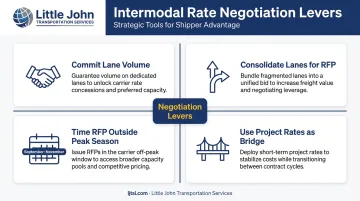
- Commit volume on a lane in exchange for contract pricing — even modest consistency can qualify
- Consolidate lanes when presenting to providers; a larger total volume picture improves your position with the railroad
- Time your RFP outside peak season (avoid September through November for West Coast lanes) to avoid negotiating into a tight market
- Ask explicitly about project rates as a bridge before committing to a full annual contract
For shippers moving complex or cross-border freight, including U.S.–Mexico intermodal through Laredo, working with a provider that already has teams, carrier relationships, and compliance infrastructure positioned in those corridors makes a real difference.
Little John Transportation Services operates with bilingual staff and CTPAT-validated facilities in Laredo, along with customs brokerage on both sides of the border — meaning shipments clear without third-party handoffs or gaps in chain of custody. Reach their team directly at quotes@ljtsi.com for a quote. A real person responds directly.
Frequently Asked Questions
What are intermodal rates?
Intermodal rates are the all-in price to move freight using two or more transportation modes (typically truck, rail, then truck again), quoted as a single door-to-door cost by the provider. That bundled rate covers origin drayage, rail linehaul, destination drayage, and applicable fuel surcharges.
What are the current intermodal freight rates?
Rates vary by lane, market conditions, and fuel levels. As a public reference point, the InTek Intermodal Index publishes weekly spot rate and volume commentary, while the DrayNow Spot Rate Tracker covers drayage pricing. Contract rates are lane-specific and negotiated annually — they won't appear in any public index.
How do I quote an intermodal load?
Prepare your freight profile (origin/destination, commodity, weight, container size, frequency) and contact an intermodal provider or 3PL with rail access. Request an all-in rate covering drayage, linehaul, and fuel surcharge — Class I railroads don't quote directly to shippers without a provider intermediary.
Are intermodal freight rates expected to rise in 2026?
FreightWaves noted in early 2026 that intermodal spot rates had lagged behind strengthening truckload spot pricing, a gap that typically precedes upward pressure on intermodal as the modal savings advantage widens. Contract rates locked during annual bids provide protection from spot market movement in either direction.
What is the difference between intermodal spot rates and contract rates?
Spot rates (FAK) are market-priced on demand and fluctuate with lane capacity and fuel. Contract rates (SPQs) are lane-specific prices negotiated during annual bid cycles and fixed for the contract term — offering rate stability and often better pricing for shippers with consistent volume on a lane.
What are intermodal accessorials and how do they affect my freight bill?
Accessorials are charges beyond the base rate that cover exceptions in the shipping process — per diem when containers sit too long, detention for driver wait time, redelivery for missed deliveries, and chassis splits when equipment is stored separately. Review the accessorial schedule before booking; on some lanes, these charges can offset the cost advantage intermodal was supposed to deliver.