Introduction
US-Mexico trade is not a niche corridor — it's the backbone of North American commerce. According to the Bureau of Transportation Statistics, trucks carried $642.2 billion worth of goods across the US-Mexico border in 2025, representing 73.6% of all bilateral freight value. That same year, 7.59 million inbound truck crossings were recorded from Mexico alone.
Yet the scale of this corridor masks how operationally demanding it is. Crossing the US-Mexico border isn't a longer version of domestic freight — it's a categorically different problem. Two regulatory environments, a live carrier handoff at the border, compounding documentation requirements, and real cargo security exposure make this the most operationally demanding freight lane on the continent.
This article covers the core challenges experienced operators run into, the practices that separate consistent execution from avoidable delays, and what to look for when selecting a partner who can perform on both sides of the border.
Key Takeaways
- Cross-border logistics involves multiple handoffs — each one a potential delay or compliance failure point
- Documentation errors cause most controllable border delays — fix them before the truck dispatches, not at the crossing
- C-TPAT and FAST certification reduce inspection exposure and border wait times — verify these credentials, don't just accept claims
- Hazmat and heavy-haul freight face compounding regulatory requirements on both sides; most carriers lack the permits to handle them
- The right partner has boots on the ground, vetted carriers, and bilingual dispatch on both sides of the border
Why US-Mexico Cross-Border Logistics Is More Complex Than Domestic Freight
Multiple Handoffs, Multiple Failure Points
A cross-border truck move involves at minimum: a US carrier, a Mexican border-drayage carrier, customs agents on both sides, and often a cross-dock or transload facility. Each transition point carries its own failure risk: documentation mismatches, equipment incompatibilities, timing gaps, or compliance issues can surface at any stage.
The two primary shipment modes each carry distinct trade-offs:
- Through-trailer (direct trailer interchange): Freight stays in the same trailer; only the tractor changes at the border. Lower handling risk, preferred for time-sensitive or high-value loads. Requires Mexican carrier operating authority on their side of the border.
- Transload: Freight is physically transferred between a US trailer and a Mexican carrier's trailer at a border facility. Introduces more touchpoints and handling risk, but is often necessary for oversized, overweight, or hazmat cargo where equipment compatibility doesn't cross jurisdictions.
Regulatory Divergence Is Real
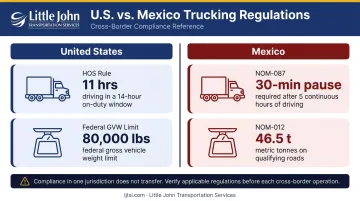
US and Mexican driver regulations do not mirror each other. US property drivers may drive 11 hours within a 14-hour window. Mexico's NOM-087 requires a 30-minute pause after just five continuous driving hours.
Weight limits diverge just as sharply. The US federal gross limit is 80,000 lbs, while Mexico's NOM-012 permits up to 46.5 metric tonnes for qualifying configurations on eligible federal roads.
Those differences don't cancel each other out — a carrier fully compliant on one side may be out of compliance the moment they cross. That creates real operational and liability exposure for shippers who don't verify credentials on both sides independently.
The Core Challenges in US-Mexico Cross-Border Logistics
Border Congestion and Infrastructure Bottlenecks
Laredo alone handled 2,945,388 inbound truck crossings in 2025 — 38.8% of all US-Mexico truck traffic. BTS reports a 45-minute peak-hour average wait at Laredo under normal conditions, but that figure can deteriorate rapidly. In April 2022, additional Texas DPS inspections pushed wait times above five hours at some crossings and reduced commercial traffic by as much as 60%.
Minor disruptions — increased inspection rates, staffing changes, weather events — cascade into multi-hour or multi-day delays for shippers without contingency routing.
Customs Documentation Errors
A missing commercial invoice, an incorrect HTS code, or an incomplete Complemento Carta Porte filing can halt a shipment cold at the border. Storage fees accumulate, compliance audits open, and supply chains stall.
Documentation must be reviewed and confirmed before freight reaches the crossing, not at it. Operators who treat paperwork as an on-arrival task consistently experience avoidable delays.
Cargo Security in High-Risk Corridors
TT Club and BSI's 2025 Mexico freight crime report documents a significant rise in cargo theft over the preceding three years, with 2022 and 2023 theft claims roughly double the earlier five-year average. Criminals target unsecured parking, rest stops, facilities, and in-transit trucks — with dwell time at border facilities representing a particularly high-risk window.
Mitigation requires layered controls:
- GPS tracking on all in-transit loads
- Vetted, credentialed carrier selection
- Secure, monitored yard facilities
- Minimized dwell time at border crossings
Shipment Visibility Gaps
Once freight crosses into Mexico or changes carrier hands, many shippers experience a sudden loss of real-time tracking data. This gap isn't just frustrating — it slows exception response, creates planning failures, and increases risk for high-value loads. The visibility gap is almost always a symptom of a partner without physical operations on the Mexico side.
Regulatory and Compliance Divergence
B-1 visa requirements for Mexican commercial drivers operating in the US, English Language Proficiency enforcement (ELP violations returned to out-of-service criteria effective June 25, 2025), and carrier vetting standards have all tightened in recent years.
C-TPAT and Mexico's OEA (Operador Económico Autorizado) are separate programs — one does not replace the other, and mutual recognition has limits. Shippers working with providers who haven't verified compliance on both sides carry exposure they may not realize exists.
Best Practices for Navigating the US-Mexico Border
Lock Documentation Before the Truck Moves
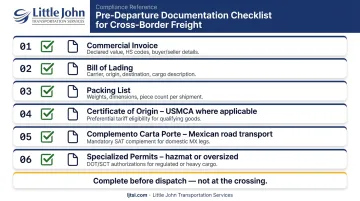
Establish a pre-departure checklist covering:
- Commercial invoice
- Bill of lading
- Packing list
- Certificate of origin (USMCA where applicable)
- Complemento Carta Porte (for Mexican road transport)
- Any specialized permits (hazmat, oversized load)
Experienced operators complete and review all customs documentation before dispatch — not at the crossing. The cost of an incomplete document is measured in days, not hours.
Use Certified Programs to Reduce Inspection Exposure
C-TPAT (Customs-Trade Partnership Against Terrorism) grants participants trusted trader status with CBP: reduced mandatory inspections, front-of-line access, and expedited processing. FAST certification provides dedicated lane access for pre-approved commercial shipments at qualifying crossings.
Verify these credentials explicitly. Ask for current documentation and confirm coverage extends to the full driver and carrier network — gaps at the carrier level eliminate the benefit entirely.
Require End-to-End Bilingual Visibility
Providers worth using maintain real-time tracking through the full journey — including the Mexico-side leg — with bilingual dispatch available 24/7 to resolve exceptions before they compound into delays. For high-value or time-sensitive freight, this is a baseline requirement.
Little John Transportation Services runs bilingual English/Spanish dispatch operations with physical teams stationed in Laredo, Monterrey, and Guadalajara. When an exception surfaces on the Mexico side, their dispatchers communicate directly with Mexican carriers and customs contacts — no relay, no translation delay.
Vet Every Link in the Carrier Chain
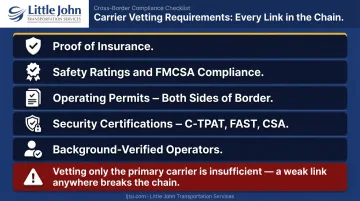
The drayage partner, the Mexican inland carrier, and the transload facility each carry independent risk. For each, require:
- Proof of insurance
- Safety ratings and FMCSA compliance
- Operating permits on both sides
- Security certifications (C-TPAT, FAST, CSA)
- Background-verified operators
Vetting only the primary carrier is insufficient. A strong US-side operation paired with an unvetted Mexican partner is still a weak chain.
Build in Contingency Planning
Even well-managed cross-border operations encounter unexpected delays. Work with providers who have:
- Alternative crossing points available (not just Laredo)
- Carrier network depth to re-route without losing days
- Flexible scheduling for inspection holds or bridge closures
- Physical teams at multiple gateways, not just the primary hub
Little John operates across 12 US-Mexico border gateways — from Otay Mesa to Brownsville — with a network of 250+ Mexican interchange agreements and 65,000+ approved carriers. When Laredo slows, re-routing doesn't require starting from scratch.
Special Considerations for Hazmat and Heavy-Haul Cross-Border Freight
Hazardous materials and oversized loads face a compounding set of requirements at the US-Mexico border that most carriers simply aren't equipped to handle.
Hazmat: The HMSP Requirement
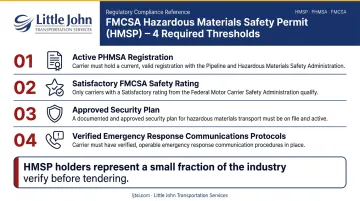
On the US side, certain hazmat categories — including high-consequence explosives, Hazard Zone A/B inhalation hazards, and bulk liquefied methane — require an FMCSA Hazardous Materials Safety Permit (HMSP). Earning that permit requires carriers to meet four distinct thresholds:
- Active PHMSA registration
- A satisfactory FMCSA safety rating
- An approved security plan
- Verified emergency response communications protocols
Mexico maintains separate specialized transport permits and driver licensing requirements under SCT.
Carriers without the right credentials will be turned away at the border. The permit is genuinely scarce — FMCSA issues it carrier-by-carrier, and verified holders represent a small fraction of the industry.
Little John Transportation Services holds the FMCSA HMSP and operates with 100% Hazmat-endorsed drivers across its BCO network, covering all nine hazard classes. For shippers moving chemicals, petrochemicals, energy equipment, or industrial machinery across the border, most carriers cannot legally touch these loads.
Heavy-Haul: Dual-Jurisdiction Permitting
Where hazmat compliance demands the right credentials, heavy-haul demands the right infrastructure on both sides of the line. Route surveys, escort coordination, and permit filings span two completely separate regulatory systems. A Texas OS/OW permit does not satisfy Mexican NOM-040 requirements for indivisible heavy objects, and neither covers the other's jurisdiction.
Little John's 50-acre CTPAT-compliant facility in Laredo includes a custom-built 120-ton bridge crane capable of completing superload transloads in under two hours — built specifically because heavy equipment rarely crosses on the same trailer. With teams physically stationed in Laredo, Monterrey, and Guadalajara, permit coordination and escort planning on both sides of the border is managed internally, not outsourced.
How to Evaluate a Cross-Border Logistics Partner
Not every provider claiming cross-border capability actually has it. Before you commit, here's what separates real operators from paper networks:
Physical Presence on Both Sides Is Non-Negotiable
Ask specifically whether the provider has operational teams and facilities in Mexico — not just a US-side terminal. Coverage that stops at Laredo means you lose visibility and control the moment freight crosses. Providers with offices in Monterrey and Guadalajara offer meaningfully better inland coordination and faster exception response.
Credentials Must Be Verifiable and Current
The baseline credential set for a serious cross-border carrier:
| Credential | What It Confirms |
|---|---|
| C-TPAT Validation | Trusted trader status, CBP-verified security |
| FAST Certification | Dedicated lane access, pre-screened status |
| FMCSA Satisfactory Rating | US-side safety compliance |
| ISO 9001:2015 | Documented quality management |
| FMCSA HMSP | Authority to move high-consequence hazmat |
| Hazmat Endorsements | Applies to 100% of drivers, not a subset |
Ask for documentation. Verify that credentials apply to the full network — not selectively to a few routes or drivers.
Communication Structure Matters as Much as Capacity
A provider should offer:
- A single, named point of contact
- 24/7 bilingual dispatch (English/Spanish)
- Audit-ready chain-of-custody documentation
- Real-time tracking that does not go dark at the border
These are operational requirements for complex cross-border freight. Providers who cannot confirm these don't have them — and you'll find that out mid-shipment.
Demand Proof of Performance
Evaluate on-time performance, claim rates, and customer tenure. Little John holds a 99.9% claim-free delivery rate across its specialized operations and a 100% retention rate among its Top 100 customers — with an average client tenure of 33 years among its top accounts. Numbers like that tell you how a provider actually performs when freight is complex, timelines are tight, and things don't go according to plan.
Frequently Asked Questions
What documents are required for US-Mexico cross-border shipping?
Core requirements include a commercial invoice, bill of lading, packing list, and certificate of origin (USMCA where applicable). Mexican road transport also requires a Complemento Carta Porte filing. Hazmat, oversized, and regulated freight carry additional permit requirements on each side that must be verified independently.
How does C-TPAT certification speed up border crossings?
C-TPAT grants participating carriers trusted trader status with CBP, resulting in fewer mandatory cargo inspections, front-of-line treatment, and access to FAST lanes where available. For shippers, this translates to reduced dwell time, lower probability of inspection holds, and more predictable transit windows.
What is the difference between through-trailer and transload in cross-border shipping?
Through-trailer keeps freight in the same trailer with only a tractor swap at the border: lower handling risk, preferred for time-sensitive or high-value loads. Transload physically transfers freight between trailers at a border facility, which adds touchpoints but is necessary for oversized loads, hazmat cargo, or incompatible carrier equipment.
What are the biggest cargo security risks in the US-Mexico corridor?
Organized cargo theft is the primary documented risk, concentrated during dwell time at border facilities, transload operations, and travel through certain inland corridors. Mitigation requires GPS tracking, vetted carriers, monitored staging yards, and minimizing dwell time at every handoff point.
How do I choose a reliable carrier for US-Mexico freight?
Verify C-TPAT and FAST certification, FMCSA safety ratings, physical presence in Mexico, bilingual dispatch capability, and a track record with complex freight. Avoid providers who cannot produce credentials for their full driver and carrier network, not just the primary operator on your lane.
Does nearshoring to Mexico increase cross-border logistics complexity?
Yes. Higher shipment frequency and volume amplify every existing complexity — documentation load, capacity demand, security exposure, and customs processing. BTS data shows Mexico truck crossings in 2025 ran 6.1% above 2019 levels. As volumes grow, the operational gaps in a weak provider become harder to absorb and more costly to recover from.