Introduction
A container ship docks at a major U.S. seaport. Customs clears the cargo. The vessel's job is done — but the freight hasn't moved an inch toward its final destination. Before any warehouse can receive it, before any assembly line can consume it, before any retailer can stock it, someone needs to move that container off the terminal and onto the next leg of the journey.
That short, ground-level move is called port drayage — a service that's far more consequential than its short distance suggests.
This guide covers everything shippers need to know: the definition, how the process works step by step, the different service types, what drives costs, and what separates a capable drayage provider from a costly one.
Key Takeaways
- Port drayage moves containers between a seaport or intermodal terminal and a nearby warehouse, rail yard, or distribution facility
- It's the ground-level link that makes intermodal freight chains function
- Costs include base linehaul, fuel surcharge, chassis fees, plus detention and per diem charges
- TWIC certification and C-TPAT validation are required for port access and cargo security
- A weak drayage provider doesn't just delay one shipment — it unravels the entire downstream supply chain
What Is Port Drayage?
Port drayage is the short-haul trucking of shipping containers between a seaport (or rail terminal) and a nearby warehouse, distribution center, or next transportation mode — typically within the same metro area.
The word "dray" traces back to Middle English: a low, flat cart for hauling heavy loads short distances. Horse-drawn dray carts moved barrels and cargo from docks to nearby storage for centuries. Modern drayage swapped the horses for semi-truck tractors and standardized ISO containers, but the function is the same: move heavy cargo a short distance from a port.
That short-distance function plays out in two distinct ways, depending on where the cargo is headed next.
Marine Drayage vs. Domestic Drayage
Not all drayage moves are the same at the cargo level:
- Marine drayage — the container travels intact from the port to its final destination; no cargo transfer occurs. Used when the destination is within practical reach and the ocean container can be accepted.
- Domestic drayage — cargo is transloaded from the ocean container into a standard 53-foot domestic trailer before moving inland. Used when the destination requires domestic trailer equipment, or when consolidating freight from multiple containers.
Why It's Not Just Trucking
Treating drayage as ordinary trucking is a common mistake. Standard freight is long-haul, region-to-region transport — drayage is a short-distance intermodal connector — often covering the distance the EPA's DrayFLEET model defaults to 25 miles from port to shipper/receiver — and it comes with a distinct set of compliance requirements: TWIC access credentials, chassis management, port gate protocols, and terminal appointment systems that standard OTR trucking never encounters.
IANA reports 102 million drayage moves annually across North America. Understanding what makes those moves different from standard freight is the starting point for managing them effectively.
How Port Drayage Works: The Step-by-Step Process
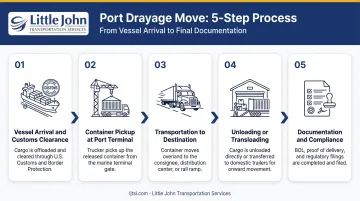
Step 1: Vessel Arrival and Customs Clearance
The ocean carrier notifies the consignee of vessel arrival. Before any drayage move can happen, the container must clear U.S. Customs and Border Protection (CBP) through the Automated Commercial Environment (ACE) system. CBP holds, partner-agency document requests, and physical examinations all suspend release until resolved. Every hour of delay here directly pushes back the dispatch window in Step 2.
Step 2: Container Pickup at the Port Terminal
Once released, the drayage carrier dispatches a TWIC-certified driver with the appropriate chassis to the terminal. The driver presents the container release order, completes the terminal appointment, and takes possession of the container.
A chassis is the wheeled steel frame that supports the shipping container on the road — without it, the container can't move by truck. Chassis availability is a documented bottleneck: an FMC port congestion report linked chassis shortages to street-dwell delays, hoarding, and inefficient repositioning, estimating $348 million in annual drayage-delay costs.
Step 3: Transportation to the Intermediate Destination
The driver transports the container — typically 20 to 100 miles — to a warehouse, distribution center, rail ramp, or transload facility. Timing coordination with the receiving facility is critical here. Arrive early and the facility may not be ready. Arrive late and the driver burns free time, triggering detention fees.
Step 4: Unloading or Transloading
At the destination, one of two things happens:
- Standard unload — cargo is removed from the ocean container, which is then returned empty to the port or depot
- Transload — in domestic drayage, cargo is transferred into a 53-foot domestic trailer for inland movement; the empty ocean container and chassis go back to the terminal
Step 5: Documentation and Compliance
Every drayage move generates a paper trail that matters:
- Equipment Interchange Reports (EIRs) — document container condition at pickup and return
- Interchange receipts — confirm custody transfers
- Proof of delivery — confirms final delivery
- Hazmat documentation — required when transporting regulated materials
Complete, accurate documentation is what allows all parties to recover costs in cargo claims, respond to CBP audits, and resolve chain-of-custody disputes. Missing records remove that protection entirely.
Types of Drayage Services
The type of drayage service a shipment needs depends on the cargo, routing, and urgency. The four main categories:
Intermodal Drayage
The most common form. Intermodal drayage connects two transportation modes — ship to rail, rail to warehouse, port to distribution center — using truck for the short ground leg. Rail handles the long-haul economics; drayage covers the first and final miles that rail can't reach.
Pier Drayage
Movement of cargo to or from a dock or pier — most commonly used in export shipments where freight from an inland warehouse must reach a ship's loading berth. Strict port gate appointment scheduling is required; missing a window can mean missing a vessel departure.
Expedited Drayage
When a container can't wait for standard scheduling. Used for time-sensitive cargo — pharmaceutical cold chain, automotive parts on just-in-time schedules, or perishable food products. Expedited drayage commands a rate premium. For JIT automotive or cold-chain pharmaceutical loads, that premium is typically a fraction of what a missed delivery window actually costs in production delays or spoilage claims.
Shuttle and Domestic Drayage
- Shuttle drayage — when terminals become congested and run out of space, containers are moved to off-dock staging yards temporarily. This relieves terminal pressure but adds cost and complexity.
- Domestic drayage — the transload scenario: ocean container contents move into 53-foot domestic trailers for inland distribution, as covered in the process section above.
What Drives Port Drayage Costs?
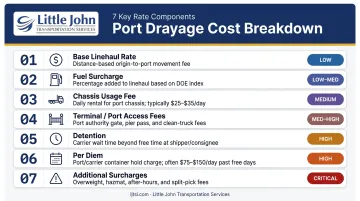
Drayage invoices aren't single-line items. A typical invoice includes several distinct components — and knowing what each one covers is the first step toward managing them:
| Cost Component | What It Covers |
|---|---|
| Base linehaul rate | Mileage from port terminal to destination |
| Fuel surcharge | Tied to diesel index; billed as a percentage of base rate |
| Chassis usage fee | Daily rental of the wheeled frame; Port Houston's 2025 tariff lists this at $11.94/unit/day |
| Terminal/access fees | Port-specific charges; LA/Long Beach collect $10 per loaded TEU via their Clean Truck Fund |
Detention and Per Diem: The Biggest Budget Risk
These two fee categories cause more unplanned charges than any other line item:
- Detention — accrues when a driver waits beyond the free-time window at a port or delivery location
- Per diem — accrues when a chassis or container is held past the carrier's free-time allowance; Port Houston charges $34.25/day for 20-foot containers and $68.48/day for 40-foot or larger units after the free period expires
The fix isn't complicated: precise arrival scheduling, rapid unloading at the receiving facility, and a drayage provider who coordinates both. A two-hour delay at the receiving dock can easily erase any savings gained on the linehaul rate.
Additional Cost Drivers
Beyond detention and per diem, several other factors can push drayage costs higher:
- Overweight surcharges — containers exceeding federal limits (80,000 lb gross, 34,000 lb tandem axle) require state permits, which vary by route and jurisdiction
- Hazmat endorsement fees — regulated materials require specially certified drivers and handling
- After-hours gate fees — weekend or off-hours terminal access costs more
- Split-pick fees — charged when a container isn't available for pickup in a single lift
Why Port Drayage Is Critical to Your Supply Chain
The top 25 U.S. container ports handled 39 million loaded TEUs in 2023, and across North America, IANA measures 102 million drayage moves annually. Every one of those moves is a potential failure point.
Drayage failures don't stay local. A missed terminal appointment, an unavailable chassis, or a driver without TWIC access sets off a chain reaction:
- Demurrage fees accrue from the ocean carrier
- Warehouse receiving schedules slip downstream
- Manufacturing or retail operations stall waiting on that inventory
The stakes are real for industries where timing is non-negotiable. An automotive assembly plant running just-in-time parts can't absorb a 48-hour drayage delay. A pharmaceutical shipper with temperature-sensitive cargo can't wait for a second chassis to show up.
Drayage covers the shortest mileage in the supply chain but carries disproportionate risk. Shippers who treat it as an afterthought — picking the cheapest option without vetting compliance or scheduling capability — see higher total logistics costs. The per-mile rate is low. The cost of a failure is not.
What to Look for in a Port Drayage Provider
TWIC and C-TPAT Compliance
TWIC (Transportation Worker Identification Credential) is a federal TSA requirement for unescorted access to secure maritime facilities. Without it, a driver simply cannot enter the terminal — no exceptions, no workarounds.
C-TPAT (Customs-Trade Partnership Against Terrorism) validation signals to CBP that a carrier's security practices meet CBP's standards. The practical benefits include fewer physical inspections and front-of-line processing — both of which directly reduce dwell time and cargo release delays.
Little John Transportation Services holds both TWIC certification and C-TPAT validation, backed by 8,000+ hazmat-endorsed, TWIC-certified drivers at port-adjacent locations including Houston and Charlotte.
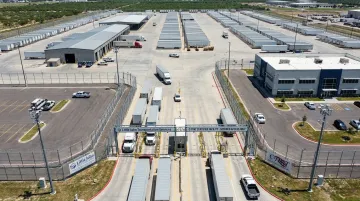
That C-TPAT status is reinforced by a 50-acre CTPAT-compliant Laredo facility with 24/7 monitored access — the kind of physical security infrastructure CBP evaluates when determining inspection priority.
Chassis and Equipment Availability
Ask every prospective provider two questions:
- How do you source chassis — owned, leased, or pool?
- What's your contingency when the pool is short during congestion?
- Do you have equipment pre-positioned near the port, or does it need to be repositioned?
A provider with owned or managed chassis assets has more control than one entirely dependent on third-party pools, which historically tighten during peak periods at major ports.
Documentation and Cargo Specialization
For hazmat, overweight, or temperature-sensitive containers, verify the provider holds the necessary credentials:
- FMCSA Hazmat endorsement covering regulated materials across all applicable classes
- HMSP (Hazardous Materials Safety Permit) — required for the most restricted commodity categories and held by fewer than 1% of U.S. carriers
- EIR and interchange receipt generation issued as standard practice for every move, not on request
For shippers moving chemical, pharmaceutical, or industrial cargo through port terminals, FMCSA HMSP status matters — it's the credential that separates carriers who can legally handle the most restricted hazmat categories from those who can't. Little John holds FMCSA HMSP status and covers all nine hazmat classes.
Frequently Asked Questions
What does port drayage mean?
Port drayage refers to the short-distance trucking of shipping containers between a seaport (or intermodal terminal) and a nearby warehouse, rail yard, or distribution facility. It's the ground-level connector that links ocean freight to the next stage of the supply chain.
What is the difference between freight and drayage?
General freight involves long-haul transport across regions. Drayage is a short-distance intermodal connector covering the first or last leg between a port and a nearby facility. It carries different pricing structures, compliance requirements, and scheduling precision than standard over-the-road trucking.
What is a port drayage charge?
A port drayage charge covers moving a container from a port terminal to its next destination. It typically includes a base linehaul rate, fuel surcharge, chassis fee, and port access fees — plus detention or per diem charges if containers or equipment are held beyond free-time allowances.
What certifications do port drayage drivers need?
Drivers must hold a TWIC for unescorted access to secure port areas. A CDL with Hazmat endorsement is required for containers carrying regulated materials. Carriers operating in cross-border or bonded environments may also require C-TPAT validation at the company level.
What is the difference between port drayage and intermodal shipping?
Intermodal shipping is the broader strategy of moving freight through multiple transportation modes in sequence — ship, rail, and truck. Port drayage is the specific short-haul trucking leg that connects the port to the next mode, making it a component of intermodal shipping, not a synonym for it.
How long does a port drayage move typically take?
The physical drive is usually a matter of hours given short distances. Total time from container availability to final delivery can run considerably longer. Container dwell at San Pedro Bay ports averaged 2.47 days for truck-bound containers in May 2024, driven by port congestion, customs clearance, terminal appointment windows, and receiving facility scheduling.