Global CGT spending reached $5.9 billion in 2023, up 38% from 2022, according to IQVIA — and with 76 therapies launched globally by year-end 2023, the pressure on cold chain infrastructure is accelerating fast. Standard pharmaceutical logistics cannot keep up with what CGT demands.
This article covers what makes CGT cold chain fundamentally different, the temperature and packaging requirements, regulatory frameworks, monitoring protocols, common failure points, and what to look for in a qualified carrier.
Key Takeaways
- CGT products require cryogenic temperatures (-80°C to -196°C) that standard pharma carriers cannot reliably maintain
- Chain of identity (distinct from chain of custody) is a regulatory and patient-safety requirement unique to autologous CGT
- Most shipments fall under multiple overlapping frameworks — FDA 21 CFR Part 1271, EU GDP guidelines, and IATA Dangerous Goods Regulations — simultaneously
- Real-time monitoring without a documented excursion response protocol is insufficient
- Carrier vetting must include validation data, hazmat credentials, and 24/7 operational support
What Makes Cell and Gene Therapy Cold Chain Different
Living Cargo With No Backup
Standard pharmaceutical products tolerate temperature deviations, batch recalls, and reformulation. CGT products do not. A CAR-T therapy manufactured from a patient's own T-cells is, by definition, a batch of one. If a shipment fails, there is no replacement sitting on a shelf — the patient's apheresis process must restart, and manufacturing takes weeks.
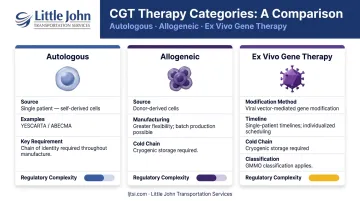
This is the autologous/allogeneic distinction in practice:
- Autologous therapies (such as CAR-T cells like YESCARTA or ABECMA) are derived from the patient's own cells. FDA guidance on CAR-T products expressly recommends maintaining chain of identity from leukapheresis through administration, with at least two unique patient identifiers and "FOR AUTOLOGOUS USE ONLY" labeling.
- Allogeneic therapies use donor-derived cells and offer slightly more manufacturing flexibility, but are still highly temperature-sensitive and equally subject to cold chain requirements.
- Ex vivo gene therapies — including viral vector-modified cell products — often combine both challenges: single-patient manufacturing timelines with cryogenic storage requirements and GMMO regulatory classification.
Narrow Windows and Regulatory Complexity
CGT shipments move between manufacturer, clinical site, and sometimes back again, crossing state or international borders within tightly defined stability windows. A product approved for storage at ≤-150°C cannot be held in a standard pharmaceutical freezer during a transit delay.
Many CGT shipments also involve biological substances subject to hazmat classification under IATA and DOT regulations:
- Substances capable of causing life-threatening disease in humans: UN2814 (Category A)
- Substances not meeting Category A criteria: UN3373 (Category B)
- Viral vectors classified as genetically modified microorganisms may fall under separate GMMO provisions
This means hazmat compliance sits on top of temperature compliance — simultaneously, not sequentially.
The Stakes Beyond Supply Chain
For a terminal oncology patient awaiting a CAR-T infusion, a logistics failure means restarting apheresis, waiting weeks for remanufacturing, and — in some cases — running out of time. That consequence sets the bar for what every handoff, temperature excursion protocol, and contingency plan must be built to prevent.
Temperature Requirements and Specialized Packaging
Three Operating Ranges
CGT products span a wider temperature range than any other pharmaceutical category. The approved labels for marketed products illustrate this:
| Temperature Range | Examples |
|---|---|
| Refrigerated (2°C–8°C) | HEMGENIX (gene therapy for hemophilia B) |
| Deep frozen (≤-65°C) | LUXTURNA (gene therapy for retinal dystrophy) |
| Vapor-phase liquid nitrogen (≤-130°C to ≤-150°C) | YESCARTA, ABECMA (CAR-T therapies) |
There is no universal CGT temperature requirement. Each product's approved label and validated stability data control the shipping condition.
Packaging and Validation Requirements
For ultra-low temperature transport, dry vapor shippers (insulated cryogenic containers with liquid nitrogen absorbed into a porous lining) are the primary packaging system. Validation requirements include:
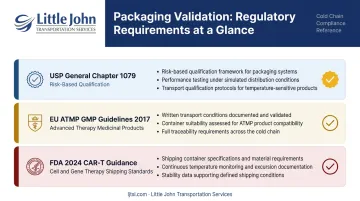
- Packaging must be validated, not assumed. USP General Chapter <1079> requires risk-based qualification, documented package performance testing, and transport performance qualification
- The EU's 2017 ATMP GMP Guidelines require written and demonstrated transport conditions, container suitability, and traceability for Advanced Therapy Medicinal Products
- FDA's 2024 CAR-T guidance requires shipping container and temperature monitoring information, with stability data supporting intended shipping and hold conditions
Air Transport Rules for Dry Shippers
Under 49 CFR 173.320, liquid nitrogen fully absorbed in porous material is excepted from certain hazmat requirements — but only when the package prevents pressure buildup and release of liquid nitrogen regardless of orientation. Free liquid eliminates that exception.
IATA Packing Instruction 650 adds that when liquid nitrogen keeps specimens cold during air transport, all applicable DGR requirements must be met. Packaging must also retain integrity after the refrigerant dissipates.
Secondary Packaging and Labeling
External packaging for CGT shipments must carry:
- Biological substance category markings (UN3373, UN2814, or UN2900 as applicable)
- Unambiguous patient/batch identification to support chain of identity
- Tamper-evident seals with documented inspection records at each handoff
Regulatory Compliance and Documentation for CGT Transport
Multiple Frameworks, Applied Simultaneously
No single regulation covers CGT logistics. The applicable frameworks overlap:
- 21 CFR Part 1271: Governs human cells, tissues, and cellular/tissue-based products (HCT/Ps). Section 1271.265 requires procedures and records for receipt, predistribution shipment, and distribution. Section 1271.290 requires tracking from donor to consignee and back.
- 21 CFR Parts 210/211: GMP requirements apply if the CGT product is regulated as a drug or biologic
- EU GDP Directive 2013/C 343/01: Requires appropriate storage conditions throughout the supply chain, route-risk assessment, qualified thermal packaging, calibrated monitoring, and documented temperature deviation investigation
- EU ATMP GMP Guidelines (2017): Adds product-specific requirements for ATMPs including traceability and contractor controls
- IATA DGR (66th Edition, 2025): Governs air transport of biological substances and dangerous goods
Required Shipment Documentation
Every CGT shipment should travel with a complete documentation package:
- Chain-of-identity records linking patient sample to final product
- Temperature logs from point of release to point of receipt
- Certificate of Analysis
- Transport consent forms where applicable
- Customs documentation for cross-border movements
- Import/export permits for biological materials
All documents must be available in audit-ready form, not reconstructed after the fact.
Cross-Border Considerations
Cross-border documentation failures aren't just a compliance problem — they're a product viability problem. For US-Mexico movements of biological materials, COFEPRIS-01-025 (entry into Mexico) and COFEPRIS-01-024 (exit) govern permitting requirements for human cells and tissues.
US Customs and Border Protection requires biological materials to be documented, labeled, packaged, and declared under applicable agency requirements. Incomplete or incorrect customs paperwork causes border hold delays, and for a product with a finite hold time in a dry vapor shipper, hours lost at a crossing can compromise the shipment entirely.
Real-Time Monitoring and Chain of Identity
What Monitoring Actually Requires
Calibrated data loggers inside each shipper recording temperature at defined intervals are the baseline. Real-time telemetry that transmits alerts when excursions occur raises the standard. Monitoring without an excursion response protocol, though, remains insufficient.
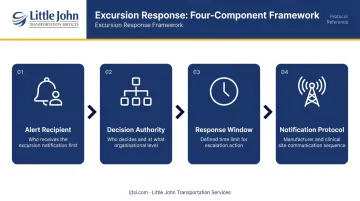
A complete monitoring framework includes:
- Who receives the alert
- What decisions can be made and by whom
- Within what time window a response must occur
- How the manufacturer and clinical site are notified
EU GDP Chapter 9 requires calibrated equipment and documented investigation of temperature deviations. FDA's CAR-T guidance requires temperature monitoring information for both leukapheresis material and the finished product.
Chain of Identity vs. Chain of Custody
For autologous therapies, these two concepts serve distinct functions:
- Chain of custody documents who handled the product and when — tracking physical control at each handoff point
- Chain of identity tracks that the specific patient-derived material — from leukapheresis through manufacturing, shipping, and administration — belongs to and will be given to the correct patient
ICCBBA's ISBT 128 Chain of Identity identifier links collection material and derived products to the intended therapy across the supply chain using a single persistent identifier — a practical implementation of CoI documentation.
Carriers supporting CoI in practice must provide:
- Unique shipment identifiers tied to patient/lot records
- Tamper-evident seals with documented inspection at each handoff
- Electronic tracking that logs GPS location and custody transfers in real time
- Personnel who understand the significance of what they are handling
Common Cold Chain Failures and Contingency Planning
Where Failures Occur
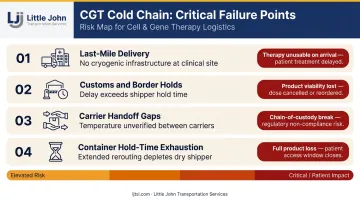
The most common points of failure in CGT cold chain are predictable:
- Last-mile delivery to the clinical site, where dedicated cryogenic infrastructure may not be available
- Customs and border holds that exceed shipper hold times
- Carrier-to-carrier handoffs where temperature is neither verified nor documented
- Container hold-time exhaustion during extended delays or rerouting
When a cold chain failure occurs, the product may be quarantined pending investigation. For autologous therapies, an unsuitable product means another apheresis procedure and weeks of additional manufacturing time — time many patients cannot afford to lose.
Contingency Planning Is Not Optional
Effective contingency planning for CGT logistics includes:
- Qualified backup shippers staged at key transit points
- Pre-qualified alternative routing for primary lane disruptions
- 24/7 carrier dispatch with documented escalation protocols
- Clear, pre-agreed response procedures between manufacturer, logistics provider, and clinical site
The difference between a cold chain incident and a patient crisis comes down to one thing: whether the escalation chain activates in minutes, using options that were qualified long before the disruption occurred.
How to Choose the Right Carrier for CGT Cold Chain Logistics
Non-Negotiable Qualifications
When vetting a carrier for CGT shipments, documentation and credentials matter more than sales conversations. Look for:
- FMCSA HMSP certification for ground transport of applicable hazmat quantities (held by fewer than 1% of active US motor carriers)
- A documented pharmaceutical QMS with audited processes, traceable records, and accountability at each handoff
- Validated cold chain performance data: lane-specific temperature mapping and packaging qualification records, not just equipment specs
- Hazmat-endorsed drivers with demonstrated training for biological substance classifications
- Audit-ready chain-of-custody documentation structured to withstand FDA and GDP scrutiny
- 24/7 dispatch with bilingual support for North American cross-border corridors
Few carriers check all of these boxes. Little John Transportation Services holds FMCSA HMSP certification, ISO 9001:2015, and GDP-compliant cold chain with 24/7 bilingual dispatch — backed by a CTPAT-validated 50-acre Laredo facility with in-house customs brokerage that directly reduces border dwell time on pharmaceutical shipments.
Ask for Performance Data
A carrier unwilling to share performance metrics should raise a flag in a zero-defect industry. Request:
- On-time delivery rate for temperature-sensitive loads
- Claim-free delivery rate
- Temperature excursion incident rate
- Volume of pharmaceutical or biologic shipments handled annually
The Human Factor
Automated systems handle routine monitoring. They cannot make judgment calls when a border hold extends past a shipper's rated hold time, or when a connecting flight is cancelled and a reroute decision needs to happen in 20 minutes.
The people managing a CGT shipment — dispatchers, drivers, account managers — need to understand what they are moving. A dispatcher who treats a CAR-T cell therapy like a standard pallet will make standard-pallet decisions under pressure. The right partner takes ownership of the outcome, not just the status update.
Frequently Asked Questions
What is cold chain logistics for biologics?
Cold chain logistics for biologics refers to the temperature-controlled handling, storage, and transportation of biologically derived products — including vaccines, blood products, and cell and gene therapies — from point of manufacture to point of use. The goal is to maintain product viability and safety throughout every transit and storage leg.
What are the main components of a cold chain?
The core components include:
- Temperature-controlled packaging (insulated shippers, dry ice, vapor-phase LN2 containers)
- Real-time monitoring systems (data loggers, telemetry)
- Compliant documentation and chain-of-custody records
- Trained personnel at every transfer point
- Validated storage facilities along the full distribution route
What temperature is required for cell and gene therapy cold chain transport?
CGT products typically require ultra-low temperatures ranging from ≤-65°C to ≤-196°C (vapor-phase liquid nitrogen), depending on the specific product's approved label. This is significantly colder than standard pharmaceutical refrigerated (2°C–8°C) or frozen (-20°C) requirements.
What regulations govern cell and gene therapy cold chain logistics in the US?
FDA 21 CFR Part 1271 governs HCT/Ps, with applicable GMP regulations under 21 CFR Parts 210/211. IATA Dangerous Goods Regulations apply for air transport, and DOT/FMCSA hazmat regulations apply for ground transport. For international shipments, EU GDP guidelines and country-specific requirements apply simultaneously.
How is chain of identity maintained during CGT transport?
Chain of identity relies on unique patient/batch identifiers on packaging, tamper-evident seals inspected at each handoff, and electronic tracking systems. Documentation must trace the patient's biological material continuously — from collection through manufacturing to clinical administration.
What are the biggest risks in cold chain logistics for cell and gene therapies?
The primary risks are temperature excursions during last-mile delivery or customs holds, documentation failures that trigger product quarantine, container hold-time exhaustion during delays, and carrier handoff gaps where temperature goes unverified — any of which can render a patient-specific therapy permanently unusable.