
But "expedited shipping" is one of those terms the industry uses loosely. Parcel carriers, LTL providers, and specialized freight companies each define it differently, and the gap between a two-day parcel delivery and a dedicated cross-border truckload for hazardous materials is enormous — even if both carry the same label.
This guide covers what expedited shipping actually means for industrial and commercial shippers, how it works operationally, what drives cost, and when the cargo complexity demands a specialized carrier rather than a faster version of standard service.
Key Takeaways
- Expedited shipping means dedicated resources, direct routing, and priority handling — not just a faster service label
- The real cost driver isn't speed alone; it's distance, weight, service tier, and surcharges combined
- Hazmat, oversized, and cross-border expedited freight requires carriers with specific certifications that standard parcel carriers don't hold
- Expedited should be a deliberate operational decision, not a default triggered by poor planning
What Is Expedited Shipping?
Expedited shipping is a delivery method that moves freight faster than the shipper's standard transit tier by dedicating resources (trucks, drivers, routing priority) specifically to that load rather than routing it through a shared carrier pool.
The term is inherently relative. If your standard ground service takes five to seven business days, any service delivering in one to three business days qualifies as expedited even when no carrier explicitly labels it that way. What matters is the commitment, the handling method, and whether the shipment is moving on a dedicated or direct path.
B2C vs. B2B: Two Very Different Realities
For e-commerce, "expedited" typically means a parcel arriving in two days via a major carrier's priority tier (think UPS or FedEx two-day). For industrial and commercial shippers, it means something operationally different:
- Dedicated truckload lanes with a single driver or team assigned to the load
- Direct point-to-point routing that bypasses consolidation hubs entirely
- Time-guaranteed delivery windows, not just a delivery-day estimate
- Specialized equipment for oversized, hazardous, or temperature-sensitive cargo
What Expedited Shipping Is Not
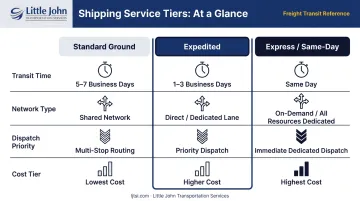
Expedited sits between standard ground and express delivery — it's not the fastest option available, and it's not a single universal service tier.
| Service Type | Typical Transit | Routing Method |
|---|---|---|
| Standard Ground | 5–7 business days | Shared network, multi-stop |
| Expedited | 1–3 business days | Direct or dedicated lane |
| Express/Same-Day | Same day | On-demand, highest priority |
Every carrier defines and prices expedited differently, which is why evaluating service by transit commitment and handling method is more reliable than comparing labels.
How Does Expedited Shipping Work?
The operational mechanics behind expedited shipping explain why it costs more — and why that cost is often worth it.
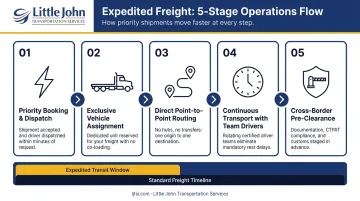
Priority Booking and Dispatch
Expedited loads are flagged immediately at booking, bypassing the standard queue. Old Dominion's documented expedited service commits to delivery within one hour of a prescheduled time, with freight charges reverting to standard LTL rates if that window is missed — a contractual consequence that enforces the commitment.
ArcBest's ground expedite specification requires exclusive-use vehicle assignment and uninterrupted movement from origin to destination. For carriers like Little John Transportation Services, that model runs on a sub-60-minute response time, available 24/7. Drivers are pre-cleared and equipment is pre-staged before a load is booked, so nothing starts from a cold stand when a critical need arises.
Direct Routing With Fewer Stops
Standard LTL freight may pass through two or three transfer facilities before reaching its destination. Expedited loads move point-to-point or with minimal stops, eliminating the time lost at sorting centers and relay points. This direct routing is one of the primary reasons expedited costs more — the truck isn't sharing space or stops with other shippers' cargo.
Continuous Transport for Long-Haul Loads
For longer distances, two-driver teams allow a vehicle to keep moving around the clock. FMCSA hours-of-service regulations still apply to individual drivers, but a team configuration means one driver rests while the other continues. The shipment never stops mid-route waiting on a rest cycle.
Real-Time Visibility and Dedicated Ownership
Expedited shipments require active, human-owned monitoring throughout transit. A dedicated dispatcher owns the load from pickup to delivery, with the authority to intervene the moment any delay threatens the window. Little John assigns a real person to every load — automated portals don't manage time-critical freight.
Cross-Border Pre-Clearance
That level of operational control matters even more at the border, where documentation gaps can erase hours of transit time regardless of how fast the truck moved domestically.
For U.S.-Mexico shipments, expedited transit depends on documentation being CBP-ready before the truck reaches the border. CTPAT validation and FAST lane eligibility reduce inspection holds at high-volume crossings like Laredo, which handled more than 3 million inbound trucks from Mexico in 2024 — up 3.1% year-over-year. Without pre-clearance infrastructure in place, a shipment can lose hours at the border even after a clean domestic run.
Expedited vs. Standard vs. Express: Understanding the Difference
Carrier labels don't map consistently across providers — the only reliable way to compare service tiers is by transit commitment and handling method.
| Service Tier | Transit Time | Handling Method | Cost Level |
|---|---|---|---|
| Standard LTL/Ground | 5–7 business days (typical) | Shared network, multiple transfer points | Lowest |
| Expedited | Time-definite, direct movement | Priority dispatch, dedicated or exclusive-use vehicle | Higher |
| Express/Same-Day | Same-day or next-day | Maximum urgency, all resources dedicated | Highest |
A few practical notes on this comparison:
- Carrier labels don't align. One carrier's "Priority" tier is another's "Expedited." ODFL's Guaranteed service commits to delivery by 5 p.m. or noon on the standard transit day; their Expedited On Demand commits to within one hour of a prescheduled time. These are meaningfully different. Don't assume a name tells you the commitment.
- Use standard ground for non-urgent, cost-sensitive freight where timing has flexibility.
- Choose expedited for time-sensitive but plannable needs: production restocks, medical supplies, event deadlines.
- Reserve express or same-day for true emergencies where cost is secondary to speed.
When Does Expedited Shipping Make Business Sense?
Production Line Shutdowns and JIT Supply Chains
When a missing component halts a manufacturing line, the math is simple: does expedited freight cost less than the downtime it prevents? ABB's 2023 survey of 3,215 industrial decision-makers found a typical unplanned downtime cost above $125,000 per hour, with 69% reporting an unplanned outage at least monthly.
At that exposure level, expedited freight is rarely the expensive option — it's the cost-justified one.
Little John serves automotive OEMs including Honda and Tesla specifically for line-down emergencies — situations where stamping dies, assembly-line robots, or sequenced parts need to reach a plant floor on a timeline that doesn't accommodate standard routing.
Energy and Project-Based Industries
Drilling rigs, construction crews, and energy project teams face the same math from a different angle: idle equipment and standing crews cost money by the hour. When a Permian Basin operation is waiting on a replacement pump component, or a construction project is stalled for a structural piece, expedited freight determines whether the crew works or idles.
Little John's hot shot service dispatches trucks within the hour for oilfield and project parts runs. Gooseneck trailers handle the irregular shapes common in field equipment, and TWIC-certified drivers cover restricted-access facilities.

Emergency Inventory Replenishment
Retailers, distributors, and industrial facilities facing unexpected stockouts use expedited freight to bridge the gap faster than a standard replenishment cycle allows. The trigger is usually a demand spike or upstream disruption — neither of which waits for a scheduled delivery window.
When Not to Use It
Expedited shipping is a deliberate operational decision — not a default. If delivery timing has flexibility, standard freight is almost always more cost-effective. McKinsey notes that repeated expediting as a coping mechanism doesn't create supply chain resilience — it just masks a planning problem with a cost premium.
Before booking, ask whether the timeline genuinely demands it — or whether poor planning created the urgency.
What Affects the Cost of Expedited Shipping?
Distance and Shipping Zones
Carriers use zone-based pricing. Cross-country expedited freight costs significantly more than regional delivery at the same service tier, and the gap widens with urgency — a same-day cross-country move involves more resources than a two-day regional run.
Weight, Dimensions, and Freight Class
NMFTA's NMFC classification determines LTL freight pricing using density, handling, stowability, and liability. The 2025 NMFC changes expanded density-based classification, meaning a large-but-light shipment can cost as much as a dense, heavy one. Oversized or overweight loads add specialized equipment costs on top of any expedited premium.
Service Tier and Delivery Guarantee
The tighter the delivery commitment, the higher the cost. Specific delivery windows add further cost on top of the expedited base rate:
- Morning or before-noon delivery windows typically carry a $50–$150 surcharge
- Appointment-based delivery adds coordination fees and may require driver wait time
- After-hours or weekend delivery often triggers overtime and accessorial charges
Surcharges to Anticipate
These tier costs don't include accessorial charges — which is exactly why an all-in quote matters. Always request a fully loaded rate, not just a base rate. Common surcharges include:
- Fuel surcharges — adjusted to diesel price indexes; varies by carrier tariff
- Hazmat handling fees — published 2025 carrier examples: Old Dominion at $30/shipment, XPO at $51.30/shipment, FedEx Freight at $58/shipment
- Residential delivery fees — typically $50–$100 per stop depending on carrier
- Peak-season surcharges — most common Q4 (October–December) and around major holidays
- Border-crossing fees for U.S.–Mexico shipments
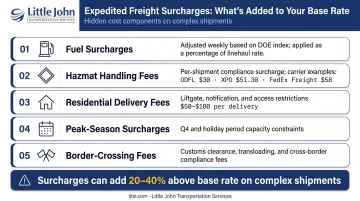
On complex shipments — hazmat, oversized, or cross-border — surcharges can add 20–40% above the base rate. Getting the full picture upfront prevents cost surprises at delivery.
Expedited Shipping for Specialized and Complex Freight
Standard parcel carriers — USPS, FedEx, UPS — are designed for packages, not for oversized industrial equipment, hazardous materials, or cross-border full truckload shipments. When the cargo is complex, the carrier requirement changes entirely.
What Separates Specialized Expedited Freight
The credentials required to move certain freight legally aren't optional upgrades — they're hard eligibility gates:
- FMCSA HMSP (Hazardous Materials Safety Permit): Only 898 carriers out of 132,574 active hazmat carriers hold this permit — 0.68% of the total. Without it, the most hazardous material categories cannot legally move. Little John holds this permit.
- TPS Approval: A carrier without this cannot legally accept sensitive government and military loads — urgency is irrelevant if the carrier isn't cleared.
- AA&E Certification: Arms, ammunition, and explosives require certified operators. Little John maintains 870+ AA&E-certified operators, with some drivers holding Secret-level security clearances — and a training program that exceeds DoD frequency requirements.
- TWIC Certification: Required for unescorted access to ports and secure federal facilities. A carrier without TWIC-certified drivers faces access delays that defeat the purpose of expedited service entirely.
- CTPAT Validation and FAST Lane Eligibility: For U.S.-Mexico freight, CTPAT-validated carriers receive priority treatment at ports of entry and access to dedicated FAST lanes, reducing inspection exposure at high-volume crossings like Laredo.
Why Carrier Selection Matters More Than Speed
For industries like energy, defense, chemical, and automotive — where expedited freight is an operational dependency, not an occasional upgrade — the carrier's certification stack determines whether the shipment can move at all.
Little John's 50-acre CTPAT-compliant Laredo facility is built around that reality:
- 30-bay cross-dock with 1,200-trailer staging capacity
- 120-ton bridge crane for transloading superloads in under two hours
- Bilingual operations teams in Laredo, Monterrey, and Guadalajara
- In-house U.S. and Mexican customs brokerage on both sides of the border
Cross-border expedited loads don't slow down at the handoff points where most delays actually occur.
Frequently Asked Questions
What is expedited shipping?
Expedited shipping is any delivery method that moves freight faster than the shipper's standard transit tier, using priority dispatch, direct routing, and dedicated resources to compress delivery timelines. For industrial shippers, this typically means exclusive-use vehicles, time-guaranteed delivery commitments, and fewer transfer stops than standard freight.
How long does expedited shipping take?
Transit time depends on the carrier, service tier, distance, and cargo type. Parcel expedited services generally deliver in one to three business days. Specialized full-load expedited freight is lane-specific and quote-dependent — same-day to multi-day, based on commitment level.
Who delivers expedited shipping?
Major parcel carriers (FedEx, UPS, USPS) handle expedited small packages. Specialized freight carriers handle expedited full truckload, hazmat, oversized, and cross-border shipments.
What is the difference between expedited and standard shipping?
Standard shipping is the baseline, lowest-cost delivery option moving freight through shared networks with multiple transfer points. Expedited shipping uses priority dispatch, dedicated or exclusive-use vehicles, and direct routing to deliver faster, at a higher cost. The difference is both speed and the level of resources committed to that specific load.
Is expedited shipping more expensive than standard?
Yes, always. The premium scales with the urgency of the commitment — a two-to-three-day service costs less above standard than same-day or overnight. For complex freight involving hazmat, oversized loads, or cross-border movements, specialized equipment, compliance requirements, and border logistics further affect total cost. Request all-in quotes, not base rates.
Can expedited shipping be used for hazmat or oversized freight?
Yes, but only through carriers with the proper credentials. An FMCSA Hazardous Materials Safety Permit, hazmat-endorsed drivers, and appropriate trailer configurations are legal requirements, not optional upgrades.