Many shippers and carriers treat the shipping paper as an afterthought. That's expensive. PHMSA's current civil penalty guidelines put fines at $3,700–$7,500 for a missing document entirely, and violations are assessed per shipment.
This guide walks shippers, carriers, and logistics teams through exactly what hazmat shipping papers must contain, where they must be kept, who prepares them, and what the consequences look like when something goes wrong.
Key Takeaways
- The basic description requires four elements in exact order: ID number, proper shipping name, hazard class, and packing group, plus quantity and package details
- Papers must be within the driver's reach while driving, and placed on the seat or in the door holder when the driver exits
- The shipper prepares the paper; the carrier ensures it's accessible and retains it after delivery
- Motor carriers retain hazmat shipping papers for one year; three years for hazardous waste
- Penalties for non-compliance range from $600 for a sequencing error up to $7,500 for a missing document
What Are Hazardous Materials Shipping Papers?
Per 49 CFR §171.8, a shipping paper is "a shipping order, bill of lading, manifest or other shipping document serving a similar purpose" that contains the information required by §§172.202, 172.203, and 172.204. There is no single DOT-mandated form — PHMSA has confirmed this through multiple interpretations.
The document serves two distinct purposes:
- It gives the carrier and driver a written account of exactly what regulated material is on board.
- It gives first responders the hazard and emergency information they need if an incident occurs in transit.
Bills of lading, manifests, invoices, or plain documents all qualify, provided every required element is present. The one formatting rule that applies regardless of document type: hazmat entries must be clearly distinguishable from non-hazmat line items on the same paper.
Required Information on Hazmat Shipping Papers
Identification Number and Proper Shipping Name
Under 49 CFR §172.202, the basic description consists of four elements that must appear in a specific sequence (no additional information may be interspersed between them):
- UN or NA identification number (e.g., UN1203) — sourced from Column 4 of the Hazardous Materials Table in §172.101
- Proper shipping name — the exact Roman-type name from Column 2 of the same Table
- Hazard class or division (e.g., Class 3)
- Packing group — Roman numerals I, II, or III; "PG" may precede the numeral
Trade names cannot replace the proper shipping name. The regulation mandates the specific Column 2 name — any substitution creates a violation.
Hazard Class, Subsidiary Hazards, and Quantity
If a material has a subsidiary hazard, the subsidiary class or division number appears in parentheses immediately after the primary hazard class — not brackets.
After the basic four-element description, §172.202(c) requires:
- Total quantity — by mass, volume, or another appropriate measure with the unit stated. Net explosive mass applies specifically to Class 1; the rule doesn't mandate both net and gross weight
- Number and type of packages — for example, "4 drums" or "2 cylinders"
Additional Description Requirements Under §172.203
Certain material types trigger additional required entries. Missing these is one of the most common compliance errors carriers encounter.
| Trigger | Required Entry |
|---|---|
| Special Permit | "DOT-SP" followed by the permit number |
| Reportable Quantity | "RQ" before or after the basic description |
| Poison/Toxic Inhalation Hazard | "Poison-Inhalation Hazard" or "Toxic-Inhalation Hazard" plus hazard zone |
| Elevated Temperature Material | "HOT" immediately before the proper shipping name |
| Marine Pollutant | "Marine Pollutant" with component identification where required |
| Empty Packaging/Residue | "RESIDUE: Last Contained..." (permissive wording, not a universal mandate) |
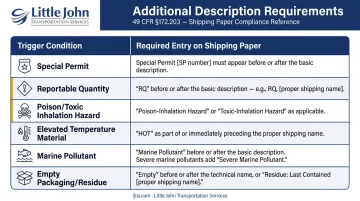
The inhalation hazard designation carries one of the steeper standalone penalties — $2,500 — so it warrants specific attention on affected shipments.
Emergency Response Telephone Number and Shipper's Certification
Two additional requirements apply to every regulated hazmat shipment.
Emergency response number (§172.604): The shipping paper must include a 24-hour telephone number monitored at all times the material is in transportation. The person answering must know the hazards and emergency response information, or have immediate access to someone who does.
When a contracted provider like CHEMTREC is used, the offeror's name and contract or customer number must appear immediately adjacent to the phone number on the document.
Shipper's certification (§172.204): The shipper must include a signed statement declaring the shipment has been properly classified, described, packaged, marked, and labeled. Any of the following may sign:
- Principal, officer, partner, employee, or agent
- Manual, typewritten, or mechanical signatures are all valid
When a highway carrier receives verbal or electronic certification, the paper must include the date and name of the certifying person.
Where Must Hazmat Shipping Papers Be Located in a Vehicle?
49 CFR §177.817 governs paper accessibility during transport. The rule exists for one straightforward reason: first responders and inspectors must be able to locate hazmat documentation immediately, without searching the cab.
In 2023, FMCSA recorded 3,394 citations specifically for shipping paper accessibility (violation code 177.817E) across 211,312 hazmat inspections — making it one of the most-cited hazmat violations during roadside inspections. Citations under this code can result in fines up to $13,695 per violation or an out-of-service order that grounds the vehicle on the spot.
While the Driver Is at the Controls
When the driver is seated and restrained by the lap belt, the shipping paper must be:
- Within immediate reach — not in a bag, toolbox, or under a seat
- Readily visible to a person entering the driver's compartment, or stored in a holder mounted inside the driver's side door
When the Driver Is Away from the Vehicle
The paper must be placed either:
- On the driver's seat, or
- In the driver's side door holder
Neither placement is optional — if a first responder reaches a vehicle and neither location holds the papers, the driver faces a recordable violation regardless of where the documents actually are.
Distinguishability Requirement
Carrying hazmat papers alongside non-hazmat documents creates a real risk during an emergency — a responder flipping through a stack of BOLs loses seconds they don't have. Under §172.201(a)(1), hazmat documents must be clearly set apart by one of these methods:
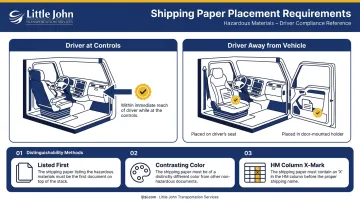
- Listed first in the document stack
- Shown in a contrasting color
- Marked with an "X" in an "HM" column (or "RQ" where applicable)
Shipper vs. Carrier: Who Is Responsible?
Responsibility is split between shipper and carrier, and each party carries distinct liability.
The shipper's duties:
- Prepare an accurate, complete shipping paper and deliver it to the carrier before or at the time of shipment
- Retain a copy for two years after acceptance by the initial carrier (three years for hazardous waste manifests)
The carrier's duties:
- Refuse to accept or transport any hazmat shipment without a Part 172-compliant paper — §177.817(a) makes acceptance without one a separate violation
- Ensure the paper is accessible in the vehicle throughout transit
- Retain the paper for one year after acceptance (three years for hazardous waste)
Where Liability Overlaps
Under 49 CFR §171.2(f), a carrier may rely on shipper-supplied information — unless the carrier knows, or a reasonable person exercising reasonable care would know, it's incorrect.
The moment a carrier accepts a shipment with incomplete documentation, it inherits a compliance exposure. Verification before the truck rolls is not optional; it's the only point in the process where errors can be caught without penalty.
Carriers holding an FMCSA Hazardous Materials Safety Permit (HMSP) — a credential held by fewer than 1% of U.S. motor carriers, including Little John Transportation Services — operate under heightened FMCSA oversight, which makes documentation verification a daily operational reality rather than a periodic audit concern.
Retention Requirements, Penalties, and Common Mistakes
Retention Timelines
| Party | Standard Retention | Hazardous Waste |
|---|---|---|
| Shipper/Offeror | 2 years after carrier acceptance | 3 years |
| Highway Carrier | 1 year after acceptance | 3 years |
Both parties must keep retained copies accessible at their principal place of business and available to authorized officials upon request. These are federal minimums — some industries or customer contracts require longer periods.
Penalties for Non-Compliance
PHMSA's current Appendix A penalty guidelines break down by violation type. Penalties apply per violation, per shipment:
| Violation | Baseline Penalty Range |
|---|---|
| No shipping paper / carrier accepts without one | $3,700–$7,500 |
| Missing identification number | $1,200–$2,500 |
| Missing/incorrect proper shipping name or hazard class | $1,000–$2,000 |
| Missing/incorrect packing group | $1,300–$1,700 |
| Missing poison-inhalation-hazard designation | $2,500 |
| Missing emergency response number | $3,200–$5,200 |
| Basic description not in required sequence | $600 |
| Missing total quantity or additional required entry | $600 |
| Missing or unsigned certification | $1,000 |
| Failure to retain shipping paper | $1,200 |
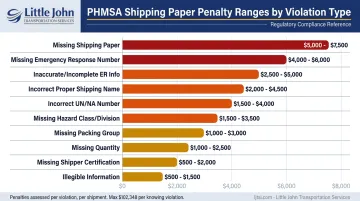
Under 49 CFR §107.329, maximum penalties reach $102,348 per knowing violation — or $238,809 when the violation results in death, serious injury, or substantial property destruction.
Most Common Shipping Paper Mistakes
These are the errors that show up most frequently in PHMSA enforcement actions and FMCSA inspections:
- Wrong sequence — the four basic description elements must appear in exact order with nothing interspersed
- Missing or incorrect packing group — omitting the Roman numeral notation is a separate, penalized violation
- Trade name substituted for proper shipping name — only the Column 2 Table name is acceptable
- Missing 24-hour emergency response number — or listing a number that isn't monitored continuously
- Omitted §172.203 additions — particularly the RQ designation and inhalation hazard language, which carry the highest standalone penalties
- Hazmat entries not distinguishable from non-hazmat line items on mixed-commodity papers
What Audit-Ready Documentation Looks Like in Practice
The mistakes above share a common thread: they're almost always caught at inspection, not caught before departure. Experienced hazmat carriers treat the shipping paper as a chain-of-custody document. Every field is verified before the truck moves, papers are stored in the correct cab location during transit, and copies are archived and accessible for the full retention period.
That documentation discipline is what separates carriers who clear inspections from those who accumulate violations — and what determines whether your carrier reduces your compliance exposure or creates new risk for it.
Frequently Asked Questions
When transporting hazardous materials, where should the shipping paper be located?
While the driver is at the controls with the seat belt fastened, the paper must be within immediate reach and either visible to someone entering the cab or stored in the driver's side door holder. When the driver leaves the vehicle, the paper must be on the driver's seat or in that same door holder, per 49 CFR §177.817.
Which of the following should be found on a shipping paper when transporting hazardous material?
Required elements include the UN/NA identification number, proper shipping name, hazard class or division, packing group (Roman numerals I–III), total quantity with unit of measure, and number and type of packages. The paper must also carry a 24-hour emergency response phone number and a signed shipper's certification.
What quantities of hazardous materials must be shown on a shipping paper?
The total quantity must be shown by mass, volume, or another measure appropriate to the hazard class, including the unit of measure. The number and type of packages must also be listed. Net explosive mass is required for Class 1 materials under 49 CFR §172.202(c).
How long must hazmat shipping papers be retained?
Motor carriers must retain papers for one year after acceptance of the shipment, or three years for hazardous waste. Shippers must retain their copy for two years after acceptance by the initial carrier, kept accessible at their principal place of business.
Who is responsible for preparing hazmat shipping papers?
The shipper — the party offering the material for transportation — prepares and provides the shipping paper. The carrier is responsible for keeping it accessible during transit, refusing non-compliant loads, and retaining the paper after delivery.
What are the penalties for missing or incomplete hazmat shipping papers?
PHMSA can assess $3,700–$7,500 for a missing shipping paper and $1,200–$2,500 for a missing identification number specifically. Other incomplete entry violations range from $600 (wrong sequence) to $2,500 (missing inhalation hazard designation). Penalties apply per violation, per shipment.