Introduction
Picture this: an ocean container arrives at a Gulf Coast port carrying automotive components bound for a plant in Monterrey. The vessel leg is done, but the freight still has hundreds of miles to travel — through U.S. customs, across the border, and into a Mexican manufacturing facility running a just-in-time line that cannot stop. A single transport mode won't complete that journey. That's where transloading comes in.
Transloading is the logistics strategy that bridges incompatible modes, regulatory boundaries, and equipment differences within a single shipment's journey. It runs daily at ports, rail terminals, and border crossings across North America — essential infrastructure that most shippers never see.
This guide covers what transloading means, how it works, the main transfer methods, its supply chain benefits, and how it differs from intermodal and cross-docking.
Key Takeaways
- Transloading physically transfers cargo between modes at an intermediate facility — unlike intermodal, where the container stays intact
- Five stages define the process: receipt, unloading/sorting, value-added handling, outbound loading, and dispatch
- Rail-to-truck is the most common domestic combination, driven by rail's 472 ton-miles per gallon fuel advantage
- U.S.–Mexico transloading demands compliance credentials (C-TPAT, FAST, HMSP), not just equipment
- Transloading is the right choice when modes must change, consolidation is needed, or regulatory handoffs require physical cargo transfer
What Is Transloading?
The Federal Railroad Administration defines transloading as "the process of transferring freight between two modes of transportation" — with or without a container. The key distinction isn't the equipment — it's that the cargo itself moves between modes at an intermediate facility.
How It Differs from Intermodal
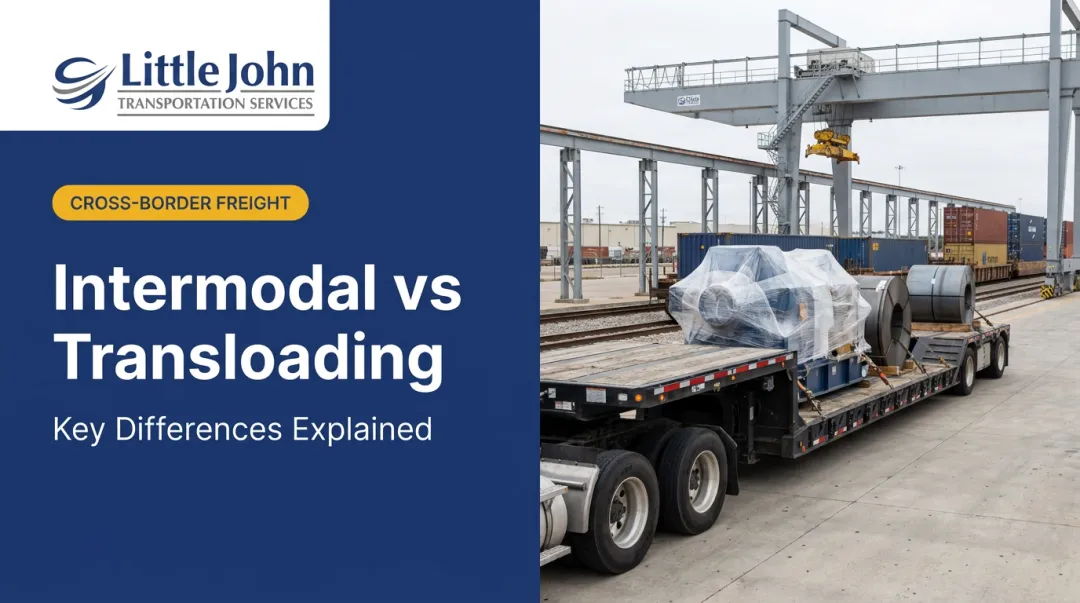
In intermodal shipping, a container or trailer moves across multiple modes (rail plus truck, for example) without the goods inside being touched. Transloading involves physically unloading and reloading the cargo. That added handling does introduce cost and labor — yet it also opens up flexibility that pure intermodal cannot match:
- Payload can be maximized for each mode independently
- Cargo from multiple origins can be consolidated
- Equipment incompatible across modes (ocean containers vs. domestic trailers) can be swapped
- Regulatory requirements at border crossings can be met
Where Transloading Applies
Transloading applies across domestic routes, international imports, and cross-border lanes. Common scenarios include:
- Domestic routes — bulk commodities shifting from rail to truck for last-mile delivery
- International imports — ocean containers stripped at a port facility and reloaded into domestic trailers
- Cross-border lanes — cargo transferring between U.S. and Mexican carriers at border hubs due to regulatory and equipment differences
- Consolidated and split loads — FCL and LCL shipments across industries from retail to heavy industrial
How the Transloading Process Works Step-by-Step
Step 1 — Cargo Receipt and Documentation Review
Freight arrives at a transload facility (typically near a port, rail terminal, or border crossing). Staff verify shipping documents, inspect the shipment's condition, and log the intake. For regulated cargo — hazardous materials, bonded goods, military freight — compliance checks happen here, not after the fact.
Step 2 — Unloading and Sorting
Cargo is unloaded from the inbound mode using equipment matched to the load type: forklifts for palletized goods, cranes for heavy or oversized freight, conveyor systems for bulk material. Once off the inbound vehicle, freight is sorted by destination, SKU, consignee, or delivery priority. A disorganized sort compounds into delays downstream. Getting it right here sets up a clean outbound leg.
Step 3 — Value-Added Handling (When Required)
Not every transload is a simple mode swap. Many operations include intermediate steps that prepare freight for domestic or retail distribution:
- Palletization — converting loose cargo into stable pallet units
- Repackaging — replacing ocean-compliant packaging with retail or warehouse-ready formats
- Labeling — applying domestic or retailer-specific labels
- Kitting — assembling components into ready-to-ship sets
Which of these steps apply depends on cargo type, destination requirements, and the facility's capabilities.
Step 4 — Loading onto Outbound Transport
Sorted and prepared freight is loaded onto the outbound mode (truck, railcar, flatbed, or specialized trailer) using equipment matched to the load. Cargo type, dimensions, weight, and destination all influence the method.
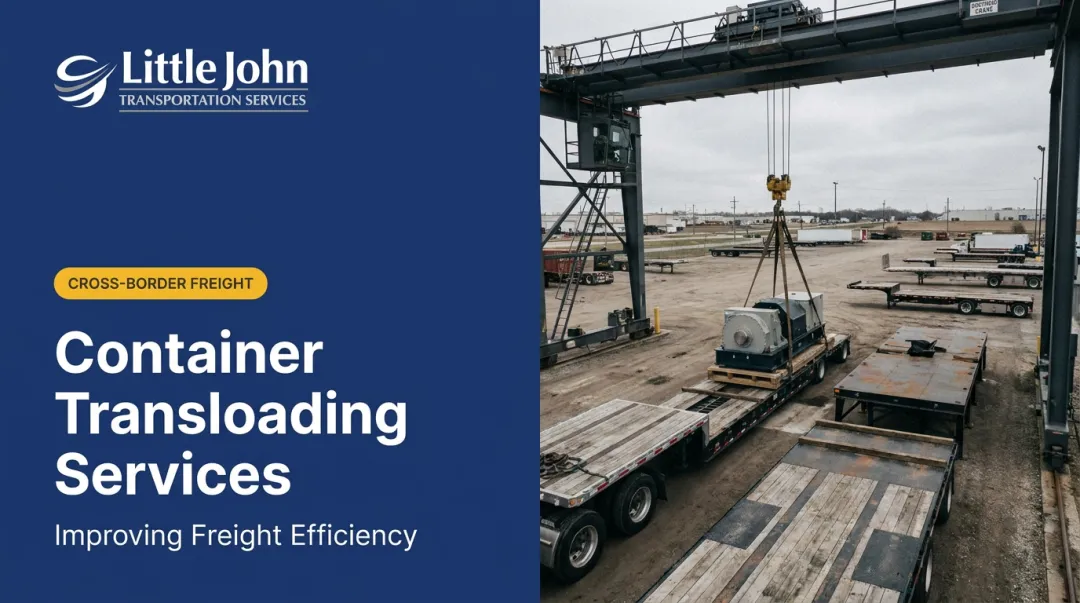
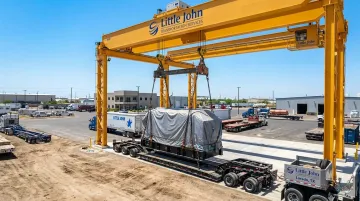
A 40-ton industrial component crossing the U.S.–Mexico border, for example, requires crane-assisted transfer onto an outbound trailer. At Little John Transportation Services' 50-acre facility in Laredo, the custom-built 120-ton bridge crane handles exactly these scenarios, completing superload transfers in under two hours.
Step 5 — Final Dispatch and Tracking
Outbound freight is dispatched to its next stop (distribution center, manufacturing plant, job site, or end customer). Real-time visibility and chain-of-custody documentation are critical at this stage, particularly for regulated, high-value, or time-sensitive shipments. For cross-border freight, 24/7 tracking with bilingual dispatch ensures visibility doesn't drop at the border handoff.
Key Transloading Transfer Methods
Rail-to-Truck Transloading
The most common domestic method. Freight travels by rail for the long-haul leg, then transfers to trucks for last-mile delivery. According to the Association of American Railroads, U.S. freight railroads moved one ton of freight an average of 472 miles per gallon in 2019 — three to four times more fuel-efficient than trucks.
That efficiency advantage applies primarily to the long-haul leg. Build a full lane-level model — including drayage, terminal handling, and minimum-volume commitments — before committing to a rail-anchored strategy.
Ocean/Port-to-Truck or Rail Transloading
Ocean containers arrive at a major port; cargo is unloaded at a nearby transload facility and transferred into domestic trailers or railcars. The goal is simple: return ocean equipment fast.
The Federal Maritime Commission reports that nine major carriers collected approximately $15.4 billion in detention and demurrage charges from April 2020 through March 2025. Port Houston separately assesses a $45/day sustained-import dwell fee starting on the eighth day after free time expires. Transloading near the port eliminates that exposure by getting ocean containers emptied and returned quickly.
At Los Angeles and Long Beach, truck-bound containers averaged 2.47 days at terminals in December 2025 — down from 3.11 days the prior December. Transload facilities positioned close to port gates accelerate that cycle further.
Cross-Border Transloading
At U.S.–Mexico border crossings, cargo routinely transfers between modes and carriers for three reasons: regulatory requirements, equipment differences, and customs protocols. Mexican carriers typically cannot operate freely on U.S. roads, and U.S. carriers face equivalent restrictions southbound. Physical cargo transfer at a bonded border facility is the standard solution.
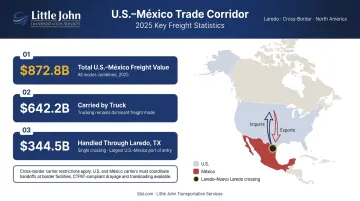
The scale of this corridor matters. U.S.–Mexico freight reached $872.8 billion in 2025, with trucks carrying $642.2 billion of that volume. Laredo alone handled $344.5 billion — the busiest North American land port by trade value.
Operating effectively here requires more than a loading dock: C-TPAT validation, FAST certification, in-house customs brokerage on both sides of the border, and bilingual operational teams.
Little John Transportation Services runs dedicated operations in Laredo, Monterrey, and Guadalajara built around this complexity — including 250+ Mexican interchange agreements, 17,000+ cross-border trailers managed, and in-house customs brokerage on both sides.
Truck-to-Truck and Specialized Cargo Transfers
Some transfers happen between trucks when cargo demands specialized equipment, certified handlers, or compliance documentation at the transfer point — regardless of mode change. Common scenarios include:
- Oversized loads shifting from a multi-axle lowboy to a step-deck for urban delivery
- Hazardous materials requiring HMSP-certified operators at every handoff
- Temperature-sensitive freight requiring trailer pre-cooling verification before transfer
Key Benefits of Transloading for Your Supply Chain
Supply Chain Flexibility
Transloading lets shippers use the optimal mode for each leg rather than forcing a single-mode compromise across the entire route. More practically, it provides rerouting capability when disruptions hit:
- Port congestion → shift volumes to alternate gateways
- Labor actions → redirect to facilities with different carrier networks
- Weather events → reroute inland without stranding freight mid-journey
That optionality matters most when a single-mode commitment would leave you with no fallback.
Cost Reduction
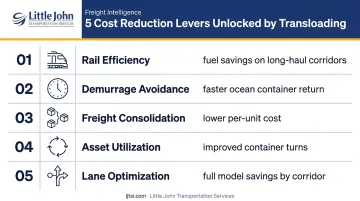
Transloading activates several cost levers simultaneously:
- Captures rail's fuel efficiency advantage on dense long-haul corridors
- Avoids demurrage and detention charges by returning ocean containers quickly
- Combines smaller shipments into a single outbound load, cutting per-unit cost
- Speeds container turns and improves asset utilization across the supply chain
The savings calculation is lane-specific. Model the full transfer cost — including terminal handling, drayage, and dwell time — against the mode savings before drawing conclusions.
Freight Consolidation
Multiple shipments from different origins or suppliers can be combined into a single outbound load at a transload facility. The result: fewer truck dispatches, simpler scheduling, and lower total freight spend. This is especially valuable for LTL shippers who lack the volume to fill a truck from a single origin but, when combined, can achieve full truckload economics.
Faster Transit and Reduced Dwell Time
When transload facilities are positioned near ports or rail ramps, freight begins moving inland almost immediately after vessel discharge, rather than sitting in an ocean container waiting for a chassis appointment. That distinction compounds across a lane: a two-day dwell difference at the port becomes a meaningful lead-time advantage at the destination.
Reduced Emissions
Shifting long-haul volume to rail and consolidating outbound loads reduces the carbon footprint of a shipment. EPA's 2024 SmartWay documentation gives 20.72 g CO2 per short ton-mile for rail versus 108 g CO2 per short ton-mile for a non-SmartWay dry-van truck — an approximately 80% reduction on a per-ton-mile basis. These are industry averages, not matched observations from the same methodology, so use carrier- and lane-specific data when calculating project savings.
Transloading vs. Intermodal, Cross-Docking, and Transshipment
These terms get used interchangeably in logistics conversations. They shouldn't be.
| Method | What Happens to the Cargo | Mode Relationship | Best Fit |
|---|---|---|---|
| Transloading | Physically moves between transport equipment | Changes mode | Equipment, payload, or destination flexibility required |
| Intermodal | Stays in the same container across all modes | Multiple modes, one loading unit | Minimize cargo handling on long-haul FCL |
| Cross-docking | Unloaded and routed directly to outbound vehicles with minimal storage | Mode change optional | Rapid sorting or consolidation of fast-moving goods |
| Transshipment | Routed through an intermediate location | Not defined by a mode change | Legal/customs routing concept, not a physical process |
When to Choose Each
- Intermodal when freight travels in the same container end-to-end with no consolidation, repackaging, or compliance handling required at transfer
- Cross-docking when you're moving fast-moving domestic retail goods and sortation speed outweighs any mode consideration
- Transloading when cargo must physically change equipment or modes, when consolidation or repackaging is needed, or when regulated freight (hazmat, oversize, cross-border) requires compliance handling at the transfer point
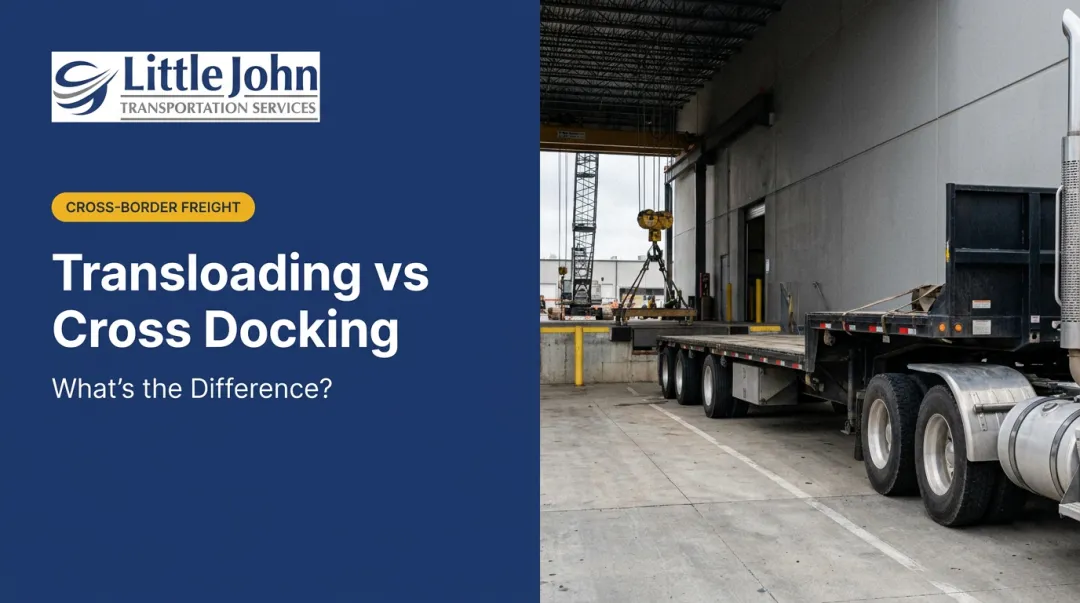
In practice, many facilities offer combinations. A transload hub near a port often handles cross-docking functions simultaneously. For specialized freight — particularly hazmat, overweight loads, or U.S.–México cross-border moves — the compliance requirements at the transfer point typically dictate which method applies, not just the mode.
When Is Transloading the Right Choice?
Not every shipment needs transloading — but when the conditions are right, it's often the only move that works. Here's when it makes operational sense.
Conditions That Make Transloading the Right Call
- Shipping high container volumes from international origins and needing to return ocean equipment fast
- Serving multiple dispersed delivery locations that no single direct route can reach efficiently
- Moving mixed cargo that benefits from consolidation before domestic distribution
- Operating in corridors with complex infrastructure — particularly U.S.–Mexico cross-border lanes
- Handling cargo that requires compliance transfers: hazmat, bonded goods, military freight, oversized loads
Industries That Rely on Transloading
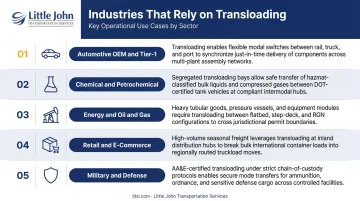
| Industry | Why Transloading Is Operationally Critical |
|---|---|
| Automotive OEM & Tier-1 | Cross-border regulatory differences make carrier transfers mandatory; JIT lines cannot absorb dwell time |
| Chemical & Petrochemical | Regulated cargo requires certified handlers and unbroken chain-of-custody at every transfer point |
| Energy & Oil and Gas | Oversized oilfield equipment needs specialized heavy-haul trailers on each side of the border; crane-assisted transfer is often required |
| Retail & E-Commerce | High-volume imports must be stripped near port and reloaded into domestic trailers for inland distribution |
| Military & Defense | AA&E and TPS-restricted cargo requires cleared personnel, secured facilities, and documented chain-of-custody |
Choosing the Right Transloading Partner
Look for:
- Strategic facility positioning near your key ports or border crossings
- Compliance credentials matched to your cargo type — not just basic operating authority
- Real-time tracking and audit-ready documentation from receipt through dispatch
- Demonstrated cross-border or multimodal experience, not just proximity to a corridor
Little John Transportation Services has moved complex freight across North America for 30+ years — hazmat, oversized, and cross-border cargo that most carriers won't touch. The 50-acre Laredo facility runs a 30-bay cross-dock, 1,200 trailer-space staging yard, and a custom-built 120-ton bridge crane. C-TPAT validated, FAST certified, and FMCSA HMSP credentialed (a designation held by fewer than 1% of U.S. carriers), with dedicated bilingual teams in Laredo, Monterrey, and Guadalajara.
Frequently Asked Questions
What is the meaning of transloading?
Transloading is the physical transfer of cargo from one mode of transportation to another at an intermediate facility during a shipment's journey from origin to final destination. Unlike intermodal shipping, where cargo stays in the same container across all modes, transloading involves actually unloading and reloading the goods.
What is the process of transloading?
Most transloading operations follow five stages:
- Cargo receipt and documentation review
- Unloading and sorting
- Optional value-added handling (palletization, repackaging)
- Loading onto outbound transport
- Dispatch with real-time tracking
Exact steps vary by cargo type, regulatory requirements, and facility capabilities.
How is transloading different from drayage and transshipment?
Drayage is short-distance truck movement, typically port to nearby facility, with no mode change involved. Transshipment is a legal and customs term for rerouting freight through an intermediate location. Transloading is the physical act of transferring cargo between different transport modes at an intermediate facility.
What types of cargo are best suited for transloading?
Consumer goods, automotive components, construction materials, bulk commodities, and specialized freight including hazardous materials and oversized loads are all suitable. Regulated cargo — hazmat, military, bonded goods — requires facilities and operators with the appropriate certifications and handling protocols.
When should a company use transloading instead of intermodal shipping?
Choose transloading when cargo needs to physically move between containers or modes — for consolidation, repackaging, compliance handling, or cross-border equipment transfers. Choose intermodal when freight can stay in the same container across all modes with minimal intermediate handling and no consolidation requirement.
What should I look for in a transloading partner?
Prioritize strategic facility locations near your key ports or border crossings, compliance credentials matched to your specific cargo type, real-time tracking and documentation capabilities, and proven experience with the specific modes, corridors, or regulatory frameworks your freight involves. For cross-border or regulated cargo, certifications like C-TPAT, FAST, and FMCSA HMSP are non-negotiable.