Introduction
U.S.–México cross-border freight isn't just complex — it's a different category of logistics entirely. Customs holds, documentation errors, shifting tariff rules, and border congestion create failure points that simply don't exist in domestic shipping.
According to the Bureau of Transportation Statistics, U.S.–México truck freight reached $642 billion in 2025, representing over 73% of all freight movement between the two countries.
With nearshoring investment in México growing and USMCA enforcement tightening, the bar for what "optimized" actually looks like has risen considerably.
Five practical tips follow — each one actionable now — to reduce border delays, control duty costs, and keep cross-border freight moving in 2026.
Key Takeaways
- Documentation completed before departure does more to prevent border holds than any other single action
- C-TPAT validated carriers unlock expedited clearance lanes and reduce inspection risk
- USMCA can cut duty costs significantly — but only with correct classification and airtight origin documentation
- End-to-end visibility, including bilingual communication, is essential for managing exceptions before they compound
- Having people at the crossing, not just at origin, determines how fast problems get resolved
Tip 1: Get Your Cross-Border Documentation Right Before the Truck Rolls
Documentation errors are the leading cause of avoidable border delays in U.S.–México freight. A single mistake on a commercial invoice, bill of lading, or certificate of origin can hold a shipment for days. Customs officials require total accuracy — there's no grace period for close enough.
The Core Document Set
Every U.S.–México cross-border shipment requires:
- Commercial invoice — must include accurate description, value, quantity, and buyer/seller details
- Bill of lading (BOL) — the freight contract between shipper and carrier
- Packing list — itemized cargo breakdown used for inspection
- Certificate of origin — required to claim USMCA preferential tariff rates
- Mexican pedimento — Mexico's customs entry document, without which cargo cannot legally clear
- CITES or hazmat declarations — required for regulated, controlled, or dangerous goods
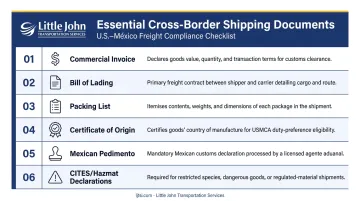
Any gap in this set creates grounds for a hold — which is exactly what pre-clearance is designed to prevent.
Pre-Clearance: Your Best Defense Against Dwell Time
Working with a licensed customs broker on both sides of the border to pre-file documentation before the truck arrives at the port of entry dramatically reduces dwell time. Pre-clearance lets customs officials review paperwork in advance, so when the truck arrives, clearance can often begin immediately rather than waiting in a queue.
For any shipper moving recurring cross-border freight, this should be standard operating procedure.
Two High-Risk Errors to Eliminate
Wrong HS (Harmonized System) tariff code classification ranks among the most common and costly documentation mistakes. Incorrect codes can trigger duty reassessments, audits, fines, or cargo seizure — all preventable with a proper review protocol.
Inaccurate country-of-origin statements carry equal risk. In 2026's elevated enforcement environment, CBP is scrutinizing origin claims more aggressively, particularly for goods in tariff-sensitive categories like automotive components, steel, and electronics.
Build a documentation checklist for every shipment type and require your carrier to provide audit-ready, chain-of-custody paperwork as a default — organized, accurate, and time-stamped before the truck ever leaves the yard.
Tip 2: Work with C-TPAT Validated and Compliance-Certified Carriers
What C-TPAT Actually Does for Your Shipment
C-TPAT (Customs-Trade Partnership Against Terrorism) is a U.S. Customs and Border Protection program that validates carriers, importers, and brokers as trusted trading partners. The core benefit is operational: C-TPAT partners saved $47.3 million in reduced cargo examinations in FY2024 and represent 52% of U.S. imports by value.
Validated shipments face fewer intensive inspections at busy crossings like Laredo — which means faster clearance and less unpredictable dwell time.
The FAST (Free and Secure Trade) program extends this further. Drivers enrolled in FAST can use dedicated expedited lanes at land border crossings, compressing transit time on critical lanes. Every link in the supply chain must be C-TPAT certified for FAST eligibility to apply.
Additional Certifications That Matter
For specialized or hazmat cross-border freight, look beyond C-TPAT and FAST:
- FMCSA HMSP — only 898 out of 787,189 active carriers held a Hazardous Materials Safety Permit in 2023; if your cargo is regulated, your carrier must have one
- ISO 9001:2015 — confirms audited quality management and documented process accountability
- TWIC certification — required for drivers accessing secure or defense-related facilities
- Hazmat endorsements — must be individually held by drivers, not just the carrier entity
Vetting Questions to Ask Every Cross-Border Carrier
Before you commit to a carrier for U.S.–México freight, ask:
- Are you C-TPAT validated?
- Do your drivers hold FAST enrollment?
- What is your FMCSA safety rating?
- Does your HMSP cover all nine hazmat classes?
- How do you document chain of custody across the border?
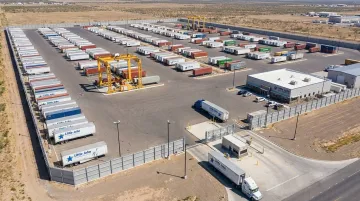
Few carriers check every box on that list. Little John Transportation Services holds C-TPAT validation, FAST certification, and an FMCSA HMSP covering all nine hazmat classes — a combination held by fewer than 1% of U.S. carriers. Their 50-acre Laredo facility is built to C-TPAT compliance standards, with restricted perimeter access, continuous surveillance, and 24/7 monitored entrances. For shippers moving regulated freight across the U.S.–México border, that credential stack matters at every crossing.
Tip 3: Leverage USMCA and Stay Ahead of 2026 Tariff Dynamics
How USMCA Works for Freight Shippers
Goods that meet USMCA rules of origin qualify for preferential tariff rates — often zero or significantly reduced. But those benefits don't apply automatically.
The certificate of origin must be completed correctly, and product classification must be accurate. If either element is wrong, standard MFN (most favored nation) rates apply, and the shipper absorbs the full duty cost.
For automotive-sector shippers specifically, this matters enormously: duties paid on vehicles imported from México rose from $517 million in 2019 to $8.9 billion in 2023, because USMCA compliance requirements tightened and not all importers kept pace.
The 2026 Tariff Environment
Several duty layers are now active on U.S.–México freight simultaneously:
- IEEPA duties — effective March 4, 2025, with USMCA exceptions applying from March 7 onward (duties paid between March 4–6 are not refundable)
- Section 232 duties — apply to autos and parts (effective May 3, 2025) and steel/aluminum, with no duty drawback available on these categories
- Section 301 proposed action — in June 2026, USTR proposed a 10% additional duty on México-origin goods related to forced labor import prohibition enforcement findings
Shippers in automotive, steel, chemical, and electronics categories need to know exactly which duty layers apply to their goods — and whether their certificates of origin are structured to claim available exceptions.
Understanding that exposure is the first step. The next is knowing which tools are available to reduce it.
Practical Duty Optimization Strategies
| Strategy | How It Works |
|---|---|
| Correct HS classification | Avoid overpaying by ensuring codes accurately reflect the goods |
| Duty drawback | Recover duties paid on goods that are subsequently re-exported (note: not available for Section 232) |
| Bonded warehousing | Defer duty payment until goods are formally entered for consumption |
| First-sale valuation | Declare the first transaction price in a multi-tier supply chain, reducing dutiable value |
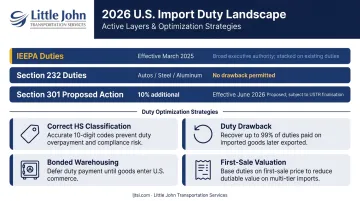
All of these require coordination between the shipper, customs broker, and carrier. In 2026's enforcement climate, misclassification triggers audits, retroactive assessments, and penalties — not just paperwork corrections.
Tip 4: Demand Real-Time Visibility Across Every Border Crossing
Why Cross-Border Visibility Is Different
A domestic shipment stays in one regulatory jurisdiction from pickup to delivery. A cross-border shipment doesn't. It changes hands between a U.S. carrier and a Mexican drayage operator (or vice versa), passes through customs on both sides, and can sit in a hold without clear timeline information.
These "black hole" moments — the gap between a truck departing the U.S. port of entry and confirmation that it's cleared on the Mexican side — cause missed production windows, inventory stockouts, and customer escalations. All of it preventable with the right visibility infrastructure.
What Genuine End-to-End Visibility Requires
Genuine cross-border visibility isn't a tracking number that goes dark at the border. It includes:
- A single unified interface showing shipment status on both sides
- Milestone updates at key checkpoints: origin pickup, port of entry arrival, customs release, delivery confirmation
- Exception alerts that trigger when a delay or hold occurs, before delays cascade
- Proof of delivery on both sides of the crossing
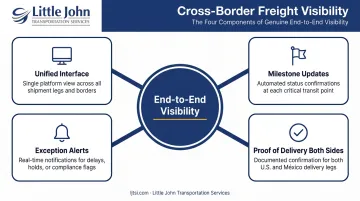
Visibility platforms that integrate via API or EDI with carrier telematics can provide this — but only when the carrier's Mexican-side operations run inside the same system. A platform is only as complete as the data feeding it.
The Bilingual Dispatch Advantage
When an exception surfaces at the crossing, resolution speed comes down to one thing: communication. A team fluent in both English and Spanish, available around the clock, can reach customs officials, Mexican brokers, and drayage operators without the lag of translation or time-zone gaps.
Little John Transportation Services maintains bilingual operations teams across Laredo, Monterrey, and Guadalajara, with 24/7 dispatch and GPS-level tracking on active cross-border loads. When a hold occurs, their team is already on the ground at the crossing — positioned there before the problem surfaces, not scrambling to catch up from a remote dispatch center.
Tip 5: Position Your Freight Resources at the Right Crossing Points
Not all U.S.–México ports of entry are equal. Laredo handles the largest share — $296 billion in truck freight value and nearly 39% of all truck crossings in 2025, according to BTS data. But Otay Mesa, El Paso/Ysleta, and Brownsville each serve distinct regional lanes, and defaulting to Laredo for every shipment isn't always the right call.
| Port | 2025 Truck Value | Avg Wait (min) |
|---|---|---|
| Laredo | $296B | Varies by bridge |
| Ysleta (El Paso area) | $112B | 56 |
| Otay Mesa | $60B | 55 |
| Calexico East | $20B | 39 |
| Brownsville | $19B | 47 |
Matching the port to your freight type, origin/destination, and carrier capability — rather than habit — can meaningfully reduce transit time and congestion exposure.
Why On-the-Ground Presence Matters More Than a Booking System
When a hold occurs at the bridge, a trailer needs repositioning, or a document needs correction before clearance, remote dispatch can't solve it. A team physically stationed at the crossing can. That gap between presence and absence is where shipments either recover quickly or sit.
Little John Transportation Services operates a 50-acre facility in Laredo built for exactly this kind of execution:
- 30-bay cross-dock and 1,200-trailer staging capacity
- 120-ton bridge crane for superload transloading
- In-house customs brokerage on both sides of the border
Teams in Monterrey and Guadalajara extend that operational coverage into interior México lanes. When complexity hits the border, physical positioning determines how fast freight moves — not how good the booking portal looks.
Frequently Asked Questions
How do you manage cross-border shipments effectively?
Effective cross-border shipment management comes down to three things: documentation pre-filed before departure, a carrier with validated customs credentials, and real-time visibility tools covering both sides of the border. A weak link in any one area will hold up the other two.
What documents are required for cross-border freight shipping between the U.S. and México?
The essential set includes the commercial invoice, bill of lading, packing list, certificate of origin (required for USMCA tariff claims), and the Mexican pedimento. Hazmat or regulated shipments require additional declarations — and missing any document at the border can result in a hold.
What is C-TPAT certification and why does it matter for cross-border shipping?
C-TPAT is a CBP trusted trader program that validates carriers as security-compliant, making their shipments eligible for expedited inspection lanes and fewer intensive examinations at high-volume crossings like Laredo. Little John Transportation Services is C-TPAT validated — a key reason cross-border freight moves efficiently through its Laredo facility.
What is the most common cause of delays at the U.S.–México border?
Incorrect or incomplete documentation — errors on commercial invoices, missing certificates of origin, or wrong HS tariff codes — is the leading cause of border holds. Working with a carrier or customs broker who reviews paperwork before the truck departs is the most effective prevention available.
How does USMCA affect cross-border freight costs in 2026?
Goods meeting USMCA rules of origin can qualify for reduced or zero tariff rates — but shippers must have correct product classification and complete certificate of origin documentation to claim those benefits. Without both, MFN rates apply automatically and the duty savings disappear.