Introduction
Expedited shipping costs rarely appear as a single budget problem. They show up as a series of individually justifiable decisions — a stockout here, a supplier delay there.
One day a logistics manager pulls the numbers and realizes the company has been consistently overspending on freight it didn't need to rush.
According to C.H. Robinson's freight budgeting analysis, shippers with under $24M in annual RFP spend average 87% unplanned freight cost overruns. That's not a rounding error — it's a structural problem. And the companies absorbing it most are those with the least margin to spare.
The cause isn't expedited shipping itself. Speed-premium services exist for a reason, and sometimes they're genuinely necessary. The problem is when expedited becomes a default rather than an exception — driven by poor planning, process gaps, and the wrong carrier relationships.
This article covers five strategies for reducing expedited freight costs: from fixing the planning gaps that create unnecessary urgency, to negotiating carrier relationships that don't penalize you every time timelines compress.
Key Takeaways
- Most avoidable expedited costs trace back to planning failures, not true supply chain emergencies
- Negotiate carrier rates before an emergency hits — not during one
- A monthly audit of expedited shipments by root cause reveals which costs are fixable internally
- Carrier reliability directly affects expedited spend — every re-ship effectively doubles your freight cost
- Strategic hub positioning often makes standard transit competitive with routes that previously required expedited rates
How Expedited Shipping Costs Typically Build Up
For most small businesses, expedited freight costs don't accumulate in one obvious place. There's no line item labeled "avoidable rush shipping." Instead, costs build through dozens of individually justified decisions — a late supplier, a miscounted SKU, a customer escalation — each one treated as a one-off rather than a pattern worth fixing.
Three patterns typically drive this accumulation:
- Episodic triggers — Stockouts, supplier delays, forecasting misses, and customer complaints generate urgency. Each event feels isolated, so businesses rarely connect them to a systematic cost problem.
- Invisible spend — Without shipment-level tracking, expedited freight registers as periodic emergency cost, not a budget line worth managing. DAT notes that standard transportation platforms generally don't monetize routing-guide leakage — meaning most businesses lack visibility into what reactive shipping is actually costing them.
- Self-reinforcing habits — Once expedited shipping becomes the standard response to supply chain stress, teams stop questioning it. The cost compounds because no one is actively tracking it against alternatives.
The practical fix starts with measurement. Businesses that track expedited shipments at the per-event level and categorize each by root cause consistently find that 30–40% of that spend ties back to a handful of recurring, fixable triggers — not unavoidable emergencies.
Cost-Reduction Strategies for Expedited Shipping
Reducing expedited shipping costs requires identifying where that cost originates: whether it's a planning gap, a process failure, a carrier reliability problem, or a geographic mismatch. The five strategies below address each root cause directly.
Strategies That Change Decisions Before a Shipment Is Booked
The highest-leverage interventions happen before freight is ever tendered. Two upstream decisions drive the majority of avoidable expedited costs.
Strategy 1: Improve Demand Forecasting to Reduce Reactive Rush Orders
Most avoidable expedited shipments are triggered by stockouts or late replenishment , both symptoms of poor demand visibility. When a business doesn't know what it needs until it needs it immediately, expedited freight becomes the only option.
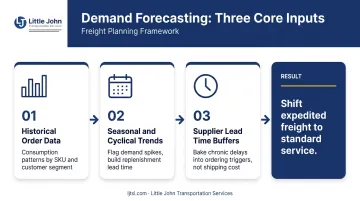
The fix doesn't require sophisticated software. A basic forecasting routine built on three inputs eliminates most reactive urgency:
- Historical order data — Identify your actual consumption patterns by SKU and customer segment
- Seasonal and cyclical trends — Flag periods where demand reliably spikes and build replenishment lead time accordingly
- Supplier lead time buffers — If a supplier consistently delivers late, build that into your ordering trigger, not your shipping cost
McKinsey projects that improved demand forecasting in industrial environments can reduce freight costs by 3% to 5% through reduced expedited shipping alone. For small businesses where margins are thin, that's a meaningful recovery and it doesn't require AI to achieve at the basic level.
The goal isn't perfect forecasting. It's narrowing the gap between when you know you need something and when it absolutely must arrive. Even a 48-hour improvement in replenishment triggers can shift a significant portion of expedited freight to standard service.
Strategy 2: Pre-Negotiate Expedited Rates Before You're in Crisis Mode
When a business books expedited freight in an emergency, it has no negotiating leverage. The carrier offers a rate, the business accepts it — typically at the worst price available that day.
The alternative is to establish rate agreements during low-pressure periods, before urgency exists. Carriers negotiate based on volume, consistency, and relationship, not on how badly you need a truck today.
Building those agreements ahead of time is straightforward:
- Identify 2-3 carriers you'd use for expedited freight across your primary lanes
- Present projected usage data — even modest volume commitments open conversations
- Negotiate service level agreements that specify response times, equipment types, and pricing tiers
- Establish account relationships so dispatchers know your freight before an emergency call
The spot market and contract rate comparison from DAT illustrates why timing matters: spot linehaul rates rose 23.3% from March 2025 to February 2026, compared to just 5% for contract rates. Businesses locked into pre-negotiated agreements absorbed a fraction of that volatility. Businesses buying spot during the same period paid nearly five times the rate increase.
For small businesses, the volume threshold is lower than most assume. Demonstrating consistent shipping patterns (even at modest levels) gives carriers enough predictability to offer preferential pricing.
Strategies That Change How Expedited Shipping Is Managed
Even when expedited shipping is genuinely necessary, it can be managed more precisely. Two practices reduce cost without reducing service.
Strategy 3: Audit Expedited Usage to Separate Genuine Urgency from Process Failure
Not every expedited shipment reflects a real supply chain emergency. Many reflect internal failures: a pick error that wasn't caught until shipping, an approval that sat in someone's inbox for two days, a miscommunication between teams that added 48 hours to a standard order cycle.
These are fixable. But only if you're tracking them.
A monthly audit of expedited shipments takes roughly an hour and produces a cost-reduction roadmap:
| Root Cause Category | Example | Fix |
|---|---|---|
| True customer emergency | Production line down, contract penalty | Accept cost — this is what expedited is for |
| Inventory stockout | Reorder point set too low | Forecasting improvement |
| Internal process failure | Late approval, pick error | Process correction |
| Carrier failure | Previous carrier lost or delayed shipment | Carrier relationship change |
| Supplier delay | Parts arrived late from vendor | Supplier agreement update |
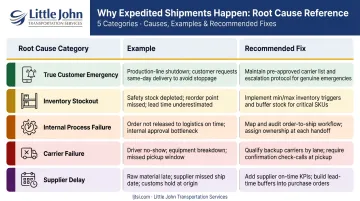
AIAG reports that automotive suppliers implementing structured materials management standards achieved up to 85% reductions in premium-freight costs by systematically identifying and eliminating the internal process failures driving expedited spend. Categorize the shipments, identify the patterns, fix the upstream cause.
Most small businesses discover that 30–50% of their expedited freight traces back to internal breakdowns rather than genuine emergencies. Those shipments are recoverable without any sacrifice in customer service.
Strategy 4: Work With Carriers That Have High Reliability to Prevent Costly Re-Ships
A shipment that arrives damaged, delayed, or goes missing doesn't just create a customer service problem : it creates a second freight cost. The replacement shipment almost always moves expedited because the original delivery window has already been missed.
It's a cost driver that rarely appears in freight spend analyses. Every carrier reliability failure that triggers a re-ship effectively doubles the freight cost for that order.
Four criteria to evaluate when vetting carriers on reliability:
- Verifiable on-time delivery rates — ask for documented performance, not marketing claims
- Damage claim history — low rates indicate proper handling; high rates indicate systemic problems
- Real-time tracking visibility — proactive updates prevent the reactive expedited orders that come from not knowing where a shipment is
- 24/7 dispatch access — issues that surface at 2 AM need a human on the line, not an automated alert
Carriers like Little John Transportation Services maintain a 99.9% claim-free delivery rate on heavy-haul freight with 24/7 bilingual dispatch, and are specifically built around eliminating the re-ship scenario. When a carrier monitors every leg of transit with real dispatchers who own the outcome, the conditions that generate replacement shipments rarely materialize.
For businesses shipping specialized or cross-border freight, this reliability dimension is doubly important. A delayed shipment at the U.S.–Mexico border that triggers an expedited replacement doesn't just cost more freight spend : it can cost production downtime.
Strategy That Changes the Context Around Expedited Shipping
Sometimes the root cause of expedited dependency isn't planning or process : it's geography. A business shipping from a single origin point to customers spread across multiple distant regions will consistently face long standard transit times, making expedited feel like the only viable option for time-sensitive freight.
Strategy 5: Use Carrier Networks With Strategic Hub Positioning to Shrink Effective Transit Zones
The fix here isn't paying more for speed. It's reducing the distance (and thus the time) that freight must travel on standard service.
When a carrier's operational infrastructure is distributed across key logistics hubs rather than concentrated at a single origin, standard transit timelines compress structurally. A shipment that previously required expedited service to reach a customer in three days may now move standard in two, simply because the freight originates from a closer hub.
For businesses shipping specialized or industrial freight across multiple U.S. regions or into Mexico, this geography matters significantly. Little John Transportation Services operates hubs in Memphis, Houston, Laredo, Charlotte, and Reno , plus locations in Monterrey, Guadalajara, and Mexico City, covering the major freight corridors across North America.
What this network achieves in practice:
- Mid-South shippers (TN, MS, AR, MO) access Memphis-based capacity without routing through distant coastal hubs
- Gulf Coast energy freight moves through Houston directly, eliminating long-haul routing for hazmat and industrial loads
- Southeast manufacturers use the Charlotte office for regional coverage that reduces effective shipping zones
- Western U.S. shippers (HVAC, building materials) benefit from Reno's position between Pacific Coast and Mountain West lanes
- U.S.–Mexico cross-border freight flows through Laredo's 50-acre CTPAT-validated facility, compressing what would otherwise be a multi-vendor, multi-zone process into a single managed corridor
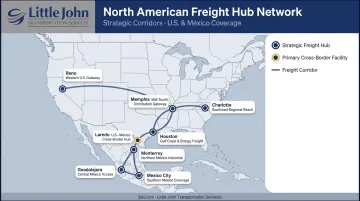
McKinsey identifies potential logistics cost reductions of 10%–15% from distribution network optimization and 10%–20% from analytics-based route optimization. For businesses without their own distribution footprint, working with a geographically distributed freight carrier achieves a comparable structural benefit without requiring capital investment.
Conclusion
Reducing expedited shipping costs isn't about eliminating speed options — it's about not paying for speed you don't need.
The businesses that manage this best tend to share the same habits: they track expedited spend by root cause rather than treating it as a fixed cost, they negotiate carrier relationships during calm periods instead of crises, and they build operational buffers that shift freight from reactive to planned. Each of those habits, applied consistently, removes unnecessary premium from your logistics budget.
When speed genuinely is required, having the right carrier relationships already in place — pre-negotiated rates, real-time visibility, reliable delivery records — means you pay the right price for expedited service, not the worst available price at the worst possible moment.
Frequently Asked Questions
Which location strategy is best for minimizing shipping cost?
Working with carriers whose hubs are distributed across key customer regions reduces the number of shipping zones freight must cross, which lowers both transit times and costs on standard service. For businesses without their own distribution footprint, partnering with a geographically distributed freight carrier achieves the same structural benefit without capital investment.
How do you optimize shipping costs?
Shipping cost optimization combines upstream planning (demand forecasting, rate negotiation) with ongoing practices like usage audits, carrier performance tracking, and zone reduction. The highest-impact lever depends on your freight type and where spend is leaking — a root-cause audit identifies that fastest.
What is the most cost-efficient shipping method?
It depends on freight type, distance, and timeline. Ground shipping and regional carrier networks offer the best per-mile value for non-urgent freight, while consolidated options reduce costs for heavier shipments. Expedited methods are cost-efficient only when they prevent a greater downstream cost — like a production stoppage or a contract penalty.
What triggers the need for expedited shipping in small businesses?
The most common triggers are inventory stockouts from inaccurate forecasting, supplier delays, internal fulfillment errors, and carrier-caused delays requiring a replacement shipment. Most of these are addressable through operational improvements — meaning the cost is avoidable, not inevitable.
Can you negotiate expedited shipping rates with carriers?
Yes. Carriers negotiate expedited rates for businesses that demonstrate volume or growth potential, and the best terms are secured before an emergency — not during one. Even shippers with modest volume can access preferential rates by presenting projected usage data and committing to a preferred carrier relationship.
How does carrier reliability affect expedited shipping costs?
An unreliable carrier that delivers late or damaged forces businesses into reactive re-ships, effectively paying twice for the same delivery. Carriers with verifiable on-time rates, low damage claims, and real-time tracking visibility eliminate that hidden cost multiplier entirely.