Most logistics managers would say cross docking. The correct answer is transloading — and the distinction matters more than most shippers realize.
Both methods move freight efficiently without relying on traditional warehousing. But they operate at different points in the supply chain, handle different freight types, and carry different compliance requirements. Choosing the wrong one doesn't just slow things down; it can create regulatory gaps, add unnecessary cost, or break a just-in-time production schedule.
This article covers clear definitions, a side-by-side comparison, real-world use cases, and a practical framework for choosing the right method — especially for shippers managing cross-border, intermodal, or multi-modal freight.
Key Takeaways
- Transloading transfers freight between transportation modes (ocean to truck, rail to truck), including physically unloading, sorting, and re-palletizing cargo
- Cross docking moves pre-palletized freight directly from inbound to outbound vehicles with no unpacking and no long-term storage
- Transloading suits international, cross-border, and intermodal shipments; cross docking suits fast-moving, time-sensitive, and perishable goods
- Both reduce warehousing costs, but they serve different freight types and route structures
- Complex supply chains often use both: transloading at the port or border, cross docking at the domestic distribution hub
Transloading vs Cross Docking: Quick Comparison
The two methods share some surface-level similarities — freight moves in, freight moves out — but they serve different freight types, timelines, and supply chain needs. Here's how they compare at a glance:
| Dimension | Transloading | Cross Docking |
|---|---|---|
| Transport modes | Multi-modal (rail to truck, ocean to truck) | Single mode (truck to truck) |
| Storage | Short-term staging possible | Minimal to none |
| Freight handling | Unloaded, sorted, re-palletized or repackaged | Pallets transferred intact |
| Turnaround | Longer; involves processing steps | Same-day or near-immediate |
| Best for | International, cross-border, intermodal freight | Time-sensitive, perishable, consolidated domestic freight |
| Coordination | Multiple parties, customs, compliance layers | Tight real-time sync between inbound/outbound dock teams |
What Is Transloading?
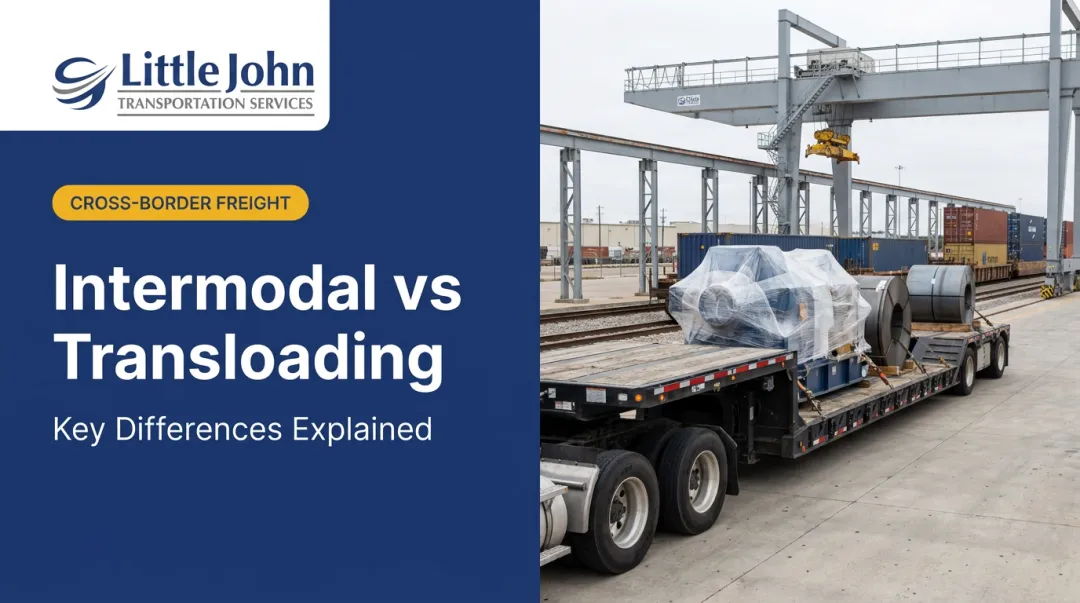
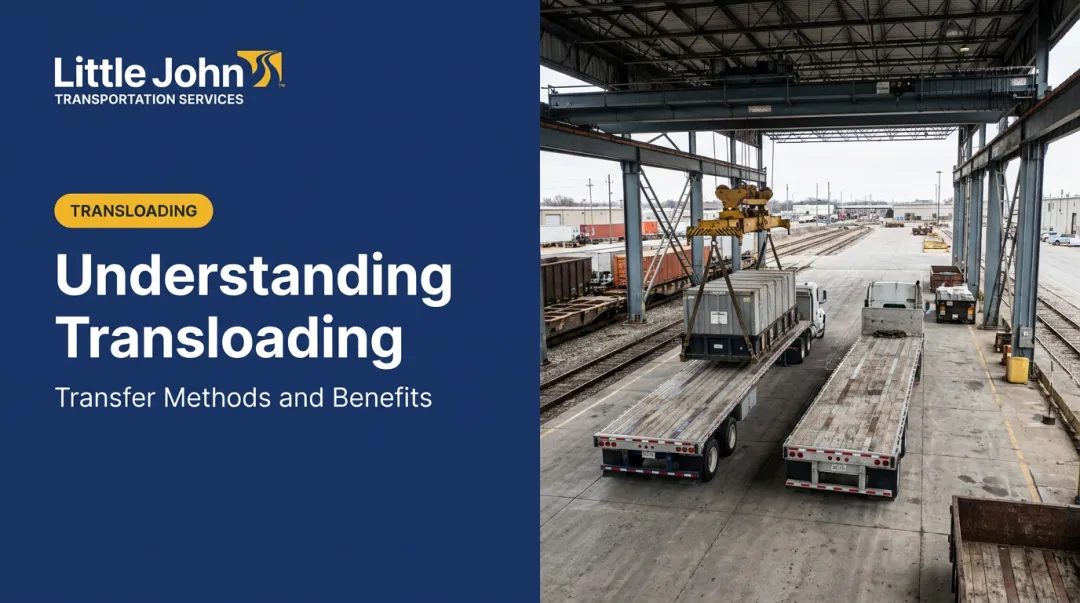
Union Pacific defines transloading as unloading products from one transportation mode and reloading them onto another — for example, from a railcar into a truck, or from an ocean container into a domestic 53-foot trailer. Unlike intermodal freight (where the container stays intact across modes), transloading physically unpacks and reloads the cargo.
How the Process Works
A typical transloading sequence looks like this:
- Cargo arrives — usually in an ocean container, rail car, or Mexican-registered trailer
- Unloaded at a specialized facility — near a port, railyard, or border crossing
- Sorted and re-palletized — cargo is organized, shrink-wrapped, or repackaged as needed
- Staged or stored briefly — until outbound transportation is ready
- Loaded onto outbound equipment — truck, rail, barge, or air for the next leg
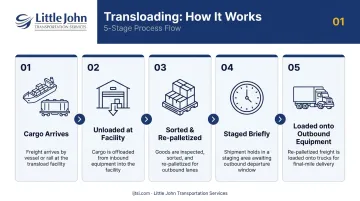
The key distinction: the cargo itself changes containers or pallets. That's what separates transloading from both intermodal (same container, different mode) and cross docking (same pallet, different truck).
Why Shippers Use Transloading
- Captures rail's lower cost-per-mile for bulk freight, even for shippers without rail-served facilities
- Extends delivery reach into areas only accessible by truck
- Satisfies the legal carrier handoff required for Mexican carriers under 49 CFR Part 368, which restricts commercial-zone operators from moving beyond U.S. border municipalities
- Allows international freight to clear U.S. customs at the port or border facility before moving inland
Transloading Use Cases
Common applications across industries:
- Vehicle parts from Mexico are transloaded onto U.S.-authorized trucks for JIT delivery to assembly plants — Port Laredo handled $64.4 billion in vehicle parts imports in 2024 alone
- Steel, lumber, plastics, and machinery move through transload facilities regularly; oversized equipment that can't move by rail transfers to flatbed or step-deck trucks at rail terminals
- Major retailers including Walmart, Target, and Nike have used Southern California import transloading to transfer ocean containers into domestic 53-foot equipment, according to FreightWaves
For cross-border operations, Little John Transportation Services runs a dedicated transloading facility at its 50-acre CTPAT-validated campus in Laredo, TX. The site includes a 30-bay cross-dock, 1,200 trailer-space staging capacity, and a custom-built 120-ton bridge crane that completes superload transfers in under two hours — built for heavy-haul and oversized cargo that standard transloading equipment can't handle.
The operation also covers the compliance layer: 250+ Mexican interchange agreements and in-house customs brokerage on both sides of the border, making cross-border transloading workable for automotive, hazmat, and industrial freight.
What Is Cross Docking?
The CSCMP defines cross docking as a distribution system where items received at a facility are not put into storage but are immediately prepared for shipment to another location. Freight moves from inbound dock to outbound dock, often within hours, without being unpacked or re-palletized.
How a Cross Dock Facility Works
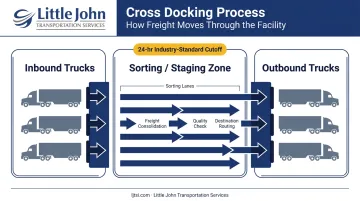
The physical layout reflects the process:
- Inbound trucks arrive on one side of the facility
- Freight is unloaded into a staging area (a temporary holding zone, not a warehouse)
- Sorted or consolidated by destination or route
- Loaded onto outbound trucks on the opposite side
The defining constraint: inbound and outbound vehicles need to be available at roughly the same time. This requires precise coordination. If outbound trucks aren't ready, the "no storage" model breaks down. The industry-standard cutoff is 24 hours — freight held longer than that typically no longer qualifies as cross docking.
Why Shippers Use Cross Docking
- Faster delivery — same-day or next-day turnaround on freight that would otherwise sit in a warehouse
- Lower inventory holding costs — no warehouse rent, labor, or utilities
- Less handling — pallets move intact, reducing damage and theft risk
- LTL consolidation — multiple partial loads combine into full truckloads for outbound efficiency
These benefits have driven broad adoption. A survey of more than 200 logistics decision-makers found 68.5% used cross docking, up from 52% just three years prior — with improved service levels and reduced transportation costs as the top drivers. That baseline reflects how firmly cross docking had embedded itself in mainstream supply chain practice well before the current era of demand volatility.
Cross Docking Use Cases
Cross docking dominates in sectors where speed and freshness matter:
- Retail — Walmart's supply chain model, documented in HBR case research, uses cross docking to eliminate warehouse storage time between suppliers and store shelves
- Grocery and perishables — temperature-sensitive goods routed through cross dock hubs to cut transit time
- Healthcare — UPS operates 27 temperature-controlled cross-dock facilities worldwide for pharmaceutical distribution
- Automotive/JIT — Toyota uses cross docking as part of lean, high-frequency inventory flows
Cross docking works best when cargo is already palletized, moving at high volume, and destined for multiple nearby locations from a central hub. Change any one of those conditions and the model typically requires adjustment.
Transloading vs Cross Docking: Which Should You Choose?
The decision comes down to four variables: the transportation modes involved, whether freight is already palletized, delivery urgency, and whether customs or border compliance applies.
Choose Transloading When:
- Freight arrives by ocean, rail, or from a cross-border carrier and must transfer to domestic truck
- Goods come from international or cross-border origins — especially the U.S.–Mexico corridor
- Cargo needs to be unpacked, sorted, or consolidated before the next delivery leg
- Temporary staging between transport legs is expected
- The shipment involves oversized or overweight loads requiring specialized equipment at the point of transfer
Choose Cross Docking When:
- Freight is already palletized and simply needs to be redirected or consolidated
- Speed is the priority — same-day or next-day delivery is required
- Perishable, temperature-sensitive, or time-critical goods are involved
- The goal is to reduce warehouse costs by eliminating storage entirely
- Inbound and outbound carriers can be coordinated at the same facility simultaneously
When Both Apply
In complex supply chains — particularly for international imports — transloading and cross docking often work sequentially on the same shipment. A practical example:
- Ocean container arrives at a West Coast port → transloaded into domestic 53-foot trailers
- Domestic trailers deliver to a regional distribution hub → cross docked to consolidate outbound loads by store or zone
- Full truckloads dispatched to final destinations
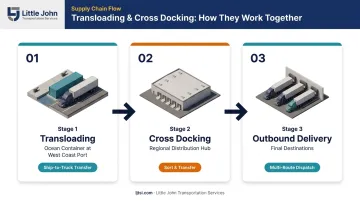
The same pattern applies to cross-border freight. U.S.-Mexico freight totaled $872.8 billion in 2025, with trucks carrying 73.6% of that value. For much of that volume — especially where Mexican carriers hold only commercial-zone authority — transloading at a border hub like Laredo is the first step. Cross docking at a domestic distribution center may follow.
For shippers managing these multi-leg routes: evaluate each leg independently. Don't apply one method to the entire journey.
If cross-border compliance, hazmat requirements, or heavy-haul cargo are in the picture, the carrier you choose needs to handle both methods — and the regulatory layer in between. Little John Transportation Services runs a 50-acre CTPAT-validated facility in Laredo, holds FMCSA HMSP authorization (fewer than 1% of U.S. carriers qualify), and maintains bilingual teams on both sides of the border — positioned specifically for freight that requires both transloading and cross docking across the same route.
Frequently Asked Questions
Is cross docking a good idea?
Cross docking works well for businesses with high-volume, fast-moving, or perishable goods that are already palletized and don't require storage. It reduces warehousing costs and speeds up delivery, but demands tight coordination between inbound and outbound carriers — if timing slips, the model breaks down quickly.
What is the difference between transship and transload?
Transshipping refers to transferring goods between vessels or transport modes at an intermediate hub without changing their form — U.S. Customs uses the term in an international customs context. Transloading involves physically unloading, re-palletizing, or repackaging cargo before moving it onto a different mode, which requires more hands-on processing at the facility.
What does transloading mean in shipping?
Transloading means moving freight from one transportation mode to another at a specialized facility — for example, from an ocean container to a domestic truck. The process typically includes unpacking, sorting, re-palletizing, and brief staging before the next delivery leg.
Can transloading and cross docking be used together in the same shipment?
Yes. International goods are commonly transloaded from an ocean container to a truck at a port, then cross docked at a regional distribution hub to consolidate and redirect final deliveries. Both methods can apply at different points along the same supply chain journey.
Which method is better for cross-border freight between the U.S. and Mexico?
Transloading is the standard method for U.S.–Mexico cross-border freight. Goods moving through ports of entry like Laredo often need to transfer from Mexican carriers to U.S.-authorized trucks — a process that requires customs compliance, C-TPAT protocols, and in some cases FMCSA or HMSP requirements for hazardous materials.
Does cross docking require a warehouse?
Cross docking does not require traditional warehouse storage. Facilities use staging areas designed for rapid sorting and transfer, typically moving freight through in hours to 24 hours. The goal is to eliminate holding time entirely — that's the core distinction from conventional warehousing.