Full Truckload (FTL) shipping is the right answer more often than many shippers realize — but only when matched to the right freight, route, and carrier. This guide covers what FTL is, when it beats LTL on cost and reliability, how capacity and pricing work, and what separates a qualified specialized carrier from a general hauler who technically owns trucks.
Key Takeaways
- FTL means one shipper, one trailer, direct from origin to destination — no shared space, no terminal transfers
- Shipments of 10+ pallets, fragile cargo, or time-sensitive deliveries nearly always favor FTL over LTL
- A 2024 Drive Research study found 1.94% of LTL shipments generated a damage or loss claim in 2023, averaging $3,777 per claim
- FTL rates are quoted per mile, not per pallet — the economics shift significantly at higher volumes
- Hazmat, heavy-haul, and cross-border FTL require carrier certifications most general carriers don't hold
What Is FTL in Trucking?
Full Truckload (FTL) means reserving an entire tractor-trailer for a single shipper's freight, from one pickup point to one destination. The shipper pays for the whole truck — regardless of whether every cubic foot is used. Exclusive use defines the mode, not a requirement to fill it.
That's the key distinction from LTL (Less-than-Truckload), where multiple shippers' freight is consolidated into one trailer. LTL shipments move through carrier terminals, get transferred between trucks, and touch multiple loading docks before reaching their destination. FTL doesn't.
Most shippers picture a standard 53-foot enclosed trailer when they hear "FTL." That's one configuration. According to FreightWaves, the equipment category runs considerably wider than that:
- Dry van — standard enclosed trailer for general freight
- Flatbed — open deck for oversized, irregularly shaped, or top-loaded cargo
- Refrigerated (reefer) — temperature-controlled for food, pharma, or chemicals
- Step-deck and lowboy — lowered deck height for tall equipment that won't clear overpasses
- Tanker — bulk liquids, gases, and hazardous materials
- Removable Gooseneck (RGN) and multi-axle — heavy equipment that drives on or requires distributed weight
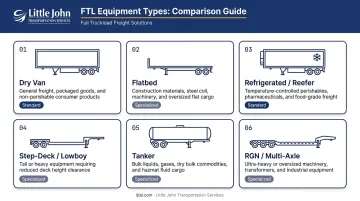
Equipment type directly shapes both rate and availability. Dry van capacity is deep and widely available; RGN and lowboy capacity is far tighter — specialized trailers represent a fraction of the national fleet, which means sourcing them requires a different kind of carrier relationship than booking a standard van.
Key Benefits of Full Truckload Freight
Faster and More Predictable Transit Times
FTL trucks go directly from origin to destination. No consolidation stops, no terminal transfers, no waiting for a partial load to fill before departure. That directness translates to transit times that are both faster and easier to guarantee than LTL.
For operations that depend on freight arriving at a specific time — manufacturing lines, retail resets, construction project schedules — a locked-in delivery window is worth real money. LTL transit estimates come with meaningful variance. FTL pickup and delivery windows don't.
Lower Freight Damage Risk
FTL cargo is loaded once at origin, the trailer is sealed, and it arrives without intermediate handling. That matters because every handling event is a damage opportunity.
The data supports this. A 2024 shipper survey conducted by Drive Research found 1.94% of LTL shipments generated a damage or loss claim in 2023, with an average claim cost of $3,777. For heavy, fragile, or irregularly shaped freight, that risk compounds with every transfer.
Greater Visibility and Control
FTL visibility is structurally simpler than LTL because the freight doesn't change hands — one trailer, one bill of lading, one carrier contact, one tracking source. That reduced complexity also means reduced exposure to damage, delays, and lost documentation.
FTL also lets shippers specify:
- Loading and unloading sequences
- Environmental conditions (temperature, humidity)
- Special handling procedures
- Seal and chain-of-custody requirements
None of those controls are available when your pallet is sharing space with 12 other shippers' freight.
Cost Efficiency at Scale
FTL's flat per-truck rate only looks expensive before you compare it to LTL at volume. LTL charges per pallet, stacks on freight classification adjustments, and adds accessorial fees that can average $419 per shipment according to the same 2024 Drive Research study.
For shipments filling roughly half a trailer or more, FTL comes out cheaper on a total cost basis — not just per unit. Shippers with consistent lanes and predictable volumes can also negotiate contract rates, which compounds savings across consistent lanes.
FTL vs. LTL: Choosing the Right Mode
The FTL vs. LTL decision comes down to four variables: shipment volume, delivery urgency, freight sensitivity, and total landed cost. No single factor alone should drive it.
| Factor | FTL | LTL |
|---|---|---|
| Cost structure | Per-mile rate, flat per truck | Per-pallet/cwt + accessorials |
| Transit time | Direct, predictable windows | Estimated, multi-stop variability |
| Handling risk | Load once, sealed trailer | Multiple terminal transfers |
| Tracking ease | One trailer, one source | Multiple handoffs, less visibility |
| Ideal shipment size | 10+ pallets, 10,000+ lbs | 1–6 pallets, under 12 linear feet |
| Delivery predictability | High — firm windows standard | Moderate — estimates with variance |
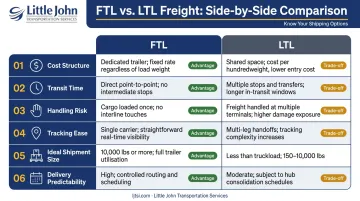
Those factors translate directly into which mode fits your load. Here's where each one wins.
When FTL Wins
- Shipments of 10+ pallets or over 10,000 lbs
- Time-sensitive or guaranteed-delivery loads
- Fragile, high-value, or temperature-sensitive freight
- Hazardous materials
- Any load requiring special equipment or handling
When LTL Makes Sense
LTL fits a specific profile:
- 1–6 pallets with flexible delivery timelines
- Lower value-to-weight ratios where handling risk is acceptable
- Non-urgent freight moving through established carrier lanes
The 6-to-10-pallet range is a gray zone. Price out both options before committing — it takes 20 minutes and can shift the math.
Partial and Shared Truckload Options
Partial Truckload (PTL) and Shared Truckload (STL) sit between FTL and LTL. Both reduce handling events compared to traditional LTL while costing less than a dedicated truck. Coverage skews regional and availability is tighter — but for shippers consistently moving 6–10 pallets, they're worth keeping in the mix alongside standard LTL quotes.
FTL Capacity, Weight Limits, and Equipment
Standard Dry Van Specs
Key specs for a standard 53-foot dry van, per FHWA federal regulations:
| Specification | Limit |
|---|---|
| Federal gross vehicle weight (Interstate) | 80,000 lbs |
| Single-axle weight limit | 20,000 lbs |
| Tandem-axle weight limit | 34,000 lbs |
| Usable cargo payload (after tractor, trailer, fuel, driver) | ~44,000–45,000 lbs |
| Standard pallet capacity (48″ × 40″, straight-loaded) | ~26 pallets (up to 30 turned) |
All weights are subject to the Bridge Formula. Pallet count varies based on dimensions, stacking height, and load distribution.
How FTL Rates Are Structured
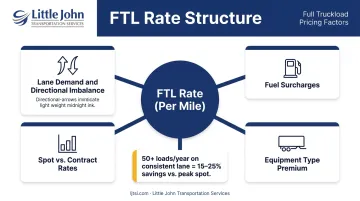
FTL pricing works on a per-mile basis from origin to destination — not by pallet count or freight class. Key rate influences include:
- Lane demand and directional imbalance (trucks returning empty from low-volume markets cost more)
- Fuel surcharges, tracked separately from linehaul rates by carriers like DAT
- Spot market vs. contract rates — the gap between these widens significantly during peak produce season, Q4 retail surges, or regional capacity crunches
- Equipment type — reefer and flatbed typically carry rate premiums over dry van
Shippers running 50+ loads per year on a consistent lane can often lock in contract rates 15–25% below peak spot pricing — making volume commitment a meaningful cost lever, not just a convenience.
Specialized FTL: Hazmat, Heavy-Haul, and Cross-Border
Standard FTL capabilities don't extend to freight that falls under hazardous materials regulations, oversize/overweight permits, or cross-border customs requirements. These loads require specific certifications, infrastructure, and compliance programs that most general carriers don't have.
Hazmat FTL
Hazmat FTL operates under a separate regulatory framework. Under FMCSA's Hazardous Materials Safety Permit (HMSP) program, carriers transporting specified quantities of certain explosives, toxic-by-inhalation materials, and highway-route-controlled radioactive materials must hold an active HMSP. Eligibility requirements include:
- Satisfactory FMCSA safety rating
- Crash and out-of-service performance outside the disqualifying top 30% of national averages
- CDL hazmat endorsement for every driver on a placarded vehicle (requires a knowledge test and TSA security threat assessment)
Little John Transportation Services holds an FMCSA HMSP — a certification held by fewer than 1% of U.S. carriers — along with 100% hazmat-endorsed BCOs across their owner-operator network. That covers all 9 DOT hazmat classes, including AA&E (Arms, Ammunition & Explosives), with audit-ready chain-of-custody documentation on every load.
Heavy-Haul FTL
Heavy-haul means cargo that exceeds federal or state weight and dimension limits. The federal width limit on the National Network is 102 inches; anything beyond standard federal thresholds requires state-issued permits, and rules vary by state — there is no single national permit.
Common equipment for heavy-haul FTL includes step-decks, lowboys, RGNs, and multi-axle configurations, selected based on cargo height, weight, and whether equipment drives on or must be craned. Industries regularly shipping heavy-haul FTL include construction, oil and gas, wind energy, and industrial machinery.
Little John operates over 7,000 specialized trailers for heavy-haul freight — step-decks, lowboys, RGNs, and multi-axle configurations — serving construction, energy, and industrial machinery shippers across North America.
Cross-Border FTL (U.S.–Mexico)
BTS reports that truck freight between the U.S. and Mexico reached $642 billion in 2025, with Laredo, TX handling nearly $296 billion of that volume as the busiest U.S.–Mexico truck port.
Cross-border FTL requires more than a truck with FMCSA authority. Carriers need:
- CTPAT validation through CBP's supply chain security program, which enables fewer inspections and FAST lane access
- ACE e-Manifest filing submitted no later than 1 hour before arrival (30 minutes for FAST shipments)
- In-house customs brokerage on both sides of the border
- Bilingual dispatch with personnel physically present at key crossing hubs
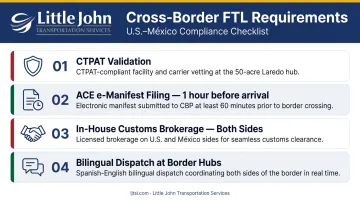
Little John's Laredo facility handles this with 250+ Mexican interchange agreements, FAST certification, in-house U.S. and Mexican customs brokerage, and bilingual teams in Laredo, Monterrey, and Guadalajara. The facility also operates a 120-ton bridge crane capable of completing superload transloads in under two hours — a critical asset when project cargo can't sit at the port. Delays at ports of entry compound fast — having people on both sides of the bridge is what prevents a one-hour customs hold from becoming a 12-hour detention charge.
How to Choose a Qualified FTL Carrier
Carrier selection for standard FTL involves verifiable, public criteria. For specialized freight, the bar is higher.
What to Check for Any FTL Carrier
- Search the FMCSA SAFER Company Snapshot by USDOT number for safety ratings, out-of-service rates, roadside inspection summaries, and crash history
- Verify relevant certifications: HMSP for hazmat, CTPAT for cross-border, TWIC for port freight, ISO 9001 for documented quality management
- Request documented on-time delivery and damage claim rates — figures, not marketing language
- Confirm equipment availability and condition — what they can reliably deploy, not just what they own on paper
What to Check for Specialized Freight
The standard checklist above gets you a baseline. For specialized freight, equipment count matters less than network depth. A vetted carrier network with ongoing compliance verification across 65,000+ approved carriers (not just a static approved list) means lane coverage holds even when a single truck becomes unavailable.
Little John Transportation Services has spent 30+ years moving the specialized freight most carriers decline, with dedicated account managers, 24/7 bilingual dispatch, and nightly carrier vetting against legal, insurance, and performance standards. Their 99.9% claim-free delivery rate and DOT crash frequency near half the national average are both publicly verifiable through FMCSA records.
For complex or regulated freight, you need a dedicated human contact who understands your load, not an automated quoting portal. That distinction becomes critical when a border crossing issue surfaces at 2 a.m. or an oversize permit route changes mid-transit.
Frequently Asked Questions
What does FTL mean in trucking?
FTL stands for Full Truckload. A shipper books the entire capacity of a tractor-trailer for a single shipment from one origin to one destination, with no shared space or intermediate stops. The shipper pays for the whole truck regardless of how much of the trailer is used.
Which is cheaper, LTL or FTL?
LTL is typically cheaper for small loads of 1–6 pallets. FTL becomes cost-competitive — often cheaper per unit — for larger shipments above half a truckloadonce you account for LTL's accessorial fees, freight classification adjustments, and longer transit times.
How many pallets can an FTL truck carry?
A standard 53-foot dry van trailer holds approximately 26 standard (48″ × 40″) pallets loaded straight, or up to 30 when pallets are turned. Actual capacity varies based on pallet dimensions, stacking height, and weight limits.
What is the weight limit for FTL shipping?
Federal regulations cap total gross vehicle weight at 80,000 lbs on the Interstate System, which typically allows a cargo payload of around 44,000–45,000 lbs depending on tractor and trailer configuration. Heavy-haul loads exceeding these limits require state-issued oversize/overweight permits.
When should I use FTL instead of LTL?
FTL makes sense for 10+ pallets, firm delivery windows, fragile or high-value cargo, hazardous materials, or freight requiring special equipment. If your shipment meets two or more of those criteria, get an FTL quote before defaulting to LTL.
What certifications should an FTL carrier have for hazmat or specialized freight?
Hazmat FTL requires a carrier-level FMCSA HMSP and CDL hazmat endorsements on every driver. For cross-border moves, look for CTPAT validation and FAST certification. Heavy-haul carriers should have documented oversize/overweight permitting experience and the right trailer configurations for your specific load.