This matters most for medium-to-large shippers moving high volumes across long distances. The decision touches transit time, cargo compatibility, infrastructure requirements, and total freight spend. Get it right and you unlock meaningful savings. Get it wrong and you're rebooking loads at premium rates.
TL;DR
- Intermodal combines truck and rail using standardized containers: best for long-haul, high-volume freight moving 700+ miles
- Carload rail moves bulk commodities directly between rail-served facilities in dedicated cars (boxcars, hoppers, tank cars) — suited for industrial-scale volumes
- Intermodal is a subset of rail, not a separate mode — the real distinction is whether cargo moves in a container or directly in a rail car
- The right choice depends on distance, cargo type, weight, infrastructure access, timeline flexibility, and shipment volume
- Some freight doesn't fit either mode and needs specialized trucking: oversized, hazmat, cross-border, or time-critical loads
Intermodal vs. Rail: Quick Comparison
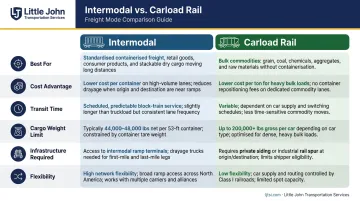
| Factor | Intermodal | Carload Rail |
|---|---|---|
| Best For | Containerized long-haul freight (700+ miles) | Bulk commodities in large volumes |
| Cost Advantage | 15–18% savings vs. truckload on qualifying lanes | Very low cost-per-ton-mile for bulk |
| Transit Time | Truck transit plus approximately one day | Slower; depends on rail schedules and routing |
| Cargo Weight Limit | ~42,500 lbs per container (highway compliance) | Higher per-car capacity depending on car type |
| Infrastructure Required | Facility within ~50 miles of an intermodal ramp | Rail siding at origin and destination |
| Flexibility | Accessible via truck to ramps; fixed rail schedules | Fixed schedules and routes; limited final-mile options |
Cost
On long-haul lanes, intermodal pricing is more stable than truckload and typically carries a meaningful discount. According to FreightWaves SONAR data from mid-2024, the intermodal cost advantage versus truckload ranged from roughly 6% to 18.5% depending on market conditions. That spread shifts with market conditions, but it's consistent and measurable across qualifying lanes. On the 1,407-mile Los Angeles–Dallas lane specifically, SONAR reported intermodal at $1.67 per mile versus $2.05 per mile for truckload.
Carload rail beats both on cost-per-ton-mile for bulk commodities, but it requires capital investment in rail sidings or access to transload facilities. For shippers without existing rail infrastructure, that upfront cost changes the math.
Flexibility and Speed
Intermodal adds approximately one day to truck transit due to drayage handling and ramp transfers. Actual transit depends on the terminal pair, rail schedule, and service plan — a Chicago–Los Angeles move on a premium intermodal service may hit five days, while a less-served corridor could run seven or more. Carload rail runs slower overall, and final-mile delivery gets complicated anywhere a rail siding isn't available.
The table above captures the core tradeoffs. The next section walks through the decision criteria that determine which mode fits your freight profile.
What Is Intermodal Transportation?
Intermodal transportation moves freight using two or more modes — typically truck and rail — where goods stay inside a standardized container for the entire journey without being reloaded between modes. In practice, it's a rail-dominant model with truck legs at each end.
Here's how a standard intermodal move unfolds:
How the Process Works
- Load at origin — Freight is packed into a container at the shipper's facility
- Drayage to ramp — A local truck hauls the container to the nearest intermodal ramp
- Rail long-haul — The container is lifted onto a flatcar or well car for the primary rail leg
- Final-mile delivery — Another truck picks up the container at the destination ramp and delivers to the consignee
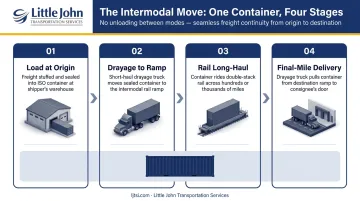
The container never gets unloaded between modes — fewer handoffs means less damage exposure and faster processing at each transfer point.
Core Advantages
- Pricing fluctuates less than spot truckload rates — useful for shippers who budget across freight cycles
- Moves freight by rail cuts greenhouse gas emissions up to 75% versus truck, per AAR's 2020 environmental analysis
- Double-stack rail cars carry two containers per flatcar slot, improving throughput on high-demand corridors
- U.S. railroads originated a record 13.84 million intermodal units in 2024 — up 9.3% year-over-year, with containers making up 96.3% of originations
Key Limitations
- Shippers must be within roughly 50 miles of an intermodal ramp for the economics to work
- Container weight is capped at 42,500 lbs of cargo to stay within highway gross-vehicle limits
- Transit adds approximately one day versus over-the-road trucking
- Drayage coordination adds complexity — you need either a 3PL or strong carrier relationships to manage it cleanly
Use Cases for Intermodal
Best-fit freight profiles include:
- High-volume, non-perishable goods moving 700+ miles
- Dry containerized products: retail goods, packaged food, beverages, auto parts, consumer electronics
- Import/export shipments moving through port cities, especially Los Angeles/Long Beach
- Shippers with timeline flexibility who can plan around rail schedules
With 180+ intermodal terminals active across the U.S., most major freight corridors have ramp access — though proximity to those ramps still determines whether the economics actually pencil out for a given shipper.
What Is Carload (Rail) Transportation?
Carload transportation — what most industrial shippers mean when they say "freight by rail" — moves goods in dedicated rail cars that travel directly between rail-served facilities. No highway-capable container required. The rail car itself is the vessel.
Car types include boxcars, hopper cars, tank cars, gondola cars, and flatcars. Each is engineered for a specific commodity type.
How Carload Rail Works
The shipper or receiver needs a rail siding on-site — or access to a nearby transload facility. From there:
- Freight loads directly into the appropriate rail car
- Cars move as part of a train consist to the destination
- No drayage leg required
Transit time depends on rail schedules and car routing.
Primary Advantages
- Very low cost-per-ton-mile for bulk commodities
- High volume capacity per car
- Reduced labor versus equivalent trucking on established corridors
- Consistent delivery times on predictable routes
- Lower emissions per ton-mile than road transport
Key Constraints
- Requires rail siding at origin and destination, or a transload facility
- Fixed schedules and routes with limited flexibility
- Not suited for time-sensitive freight
- Setup and switching costs make it inefficient for smaller or irregular shipments
Use Cases for Carload Rail
Carload rail dominates where bulk volume and infrastructure align:
- Coal, grain, fertilizer, chemicals, lumber, steel, and minerals
- High-volume industrial shipments with predictable, recurring patterns
- Energy, agriculture, chemical and petrochemical, construction materials, and forest products
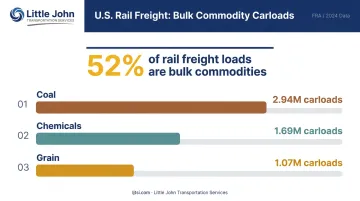
According to the FRA, 52% of rail freight loads consist of bulk commodities — the lifeblood of carload rail. In 2024 alone, U.S. railroads moved 2.94 million coal carloads, 1.07 million grain carloads, and a record 1.69 million chemical carloads.
Which Mode Is Right for Your Freight?
The decision comes down to five variables. Work through each one before committing to a mode.
The Decision Framework
- Distance — Intermodal makes economic sense at 700+ miles; shorter lanes favor trucking
- Cargo type and weight — Containerizable goods under 42,500 lbs fit intermodal; bulk commodities fit carload
- Rail infrastructure access — Do your facilities have a rail siding, or are you within 50 miles of an intermodal ramp?
- Transit time flexibility — Can you absorb an extra day for intermodal, or do you need truck-direct timing?
- Volume and frequency — High-volume, recurring shipments justify the infrastructure investment for carload; intermodal scales more flexibly
Choose Intermodal If:
- Freight is containerized and moving 700+ miles
- Origin and destination are within 50 miles of intermodal ramps
- Cargo weight stays under 42,500 lbs
- Timeline allows one additional day versus OTR trucking
- You're looking to reduce truckload spend on long, high-volume lanes
Choose Carload Rail If:
- You're shipping bulk commodities in large, predictable volumes
- Your facility has or is near a rail siding
- Transit timelines are established and not time-sensitive
- Per-ton-mile cost is the primary driver of your mode decision
When Neither Fits
Some freight is structurally incompatible with both options:
- Oversized or heavy-haul loads exceeding container weight limits or rail clearance envelopes
- Hazardous materials requiring continuous chain-of-custody and specialized certifications beyond standard rail regulations
- Time-sensitive freight where dwell time at a rail yard or terminal is unacceptable
- Cross-border shipments requiring real-time customs coordination and last-mile flexibility that fixed rail corridors can't provide
That's exactly the freight Little John Transportation Services is built around. With 30+ years in heavy-haul, all nine hazmat classes (including AA&E and TPS-restricted cargo), and U.S.–México cross-border logistics, Little John moves what most carriers and rail providers won't touch.
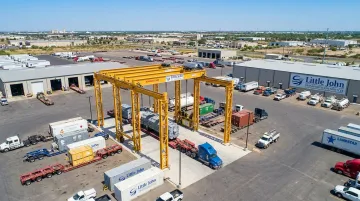
The proof is in the specifics: a 50-acre CTPAT-validated facility in Laredo with a 120-ton bridge crane, an FMCSA HMSP held by fewer than 1% of carriers, and loads exceeding 42,500 lbs as a daily freight profile — not an edge case.
A Practical Scenario
Consider a chemical manufacturer in Houston shipping 45,000 lbs of Class 3 flammable liquid to a distribution center in Dallas. Intermodal is out immediately — the cargo exceeds the 42,500 lb container limit and falls under hazmat regulations that create compliance gaps at rail terminals. Carload rail could handle the commodity class, but the Dallas facility lacks a rail siding, and the shipper needs delivery in 24 hours. Specialized OTR trucking with a certified hazmat carrier is the only viable path. Distance, weight, hazmat classification, and timeline: all four variables pointed the same direction before a single call was made.
Frequently Asked Questions
Is rail cheaper than trucking?
Rail is generally cheaper per ton-mile on long-haul and bulk shipments, but total cost depends on distance, cargo type, and whether drayage or transload fees apply. For shorter distances or time-sensitive loads, trucking is often more cost-effective once you factor in total delivered cost.
What is an example of intermodal transportation?
A retailer ships consumer goods from a West Coast port to a Midwest distribution center: a drayage truck moves the container from the port to an intermodal ramp, a train carries it for the long haul, and a second truck handles final delivery. The container never gets unloaded between modes.
What is the difference between intermodal and carload rail?
Intermodal is a subset of rail that uses highway-compatible containers or trailers placed on special rail cars. Carload rail uses dedicated car types — boxcars, hoppers, tank cars — loaded directly at a rail-served facility.
What types of freight are not suited for intermodal?
Oversized or heavy-haul loads exceeding container weight limits, hazardous materials requiring specialized handling, time-sensitive shipments, and freight without nearby ramp access are poor candidates. These loads require specialized trucking or carload rail instead.
How much longer does intermodal take compared to trucking?
Intermodal adds approximately one day to transit versus OTR trucking, per IANA's planning guidance — accounting for drayage pickup, ramp transfer, and rail scheduling. Shippers with flexible timelines on lanes over 700 miles generally find the trade-off acceptable given the cost savings.