Shippers, logistics managers, and supply chain directors across energy, automotive, chemical, and industrial manufacturing all encounter this process. But while the term appears frequently in logistics discussions, the actual mechanics, cost trade-offs, and operational requirements are rarely well understood. This article covers how the process works, when it makes sense, and where it breaks down.
Key Takeaways
- Transloading physically moves freight between railcars and trucks — unlike intermodal, where cargo stays sealed in the same container
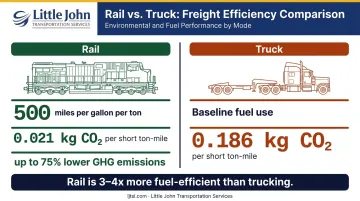
- Rail moves one ton of freight nearly 500 miles per gallon on average, making it significantly more fuel-efficient than trucking for long-haul legs
- The process follows a structured sequence: arrival and inspection → unloading and staging → truck loading and dispatch
- Cost savings only materialize on hauls long enough for rail's per-ton-mile advantage to outweigh handling fees
- The outbound truck leg is as operationally critical as the facility, particularly for hazmat, cross-border, or time-sensitive freight
What Is Rail to Truck Transloading?
Rail to truck transloading is a logistics process in which goods are physically moved off a railcar and loaded onto trucks at an intermediate facility, allowing the shipment to continue to a final destination not directly connected to rail infrastructure.
The purpose is straightforward: use rail for the long, high-volume portion of a route, where it's more cost- and fuel-efficient, then rely on trucks to complete delivery into local markets, warehouses, plants, or job sites.
How It Differs from Intermodal
This distinction matters operationally:
- Intermodal: Cargo stays sealed inside the same container as it transfers between ship, rail, and truck. No physical handling occurs. Standardized containers move untouched across modes.
- Transloading: The freight itself is physically handled and transferred. This enables repackaging, consolidation, sorting, and reconfiguration that intermodal cannot support.
A chemical manufacturer shipping bulk liquid cannot use intermodal. A shipper consolidating multiple smaller rail shipments into full truckloads for regional delivery needs transloading, not intermodal.
How It Differs from Transshipment
Transshipment moves cargo between vessels or transportation nodes along the same general mode — ship to ship at a port, for example. Transloading is different: it involves a deliberate mode change with hands-on freight handling, typically from rail to truck.
Why Shippers Use Rail to Truck Transloading
The core economic rationale starts with rail's efficiency advantage. According to the Association of American Railroads, rail moves one ton of freight nearly 500 miles per gallon on average and is 3–4 times as fuel-efficient as trucks.
The emissions gap is just as significant. EPA greenhouse gas emission factors put rail at 0.021 kg CO₂ per short ton-mile versus 0.186 kg CO₂ per short ton-mile for medium- and heavy-duty trucks. AAR estimates shifting freight from truck to rail reduces GHG emissions by up to 75% — a figure that matters for any company with ESG reporting obligations.
The Reach Problem
Most industrial facilities, warehouses, construction sites, and manufacturing plants are not rail-served. The U.S. freight rail network spans nearly 140,000 route miles, but that coverage doesn't extend to most final destinations. Transloading solves this: shippers capture rail economics on the long-haul leg without needing a rail spur at origin or destination.
Additional Strategic Reasons
- Place product at a regional transload hub near customer clusters, releasing inventory on demand rather than routing direct from a distant origin
- Reduce exposure to trucking volatility: the ATA reported a shortage of 78,800 qualified drivers in 2022, and fuel swings hit pure truckload strategies hard; rail absorbs the long-haul leg
- Merge multiple rail shipments into optimized truckload quantities at the facility, cutting outbound truck moves
How Rail to Truck Transloading Works
Freight originates at a shipper's facility or port, travels by rail to a transload facility positioned near a distribution hub or customer cluster, transfers to trucks, and trucks complete final delivery to destinations without rail access.
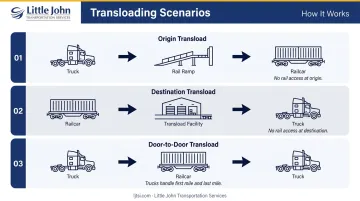
Three common scenarios based on where rail access exists:
- Origin transload: No rail at origin — trucks bring freight to the nearest rail ramp
- Destination transload: No rail at destination — freight moves from rail to truck for final delivery
- Door-to-door transload: Trucks handle both first and last mile; rail handles the main corridor leg
Step 1: Cargo Arrival and Inspection
When a railcar arrives at the transload facility, documentation is verified, cargo condition is inspected, and the shipment is checked against commodity-specific requirements. For hazmat or regulated materials, this step is governed by DOT Hazardous Materials Regulations — 49 CFR 174.67 requires that unloading be performed by properly instructed hazmat employees and that written safety procedures be maintained on-site. Miss it, and every subsequent step carries the liability forward.
Step 2: Unloading and Staging
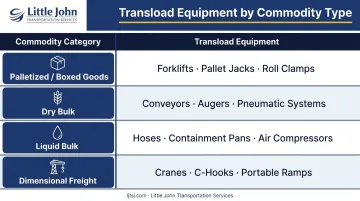
Equipment selection depends entirely on commodity type:
| Commodity Type | Equipment Used |
|---|---|
| Palletized / boxed goods | Forklifts, pallet jacks, roll clamps |
| Dry bulk (grain, cement, plastics) | Conveyors, augers, pneumatic systems |
| Liquid bulk (chemicals, fuels) | Hoses, containment pans, air compressors |
| Dimensional (steel, lumber, machinery) | Cranes, C-hooks, portable ramps |
After unloading, freight is staged by destination, customer, or commodity. Value-added services — palletization, labeling, repackaging — typically occur at this stage.
Step 3: Truck Loading and Dispatch
Staged freight is loaded onto outbound trucks — flatbeds, dry vans, tankers, or specialized trailers depending on the commodity — and dispatched to final destinations. Scheduling coordination between the transload facility and trucking providers is critical. Delays here directly create dwell time and, if rail equipment is still on-site, demurrage charges. Under Union Pacific's current tariff, demurrage for standard railroad equipment runs $145–$240 per car per day; for toxic inhalation hazard (TIH) cars, that figure reaches $3,300 per car per day.
For regulated freight — hazmat shipments, oversize loads, or cross-border moves into Mexico — the outbound carrier must hold specific certifications:
- FMCSA HMSP for hazardous materials transport
- Hazmat endorsements on every driver
- CTPAT validation for cross-border moves
- Bilingual dispatch capability for U.S.–Mexico corridor freight
Fewer than 1% of U.S. carriers hold the FMCSA Hazardous Materials Safety Permit. Little John Transportation Services holds FMCSA HMSP status, with 100% of its BCOs hazmat-endorsed and CTPAT-validated teams positioned at Laredo and across the U.S.–Mexico corridor.
Key Factors That Affect the Transloading Process
Not all transload operations run the same way. These factors determine whether an operation is efficient and cost-effective:
- Facility location: Distance from Class I railroad access, proximity to a port or inland hub, and distance to the final customer all affect total landed cost. A facility that saves three days in transit but adds 200 miles of drayage rarely pencils out.
- Commodity type and handling requirements: Dry bulk, liquid bulk, hazmat, temperature-sensitive freight, and oversized loads each require different equipment, certifications, and protocols — and not every facility is equipped to handle all of them.
- Shipment volume and frequency: Rail economics favor high-volume, recurring lanes. Low-volume or irregular shipments may not generate enough savings to offset handling costs and scheduling complexity.
- Regulatory constraints: Hazmat transloading requires certified operators, written safety procedures, physical attendance during transfer, and compliant emergency response information under 49 CFR Part 172 Subpart G — requirements that must be scoped before the first car arrives, not after.
Each of these variables compounds. A shipper who optimizes for rail cost but ignores facility capabilities or regulatory lead times often ends up paying more in delays than they saved on linehaul.
Common Issues and Misconceptions
Three misconceptions consistently create problems for shippers evaluating or executing transload moves:
Transloading and intermodal are not the same thing. Intermodal uses standardized containers that travel untouched across modes. Transloading physically handles and transfers the freight itself — which is exactly what makes it suitable for bulk commodities, hazardous materials, and freight requiring reconfiguration between modes.
Rail savings aren't automatic. They only materialize when the haul is long enough for rail's per-ton-mile advantage to outweigh the added handling and facility fees. Short hauls where trucking is readily available often don't justify the extra handling step and scheduling overhead.
The outbound truck leg deserves the same attention as facility selection. Many shippers underestimate the complexity of outbound dispatch — particularly with regulated freight, just-in-time schedules, or cross-border requirements.
Poor coordination at this stage produces dwell time, demurrage charges, missed delivery windows, and compliance exposure. The trucking partner you choose at the back end matters as much as the transload facility itself.
When Transloading May Not Be the Right Fit
Transloading works best when the economics and logistics align — and they don't always. Here's where it typically falls short:
- Short-distance hauls where handling costs and coordination costs exceed rail savings
- Freight moving between two rail-served locations — direct rail is simpler and cheaper
- Time-sensitive containerized freight already suited for intermodal movement
- Low-volume or irregular shipments that don't generate enough lane consistency to justify the overhead
- Markets where truck capacity is readily available and competitively priced
The signal that transloading is being used by default rather than by design: when shippers apply it uniformly across all lanes without evaluating haul length, volume, commodity type, and facility proximity. Run a lane-by-lane cost comparison across all-truck, intermodal, and transload before locking in any single model — the right answer changes by lane, not by policy.
Frequently Asked Questions
What is rail transloading?
Rail transloading is the process of physically transferring freight between railcars and trucks at a specialized facility. It allows goods to move by rail for the long-haul portion and by truck for final delivery to locations without direct rail access.
What is the difference between transloading and transshipment?
Transloading involves a mode change with hands-on freight handling — typically rail to truck or vice versa. Transshipment refers to moving cargo between vessels or nodes within the same general transportation mode to continue its journey, such as ship to ship at a port.
How does rail to truck transloading differ from intermodal transportation?
Intermodal keeps cargo sealed inside the same container as it moves across modes with no physical handling. Transloading physically transfers the freight itself — enabling repackaging, consolidation, or routing changes that intermodal cannot accommodate.
What types of freight are best suited for rail to truck transloading?
Heavy, high-volume, or long-distance shipments benefit most — particularly on lanes where rail infrastructure exists but the final destination is not rail-served. Common freight types include:
- Dry bulk and liquid bulk commodities
- Palletized goods and raw materials
- Hazardous materials (with proper facility certification)
- Oversized and heavy-haul equipment
When does rail to truck transloading not make sense?
Transloading is generally not cost-effective for short hauls, freight already suited for intermodal containers, low-volume or irregular shipments, and lanes where handling fees and scheduling complexity exceed the rail savings.
What should I look for in a trucking partner for the final leg of a transload operation?
At minimum, the outbound carrier should hold hazmat endorsements appropriate to the cargo, FMCSA HMSP for hazardous materials, and CTPAT validation for cross-border moves. Look for 24/7 dispatch, real-time tracking, and bilingual support if freight crosses into Mexico — each gap in those areas adds dwell time and compliance exposure.