Intermodal and transloading are frequently confused because both involve multiple modes. The distinction is simpler than it sounds: intermodal moves the container, transloading moves the cargo. That single difference creates very different operational outcomes depending on freight type, route, and what the shipment requires at each leg.
This article covers clear definitions, a side-by-side comparison, practical use cases, and a decision framework for choosing the right approach — including how compliance requirements change the calculus for hazmat, oversized, and cross-border freight.
Key Takeaways
- Intermodal keeps cargo sealed in the same container across all transport modes — minimizing handling and damage risk
- Transloading physically transfers cargo between containers or vehicles at a dedicated facility — adding flexibility but more touchpoints
- Rail is four times more fuel-efficient than trucks, making intermodal the cost leader on long-haul, high-volume routes
- Transloading wins where rail can't reach or when loads need consolidation, splitting, or mode-switching mid-journey
- For hazmat, oversized, or cross-border freight, compliance credentials determine which method is viable — not operational preference
Intermodal vs. Transloading: Quick Comparison
| Factor | Intermodal | Transloading |
|---|---|---|
| Cargo handling | Stays sealed; container transfers between modes | Physically moved between containers/vehicles |
| Cost structure | Lower on long hauls via rail efficiency | Higher labor/facility costs, but optimizes each leg |
| Flexibility | Limited by container size and rail ramp access | Highly flexible — any mode, any destination |
| Cargo risk | Lower — sealed container, minimal handling | Higher — more touchpoints, more exposure |
| Best-fit cargo | Packaged goods, retail, international shipments | Bulk commodities, oversized loads, rail-to-truck moves |
| Optimal distance | 500+ miles, per the IANA Intermodal Factbook | Flexible; truck legs typically within 50 miles of origin/destination |
What Is Intermodal Shipping?
Intermodal shipping moves cargo using two or more transport modes — truck, rail, or ocean vessel — while keeping that cargo sealed inside the same container for the entire journey. The container transfers between modes; the goods inside are never touched between loading and final delivery.
How the Process Works
A standard intermodal move follows this sequence:
- Carrier delivers empty container to the shipper's facility
- Shipper loads cargo and seals the container
- Truck hauls the container to the nearest rail ramp
- Container transfers to train for the long-haul leg
- At the destination ramp, the container loads back onto a truck chassis
- Final-mile delivery to the receiver
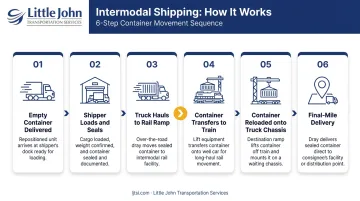
Throughout the entire journey, the cargo stays put — the container does the traveling.
Equipment and Infrastructure
Intermodal requires standardized equipment. ISO containers come in 20-ft, 40-ft, and 45-ft international sizes, with 48-ft and 53-ft domestic configurations used within North America. ISO 668:2020 governs container classifications, dimensions, and ratings.
At transfer points, gantry cranes lift containers between rail cars, chassis, and ship decks. Not every facility can handle this — bottlenecks occur when rail ramp access is limited or chassis availability is tight.
Advantages
- Reduced cargo damage — a sealed container means minimal handling throughout transit
- Cost efficiency on long hauls — freight trains can move one ton of freight 470 miles on one gallon of diesel, per FRA data
- Lower emissions — moving freight by rail instead of truck reduces greenhouse gas emissions by up to 75%, according to AAR
- Scalability — consistent container specs make high-volume shipping repeatable
Disadvantages
- Container and chassis shortages create delays — during COVID-era disruptions, one USDOT assessment found dwell times reaching 21 to 26 days versus a preferred 3 to 4 days
- Fixed rail schedules reduce responsiveness for time-sensitive freight
- Destinations without rail ramp access require additional drayage, which adds cost and complexity
Intermodal Use Cases
Intermodal works best for high-volume, long-distance moves where cargo doesn't need reconfiguration mid-journey. Common applications include retail consumer goods, electronics, automotive parts, and apparel moving from ports to inland distribution centers.
Intermodal dominates international shipping — ocean container to truck or rail — because breaking the seal mid-journey creates customs and compliance complications. On domestic corridors like West Coast ports to the Midwest, rail lanes parallel major trucking routes, making the handoff seamless.
Where intermodal hits its limits — cargo that needs to be repackaged, consolidated, or shifted between incompatible equipment — is exactly where transloading steps in.
What Is Transloading?
Transloading physically transfers cargo from one transport vehicle or container into a different one at a dedicated facility. The goods move, not just the container. This lets shippers mix and match modes — ship-to-truck, rail-to-truck, truck-to-rail — based on what's most efficient for each leg.
How the Process Works
A typical transload sequence:
- Cargo arrives at port, rail ramp, or staging facility
- Offloaded from the original container at the transload facility
- Transferred via forklift, conveyor, pump, or crane into the destination vehicle or container
- Dispatched for final delivery by the most appropriate mode
Transload facilities are strategically placed near rail lines, port exits, and major highway corridors to minimize the dead miles between modes.
Equipment Varies by Cargo Type
Not all transload facilities can handle all freight. Per Iowa DOT's freight guidance:
- Forklifts and dock equipment — palletized and packaged freight
- Gravity, pneumatic systems, and conveyors — dry bulk
- Pipelines and pumps — liquid bulk
- Cranes and lifting equipment — dimensional and heavy freight
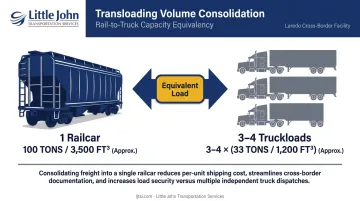
One railcar consolidates the volume of three to four truck shipments, which is why transloading often makes economic sense even with the added handling costs.
Advantages
- Reaches destinations without rail access via truck on the final leg
- Allows load consolidation or splitting to match trailer capacity
- Frees containers and chassis faster for reuse
- Supports port congestion workarounds — cargo can transload between vessels to access smaller ports
Disadvantages
- Higher damage and loss risk from repeated handling
- Additional labor and facility costs at each transfer point
- Not every facility is certified for hazardous materials — confirm DOT/FMCSA compliance credentials before routing regulated cargo through any transfer point
Transloading Use Cases
Common transloading scenarios include:
- Bulk commodities moving domestically via rail-to-truck: grain, chemicals, petroleum products, and lumber
- Shipments destined for facilities without rail siding
- Cross-border freight requiring container changes due to regulatory differences
- Hazmat transfers where only certified facilities and carriers are authorized to handle the goods
For hazardous materials specifically, transloading is a regulatory matter as much as an operational one. Little John Transportation Services holds FMCSA HMSP certification and operates a purpose-built 50-acre transload facility in Laredo, TX — with a 120-ton bridge crane capable of completing superload transfers in under two hours, covering all nine hazard classes including AA&E and TPS-restricted commodities.
Intermodal vs. Transloading: Which Should You Use?
The right choice depends on five factors: cargo type, route accessibility, shipment volume, handling sensitivity, and compliance requirements. Neither method is universally superior. Many supply chains use both on different legs of the same journey.
Situational Decision Guide
Choose intermodal when:
- Cargo is high-value or damage-sensitive and benefits from staying sealed
- Shipping long-distance on established rail corridors with ramp access
- Moving international freight where breaking the seal creates customs complications
- Volume and consistency make standardized containers practical
Choose transloading when:
- The destination doesn't have rail access and needs a truck for the final leg
- Cargo is bulk, liquid, or dimensional — formats that don't fit standard containers
- You need to consolidate or split loads at an intermediate point
- Freeing containers and chassis quickly is a supply chain priority
The Compliance Variable
For hazmat, oversized, or heavy-haul freight, the method you choose carries direct regulatory consequences. Transloading hazmat requires facilities with proper protocols, certified personnel, and documented chain-of-custody procedures. Intermodal for hazmat requires carriers holding the correct permits.
Working with a carrier that has documented compliance infrastructure matters. Little John holds credentials that let it legally handle freight categories most carriers cannot touch:
- FMCSA HMSP — held by fewer than 1% of carriers nationally
- TWIC — required for secure port and terminal access
- AA&E Certified — covers arms, ammunition, and explosives
- TPS Approved — Transportation Protective Service authorization
- CTPAT Validated — cross-border supply chain security
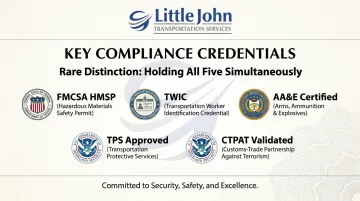
Each covers a distinct category of regulated freight. Holding all five simultaneously is rare.
The Cross-Border Dimension
For U.S.–Mexico freight, transloading at border crossings like Laredo is often operationally necessary. Laredo processed nearly 2.95 million inbound trucks from Mexico in 2025, accounting for 38.8% of all inbound trucks at the southern border. U.S. domestic trailers operating under standard authority cannot conduct domestic Mexican carriage, so cargo frequently transfers to Mexican transport units at the crossing.
That handoff requires bilingual operations, in-house customs brokerage on both sides, and carriers with pre-established Mexican interchange agreements.
Little John's Laredo hub operates with 250+ Mexican interchange agreements, in-house customs brokerage, and teams stationed in Monterrey and Guadalajara — personnel positioned on both sides of the bridge, not coordinating remotely.
Decision Matrix
| Priority | Recommended Method |
|---|---|
| Cargo security + long-haul cost efficiency | Intermodal |
| Route flexibility + last-mile access | Transloading |
| Hazmat, oversized, or cross-border freight | Certified specialized carrier capable of either method |
Conclusion
Intermodal and transloading solve different problems. Intermodal protects cargo integrity and drives cost efficiency on long, standardized hauls. Transloading delivers the flexibility and last-mile access that intermodal can't always reach. The smartest supply chains use both — the right method depends on the leg, the cargo, and the destination.
What determines the outcome isn't which method you choose — it's who executes it. For complex freight — hazmat, heavy-haul, cross-border — compliance credentials, certified equipment, and experienced personnel are what separate a clean delivery from a costly incident. Contact Little John Transportation Services to discuss your freight requirements and identify the right solution for your supply chain.
Frequently Asked Questions
Is transloading the same as cross-docking?
No. Transloading transfers freight between different transportation modes across multiple legs of a journey. Cross-docking specifically means unloading incoming freight and immediately reloading it onto outbound trucks with minimal or no storage — mode changes aren't required. In practice the two can overlap, but they remain distinct processes.
Can intermodal and transloading be used together in the same shipment?
Yes, and many real-world shipments involve both. Cargo might move intermodal via ocean container from Asia to a U.S. West Coast port, then transfer into domestic truck trailers for last-mile delivery to retailers. Each method handles the leg it's best suited for.
Which is cheaper — intermodal or transloading?
Intermodal tends to be more cost-efficient for long-distance, high-volume hauls due to rail's lower cost per ton-mile. Transloading adds labor and facility costs but can reduce total cost by selecting the most efficient mode for each leg rather than forcing all freight through a single container configuration.
What is the difference between intermodal and multimodal shipping?
Both use multiple transport modes. Intermodal specifically means cargo stays in the same loading unit throughout — goods are never handled during mode changes. Multimodal is broader: it covers any shipment using multiple modes, including those where cargo may transfer between containers. The UNECE definition requires an unchanged loading unit for intermodal.
Can hazardous materials be shipped via transloading?
Hazmat can be transloaded, but only at certified facilities with the right protocols, equipment, and credentialed personnel. Required credentials include HMSP authorization, hazmat endorsements, and TWIC certification where port or terminal access applies. Not all transload facilities are equipped or permitted for dangerous goods.
When is transloading the better choice for cross-border freight?
For U.S.–Mexico freight, transloading is often operationally necessary at crossings like Laredo. Domestic trailers cannot conduct Mexican carriage under standard U.S. authority, so cargo transfers to Mexican transport units. That requires carriers with bilingual operations, in-house customs coordination, and established Mexican interchange agreements.