The challenge isn't simply "keep it cold." A refrigerated trailer is an engineered system where insulation, mechanical cooling, real-time monitoring, and regulatory compliance must function together without interruption. One failure in the chain can mean spoiled cargo, food safety violations, and significant liability for everyone involved.
This guide breaks down how refrigerated transportation actually keeps food fresh — from how the equipment works to what regulations govern it and why the U.S.–Mexico corridor demands its own layer of compliance.
Key Takeaways
- Reefer transport combines insulated trailers, active mechanical cooling, and continuous monitoring
- Temperature requirements vary by product: processed poultry at 40°F or below, Grade A milk at 45°F or below, frozen goods at -18°C or lower
- The cold chain is a sequence — pre-cooling, careful loading, in-transit monitoring, and delivery verification must all hold
- FDA's FSMA Sanitary Transportation Rule assigns documented duties to shippers, carriers, and receivers
- Carrier credentials, audited equipment, and trained operators matter as much as the hardware itself
What Is Refrigerated Transportation?
Refrigerated transportation — commonly called reefer transport — moves perishable goods in vehicles equipped with insulated compartments and active temperature control systems. The key word is active. Without it, fresh meat, dairy, seafood, and produce would begin to deteriorate within hours of leaving their origin point.
That distinction matters. Passive cooling — shade, ice packs, ambient temperature — can't hold a set temperature across a multi-day transit. Reefer transport requires mechanical refrigeration, insulation inspection, and real-time temperature tracking throughout the move.
The Main Types of Refrigerated Transport Vehicles
The ATP Agreement classification system defines equipment by measurable performance, not just colloquial labels. The practical categories shippers encounter:
- Isothermal (insulated only) — Rigid insulated body that limits heat exchange, but no active cooling. Slows temperature change; doesn't control it
- Refrigerated (non-mechanical) — Uses cold sources such as dry ice, eutectic plates, or cryogenic gas. ATP classes range from +7°C (Class A) to -20°C (Class C) at +30°C ambient
- Mechanically refrigerated — Active refrigeration unit with its own power source. ATP Class F maintains -20°C or below , making it the standard for most commercial food freight
- Heated — For cargo sensitive to cold, maintaining minimum temperatures in freezing ambient conditions
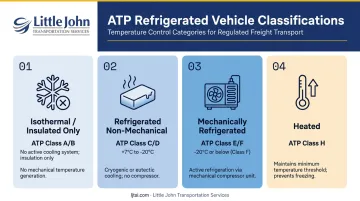
Matching equipment class to cargo temperature requirement is where compliance starts — and where most cold chain failures begin when shippers get it wrong.
How Refrigerated Transportation Keeps Food Fresh
Keeping food fresh in transit isn't a single mechanism — it's a layered system. Insulation limits heat gain. The refrigeration unit removes heat actively. Monitoring systems catch deviations before they become losses. And human protocols close the gaps that hardware can't.
Insulation: The First Line of Defense
Refrigerated trailers are built with multi-layered insulated walls, floors, roofs, and doors. Utility's 3000R trailer, for example, uses foam-in-place polyurethane with 2-inch sidewalls, 4-inch front walls, and 3-inch roof, floor, and rear doors. Great Dane's Everest line uses HFO polyurethane foam with a foil-barrier composite liner to resist moisture intrusion and insulation degradation.
The ATP standard measures whole-body thermal performance using a heat-transfer coefficient (K value). Standard insulated equipment requires K ≤ 0.70 W/m²°C; reinforced insulated equipment requires K ≤ 0.40 W/m²°C. The lower the K value, the better the thermal barrier.
Insulation alone is passive — it slows the rate of temperature change but cannot maintain a set temperature. That's the refrigeration unit's job.
The Refrigeration Unit: Active Temperature Control
A transport refrigeration unit (TRU) operates on the same vapor-compression cycle as a household refrigerator, scaled up considerably. The compressor raises refrigerant pressure and temperature; the condenser rejects heat to the outside; the expansion device drops pressure; the evaporator absorbs heat from the cargo space. That cycle runs continuously.
Two performance factors determine real-world effectiveness:
- Independent diesel engines keep units like the Carrier Vector 8500 and Thermo King Precedent S-750i running whether the truck is moving, idling at a dock, or stuck in traffic — no dependency on the truck engine
- Rated capacity under load: The Thermo King Precedent S-750i delivers 43,000 BTU/hour at 0°F cargo-side and 100°F ambient — meaning it holds temperature in summer heat, not just in ideal test conditions
Some units support multi-temperature zones within a single trailer — allowing, for example, fresh produce and frozen goods to ride together in partitioned compartments at different set temperatures.
Temperature Monitoring and Control
Modern reefer systems log internal temperatures throughout transit. Telematics platforms like Carrier's Lynx Fleet and Thermo King's TracKing record cargo-side temperatures, generate alerts when readings drift outside set parameters, and support remote setpoint adjustments.
This documentation serves two distinct purposes:
- Regulatory compliance: FDA's FSMA Sanitary Transportation Rule requires carriers to demonstrate temperature maintenance on request — continuous logs are that evidence
- Chain-of-custody protection: If a dispute arises over cargo condition at delivery, temperature records show exactly what happened and when
The risk of ignoring temperature data is concrete. USDA FSIS notes that bacteria grow most rapidly between 40°F and 140°F, with potential doubling in as little as 20 minutes. A temperature excursion — even a brief one — can accelerate bacterial growth in meat, dairy, and seafood well before the cargo visibly spoils.
Drivers and dispatchers must actively respond to alerts. The monitoring equipment records the problem; trained personnel have to act on it.
Temperature Standards and Regulatory Requirements
Federal requirements are product-specific, not universal. The commonly cited "keep it cold" instruction misses the actual regulatory nuance:
| Product | Federal Temperature Requirement |
|---|---|
| Processed poultry | 40°F (4°C) or below during transport |
| Poultry labeled "fresh" | Must remain above 26°F (-3°C) |
| Grade A milk | 45°F (7°C) or below during transportation |
| Fresh red meat | FSIS guidance: 40°F or below before loading; shipper specifies transport conditions under FSMA |
| Fresh seafood | Shipper-specified under FSMA |
| Frozen goods | Shipper-specified; -0.4°F (-18°C) is standard cold storage guidance |
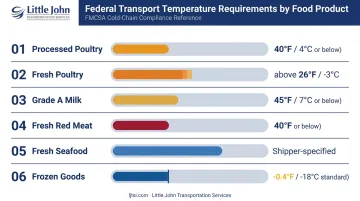
Sources: USDA FSIS transportation guidelines; 21 CFR Part 1 Subpart O
FSMA Sanitary Transportation Rule
The FDA's Food Safety Modernization Act Sanitary Transportation Rule assigns specific roles:
- Shippers set written temperature and sanitary specifications for each load
- Carriers execute assigned controls, maintain written procedures, and demonstrate temperature maintenance on request
- Loaders verify sanitary condition and pre-cooling before loading
- Receivers assess for possible temperature abuse at delivery
Training records for carrier personnel must be retained for 12 months beyond the employee's relevant work. Procedures must be retained 12 months beyond their use or termination. Both are enforceable regulatory requirements, not optional recordkeeping.
ATP Agreement for Cross-Border Freight
Domestic FSMA rules cover U.S. carriers, but cross-border shipments introduce a separate compliance layer. The ATP Agreement governs international refrigerated transport, requiring vehicles to carry a certification plate showing their rated class. Key facts for North American shippers:
- The agreement covers 52 signatory parties
- The United States acceded in 1983
- Mexico is not currently a listed party
That last point matters for U.S.–Mexico food freight. Without treaty-based automatic equivalency, shippers must address the compliance gap through carrier-level agreements and load-specific documentation rather than relying on mutual recognition.
Where Refrigerated Transportation Is Used
Food is the most visible use case — but reefer infrastructure supports a much wider range of cargo.
Food supply chain stages that depend on reefer transport:
- Food manufacturing — moving raw ingredients to production facilities under temperature control
- Wholesale distribution — product moving from distribution centers to retailers
- Foodservice distribution — supplying restaurants, hospitals, schools, and institutional kitchens
- Last-mile grocery delivery — increasingly common as direct-to-consumer food delivery grows
Non-food sectors using the same infrastructure:
- Pharmaceuticals and biologics — vaccines, temperature-sensitive medications, and clinical samples
- Floral — imported flowers moving from Miami-area handling facilities to distribution points across the country
- Fine art — humidity and temperature-controlled transport for sensitive pieces
The U.S.–Mexico Corridor
USDA recorded 3.52 million tons of Mexican fruits and vegetables moved by refrigerated truck in Q2 2024, with top commodities including seedless watermelon, plum tomatoes, avocados, cucumbers, grapes, and limes. The volume moving through ports like Laredo, Pharr, and Nogales makes this one of the highest-intensity reefer corridors in North America.
Cross-border reefer freight carries compliance requirements beyond standard domestic operations:
- CTPAT validation — CBP requires conveyance and trailer inspections, high-security seals, verification that seals remain intact, and documentation of any seal changes
- In-house customs documentation on both sides of the border
- FSMA alignment for food entering the U.S. from Mexico
- Bilingual operational coordination to manage handoffs across the border
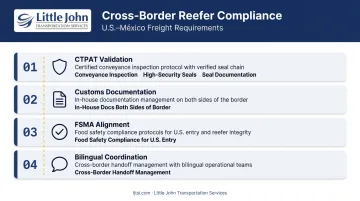
For shippers moving temperature-controlled cargo across the border, dwell time at customs is a direct threat to product integrity. Carriers with established border infrastructure — such as Little John Transportation Services' 50-acre CTPAT-validated Laredo facility — reduce border delays by having credentialed, documentation-ready teams positioned at the crossing rather than coordinating remotely.
Little John's Laredo operations also include FAST certification and in-house U.S. and Mexico customs brokerage, built specifically to keep cold chain cargo moving through one of the most congested freight crossings on the continent.
Conclusion
Refrigerated transportation keeps food fresh by combining passive insulation, active mechanical refrigeration, continuous temperature monitoring, and documented compliance into a system where every layer supports the others. Miss one — inadequate insulation, an undersized TRU, ignored temperature alerts, or missing FSMA paperwork — and the chain breaks.
Shippers who understand the mechanics can better evaluate carrier qualifications and catch problems before a load ever moves. That means knowing:
- Whether a carrier operates isothermal trailers or certified mechanically refrigerated units
- What temperature range is actually required for your commodity — not just a general "keep cold"
- What FSMA requires from carriers specifically, and whether the paperwork will hold up under audit
The difference between a compliant shipment and a rejected load often comes down to the questions asked upfront.
Frequently Asked Questions
What temperature should refrigerated trucks maintain for food?
Requirements vary by product. Processed poultry and fresh red meat must be held at 40°F (4°C) or below; Grade A milk at 45°F (7°C) or below. Frozen goods are typically held at 0°F (-18°C) or lower. Shippers must document specific requirements, and carriers must maintain and demonstrate compliance throughout transit.
What is the difference between refrigerated and frozen transport?
Refrigerated transport maintains above-freezing temperatures (typically 33°F to 45°F) for fresh perishables like produce, dairy, and fresh meat. Frozen transport holds cargo at 0°F (-18°C) or below for deep-frozen products like ice cream and frozen meals. The equipment class, refrigeration unit capacity, and insulation ratings differ significantly between the two.
What happens if the cold chain is broken during transport?
A temperature excursion can accelerate bacterial growth, shorten shelf life, cause spoilage, and create regulatory and liability exposure for both shipper and carrier. Even brief warming events in meat, dairy, or seafood compromise food safety before visible deterioration occurs.
How much does refrigerated food transport cost?
Reefer rates run higher than dry van due to specialized equipment, TRU fuel costs, and compliance requirements. As a reference point, June 2026 national spot averages were $3.35/mile for reefer versus $2.89/mile for dry van. Actual pricing depends on lane, distance, product type, and temperature requirements. Contact your carrier directly for accurate quotes.
How can I ship refrigerated food?
Identify your product's required temperature range, then select a carrier with certified reefer equipment and documented FSMA compliance. Provide accurate temperature specifications before the load moves, confirm pre-cooling at pickup, and ensure the carrier maintains continuous temperature logs throughout transit.
Do refrigerated truck drivers need a special license?
In the U.S., a Class A CDL is required for tractor-semitrailer combinations exceeding 26,001 lbs GCWR. There is no separate reefer endorsement, but FSMA training requirements apply to carrier personnel when the carrier has accepted sanitary responsibility by written agreement. Cross-border food shipments add customs and permit documentation requirements at the federal and CBP level.