Refrigerated freight — also called reefer shipping — gets discussed frequently in logistics circles, but its real value shows up in concrete business outcomes: lower spoilage rates, compliance documentation that survives regulatory scrutiny, and the ability to reach markets that dry freight simply can't serve.
This article explains what refrigerated freight actually protects, what it enables for growing businesses, and what it costs companies that skip or underinvest in it.
Key Takeaways
- Refrigerated freight maintains cargo-specific temperature conditions continuously from origin to delivery, not only at pickup and drop-off
- Core benefits cover quality preservation, regulatory compliance, and expanded distribution reach
- According to FAO research, insufficient refrigeration is responsible for approximately 12% of global food production lost across the cold chain
- Businesses that skip temperature-controlled transport face spoilage, cargo claims, and hard geographic limits on distribution
- Carrier selection matters as much as equipment: verified credentials, real-time monitoring, and cross-border capability define reliable cold chain partners
What Is Refrigerated Freight?
Refrigerated freight is the movement of perishable goods in vehicles or containers equipped with active cooling systems designed to maintain a specific temperature range throughout transit — regardless of outside conditions or how long the journey takes.
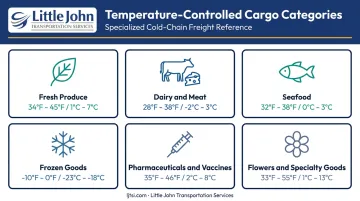
It applies far beyond frozen food. The full scope of cargo that requires temperature control includes:
- Fresh produce — leafy greens, berries, stone fruit, citrus
- Dairy and meat — fluid milk, aged cheeses, beef, pork, poultry
- Seafood — fresh fish, shellfish, shrimp
- Frozen goods — processed foods requiring 0°F or below
- Pharmaceuticals and vaccines — biologics, insulin, and temperature-sensitive drugs
- Flowers and specialty goods — cut flowers, certain chemicals with thermal stability requirements
For each of these categories, temperature deviation during transit doesn't just reduce quality — it can cause irreversible safety risk, regulatory violation, or total cargo loss. Refrigerated freight is the operational requirement that keeps perishable goods sellable, safe, and compliant from origin to delivery.
Key Benefits of Refrigerated Freight for Perishable Goods
Each benefit below maps to a specific business outcome: spoilage rates, compliance exposure, revenue potential, and delivery reliability. They reinforce each other, and gaps in any one create risk across the entire supply chain.
Product Quality Preservation and Extended Shelf Life
The core function of refrigerated freight is temperature stability — and the required range varies significantly by cargo type:
| Cargo Type | Typical Required Range |
|---|---|
| Frozen foods | 0°F (-18°C) or below |
| Fresh meat and poultry | 32–40°F (0–4°C) |
| Dairy products | 32–45°F (0–7°C), product-specific |
| Fresh produce | Varies widely by commodity |
| Pharmaceuticals/vaccines | 36–46°F (2–8°C) for most refrigerated biologics |
Even brief deviation outside the appropriate band triggers consequences that can't be reversed: bacterial growth, accelerated spoilage, compromised drug efficacy, or total cargo rejection. USDA FSIS data confirms that bacteria in the 40°F–140°F danger zone can double in as little as 20 minutes — a timeline that makes passive temperature management genuinely dangerous on any shipment longer than a short local run.
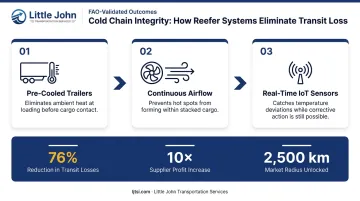
Modern reefer systems prevent this through several mechanisms working together:
- Pre-cooled trailers eliminate ambient heat absorbed during loading — one of the most common and preventable cold chain failures
- Continuous airflow prevents hot spots that can develop near loading doors or unventilated cargo stacks
- Real-time IoT temperature sensors catch deviations while corrective action is still possible
The business impact is measurable. An FAO-documented pilot combining pre-cooling and reefer transport for fresh produce reduced transit losses by 76%, increased supplier profit by 10x, and enabled distribution to a 2,500 km market radius that was previously inaccessible. For pharmaceutical shipments, the stakes are even less forgiving. Potency loss from temperature excursion is irreversible. A vaccine that left the shipper in specification can arrive at the receiver chemically compromised, with no visible sign of the failure.
Regulatory Compliance and Reduced Business Risk
Food and pharmaceutical shipments in the U.S. move under a structured regulatory framework that specifically governs temperature control during transport. FDA's FSMA Sanitary Transportation Rule (21 CFR Part 1, Subpart O) assigns documented responsibilities across every party in the cold chain:
| Party | Core Obligation |
|---|---|
| Shipper | Specify required temperatures and sanitary conditions in writing; require precooling when needed |
| Loader | Verify trailer is adequately prepared and precooled before loading temperature-controlled food |
| Carrier | Meet shipper specs when assigned by written agreement; maintain sanitation procedures and training records |
| Receiver | Assess whether significant temperature abuse occurred during transit |
Records for written procedures and agreements must generally remain available for 12 months, with off-site records retrievable within 24 hours. That audit trail is what determines whether a business survives an FDA inspection or a product liability dispute.
Refrigerated freight creates this compliance infrastructure as a byproduct of normal operations. Continuous temperature logs, trailer-wash records, pre-cool confirmation, and chain-of-custody paperwork are generated in the course of a well-run reefer shipment.
Without them, shippers face documentation gaps that are difficult to explain and expensive to defend.
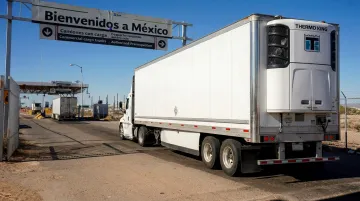
For businesses with cross-border operations, the compliance layer compounds. U.S.–Mexico perishable shipments must satisfy USDA requirements, FDA documentation standards, and Mexican customs sanitary protocols simultaneously. Carriers with in-house customs brokerage, bilingual operations teams, and C-TPAT validation — like Little John Transportation Services, which maintains dedicated teams in Laredo, Monterrey, and Guadalajara — can manage that documentation continuity across the border without creating a compliance gap at the crossing.
Expanded Market Access and Revenue Growth
Without temperature-controlled transport, perishable distribution has a hard geographic ceiling. Products must move within short local windows or they're written off. Refrigerated freight removes that ceiling.
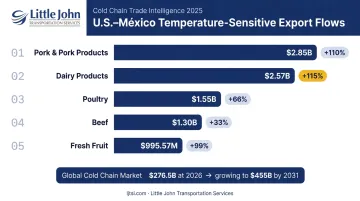
The U.S.–Mexico corridor illustrates how large this opportunity is. USDA Foreign Agricultural Service data for 2025 shows the scale of temperature-sensitive trade already moving through that corridor:
- Pork and pork products: $2.85B in U.S. exports to Mexico (up 110% since 2016)
- Dairy products: $2.57B (up 115%)
- Poultry: $1.55B (up 66%)
- Beef: $1.30B (up 33%)
- Fresh fruit: $995.57M (up 99%)
That growth reflects demand that refrigerated infrastructure makes possible. A mid-sized produce distributor or food manufacturer that previously couldn't absorb spoilage risk on a 1,500-mile run can now reach those markets with product that arrives in prime condition.
The cold chain market broadly reflects this trajectory. Estimates differ by scope and methodology, but MarketsandMarkets projects the global cold chain market at $276.5B in 2026, growing to $455B by 2031 — a signal of how rapidly refrigerated logistics infrastructure is being built out to serve expanding perishable trade.
More shelf life in transit means more addressable market. For pharmaceutical manufacturers distributing vaccines across North America, or seasonal agricultural producers targeting distant buyers, refrigerated freight is the operational prerequisite for growth.
What Happens When Refrigerated Freight Is Skipped or Mismanaged
The consequences fall into three categories, and they escalate as distribution scale grows.
Direct financial losses:
- Product spoilage and total cargo loss when temperature controls fail or aren't used at all
- Shipment rejection at the receiver's dock when product arrives outside temperature spec
- Regulatory fines or shipment holds when FDA/USDA documentation is incomplete or missing
- Product recalls that trigger costs — legal, operational, and reputational — far exceeding any freight savings
Operational downstream effects:
- Reactive replacement of lost loads on tight timelines, typically at premium spot rates
- Rising cargo insurance premiums after repeated temperature claims
- Erosion of customer trust when delivered product fails incoming quality inspection
A cold chain failure on a 10-pallet local shipment is painful but recoverable. The same failure on a 40-trailer cross-country run or a cross-border pharmaceutical move is not.
The risk doesn't scale linearly — it compounds. Shippers who treat temperature control as optional at low volumes tend to find out the real cost only after a high-volume failure has already happened.
How to Get the Most Value from Refrigerated Freight
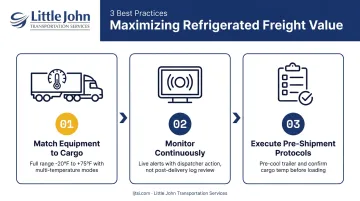
Refrigerated freight delivers maximum ROI when three conditions are met consistently.
1. Match equipment to cargo-specific requirements. Not all reefer trailers are configured the same way. A carrier capable of maintaining -20°F to +75°F across a thermally mapped fleet — with frozen, chilled, and protect-from-freeze modes — covers the full range of perishable cargo types without improvisation. Multi-temperature and partitioned trailers extend this further, enabling mixed-cargo loads without temperature compromise.
2. Monitor continuously, not just at pickup and delivery. Live temperature monitoring with automated exception alerts catches deviations while corrective action is still on the table. A carrier whose dispatch team receives alerts and acts on them — not just logs them — is a materially different partner than one that checks temperature records after the fact.
3. Don't skip pre-shipment protocols. Pre-cooling the trailer before loading is the most commonly skipped step and the most commonly cited root cause when cold chain failures are traced back to their origin. Confirming cargo temperature before it enters the reefer is the second step that gets skipped. Both are required on any shipment where temperature integrity matters.
Carrier Selection: What to Require
Verify credentials before committing to a carrier. At minimum, look for:
- GDP compliance for pharmaceutical loads
- FSMA Sanitary Transport alignment for food-grade shipments
- ISO 9001:2015 quality management documentation
- Audit-ready chain-of-custody paperwork that holds up under FDA or USDA review
For cross-border routes, add CTPAT validation, FAST certification, and in-house customs brokerage on both sides of the border. Without those, a carrier hands off temperature accountability at the crossing — exactly where cold chain failures are hardest to recover from.
Conclusion
Refrigerated freight delivers control over outcome: product quality at delivery, compliance documentation that holds up under audit, and access to markets that temperature-sensitive goods simply can't reach without it.
These advantages compound when cold chain management is treated as operational discipline. Lower spoilage builds margin. Compliance reduces liability. Expanded distribution builds revenue. All three depend on consistent execution: right equipment, continuous monitoring, verified carriers, and documentation prepared before an inspector requests it.
Frequently Asked Questions
What types of perishable goods require refrigerated freight?
Fresh produce, dairy, meat, seafood, frozen foods, pharmaceuticals and vaccines, and certain specialty goods like flowers and temperature-sensitive chemicals all require refrigerated freight. Each category has different temperature requirements — frozen goods need 0°F or below, while most refrigerated pharmaceuticals require 36–46°F — so equipment must match the specific cargo type.
What temperature is required for pharmaceutical refrigerated freight?
Most pharmaceuticals, including vaccines, insulin, and biologics, require maintenance between 2–8°C (36–46°F) during transit, though labeled storage conditions govern for each specific product. Some biologics require cryogenic temperatures, and even a brief deviation can compromise drug efficacy and trigger regulatory violations requiring documentation and potential product quarantine.
How does refrigerated freight help businesses comply with food safety regulations?
Refrigerated freight generates the temperature logs, pre-cool confirmation records, trailer sanitation documentation, and chain-of-custody records that FDA's FSMA Sanitary Transportation Rule and USDA regulations require — forming the audit trail that demonstrates compliance during inspections and protects against liability claims.
What is the difference between refrigerated freight and standard dry freight?
Standard dry freight has no active temperature control and is entirely unsuitable for perishables. Refrigerated freight uses active cooling systems to maintain a specific temperature range throughout transit — regardless of external heat, transit duration, or seasonal conditions — with continuous monitoring to verify that range is maintained from origin to delivery.
What happens if temperature control fails during a refrigerated freight shipment?
Immediate consequences include product spoilage, cargo loss, and potential compliance violations if temperature records show deviations. Downstream impacts include customer claims, regulatory exposure, and possible product recalls. Real-time monitoring systems with automated alerts exist specifically to catch excursions early, when equipment adjustments or rerouting can still prevent total loss.
Is refrigerated freight significantly more expensive than standard shipping?
Reefer freight costs more than dry freight due to specialized equipment, higher fuel consumption, and compliance overhead. That premium is a protective investment: the cost of a single rejected load, a spoilage claim, or a product recall typically far exceeds the total freight premium paid across many shipments.