This guide is written for seafood processors, distributors, importers, and food logistics managers who need a clear picture of what refrigerated freight actually requires for frozen seafood: temperature standards, federal regulations, packaging specifications, and how the end-to-end process should work.
Key Takeaways
- Frozen seafood must be maintained at 0°F (-18°C) or below throughout transit — any deviation creates food safety risk
- FSMA's Sanitary Transportation Rule and FDA's seafood HACCP regulations (21 CFR Part 123) govern commercial frozen seafood transport
- Packaging requires watertight inner liners, insulated outer containers, dry ice as coolant, and "KEEP FROZEN / PERISHABLE" labeling
- The cold chain must be unbroken from processing facility to delivery, including at transfer points and border crossings
- Carrier selection — equipment specs, monitoring, and documentation — matters as much as packaging
What Refrigerated Freight for Frozen Seafood Actually Requires
Refrigerated vs. Frozen: Not the Same Thing
The terms are used interchangeably in casual conversation. In freight operations, the distinction is critical.
- Refrigerated freight maintains temperatures roughly between 33°F–39°F — suitable for fresh seafood packed on ice
- Frozen freight requires sustained sub-zero temperatures, typically 0°F or below, and in many cases -10°F or colder
Using a standard refrigerated trailer for frozen seafood isn't just a performance gap — it's a compliance failure. Shippers who don't specify sub-zero capability when booking reefer capacity frequently discover this the hard way at delivery.
What a Reefer Trailer Actually Does
A reefer trailer is not a passive insulated box. It contains an active mechanical refrigeration system — typically a diesel-powered unit mounted on the front wall — that maintains precise temperatures regardless of outside conditions. That's completely different from an insulated van or a refrigerated container using coolant packs.
For frozen seafood, this mechanical precision matters. The reefer unit must hold 0°F or below across all three of these conditions:
- Peak summer ambient temperatures during warm-weather hauls
- Multi-day cross-country transits with no temperature recovery time
- Door-open events at loading docks, where cold air escapes and ambient heat enters
Why Frozen Seafood Has Zero Margin for Error
Temperature abuse in frozen seafood isn't just a quality issue — it's a pathogen risk. FDA guidance identifies nonproteolytic Clostridium botulinum (types B, E, and F) as capable of growth and toxin formation at temperatures as low as 38°F (3.3°C). For vacuum-packed or reduced-oxygen-packaged fish, freezing is the primary safety barrier — meaning if the product thaws, that barrier is gone.
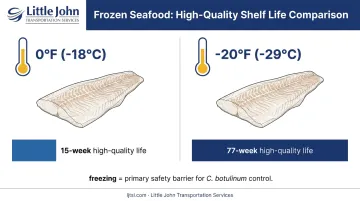
The shelf-life impact is equally stark. GCCA commodity data shows cod fillets stored at 0°F have a high-quality storage life of 15 weeks. At -20°F, that extends to 77 weeks. Temperature controls both food safety and whether the product is commercially viable on arrival.
Regulatory Requirements for Shipping Frozen Seafood
FSMA Sanitary Transportation Rule
Under 21 CFR Part 1, Subpart O, vehicles and transportation equipment must be designed, maintained, and used so food does not become unsafe. For commercial shippers, that translates to four concrete obligations:
- Shippers must communicate required temperatures and sanitary specifications in writing to carriers
- Carriers assigned responsibility must pre-cool equipment as directed and maintain specified conditions throughout transit
- On request, carriers must demonstrate that required temperatures were maintained — via time-temperature data or ambient measurements at loading and unloading
- Written procedures and agreements must be retained for 12 months beyond the period they are in use
FSMA applies to any carrier transporting food commercially in the U.S., regardless of shipment size. Only very small businesses meeting specific annual sales thresholds qualify for modified requirements — most mid-to-large shippers are fully covered.
Seafood HACCP (21 CFR Part 123)
FDA's 21 CFR Part 123 established mandatory HACCP requirements for seafood — one of the first food categories to face this obligation — with the final rule taking effect December 18, 1997. Unlike FSMA's transportation-focused requirements, HACCP obligations follow the product itself. HACCP plans must:
- Identify all critical control points (CCPs), including transport temperature
- Be available for inspection by FDA and USDC representatives
- Document corrective actions when CCPs are not met
For frozen seafood where freezing is the control for C. botulinum, keeping product frozen throughout transit is itself a CCP — not just a handling preference.
Good Manufacturing Practices During Transit
GMPs don't stop at the dock door. Carriers and shippers share responsibility for maintaining GMP compliance once product is in motion — and FDA inspectors can request evidence at the receiving end. During transit, relevant requirements include:
- Equipment sanitation between loads (trailer-wash logs as evidence)
- Separation of incompatible products
- Protection from contamination during loading, transit, and unloading
Cross-Border Requirements: U.S.–Mexico Shipments
Frozen seafood crossing from Mexico into the U.S. carries additional regulatory requirements:
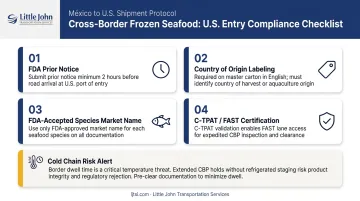
- FDA Prior Notice must be submitted at least 2 hours before road arrival, covering product identity, manufacturer, shipper, country of production, and carrier information
- Country of Origin Labeling (COOL) under 7 CFR Part 60 requires frozen fish and shellfish to display origin and production method (wild-caught or farm-raised) on the master shipping container
- Species identification must use FDA-accepted market names per the FDA Seafood List
All documentation must be complete before the truck reaches the port of entry. Border dwell time is a direct cold chain risk — even short delays can compromise frozen product integrity. On high-volume corridors like Laredo, carriers with C-TPAT validation and FAST certification qualify for expedited CBP processing, which meaningfully reduces inspection-induced temperature exposure for perishable freight.
Packaging Requirements for Frozen Seafood Freight
Primary Packaging
Before the freight container, the product itself must be properly packaged:
- Product must be fully frozen prior to packaging — not chilled and then frozen in the container
- Individual portions benefit from vacuum sealing or watertight plastic wrap to prevent freezer burn and cross-contamination
- Species-specific handling matters: delicate fillets are more susceptible to mechanical damage and dehydration than shell-on shrimp or whole fish
Insulated Container and Case Requirements
For FTL reefer shipments, the trailer provides primary thermal control. Individual case packaging still needs adequate insulation to survive:
- Loading and unloading windows (doors open, refrigeration off or cycling)
- Potential cross-docking exposure
- Any unexpected delays at inspection points
Outer corrugated cases must be capable of stacking without compression failure on loaded pallets.
Coolant Selection: Dry Ice vs. Gel Packs
Gel packs maintain refrigerated temperatures — typically 35°F–46°F — not sub-zero. They're the wrong coolant for frozen seafood. Dry ice is the correct choice. Key considerations:
- Sublimation rate must be calculated against total transit time — longer routes require more dry ice volume
- Under 49 CFR 173.217, dry ice shipped by highway is exempt from DOT Hazardous Materials Regulations — UN1845 markings and Class 9 labels required for air do not apply to reefer trailer loads
- For air shipments or intermodal movements involving air, the full hazmat labeling requirements do apply
Exterior Labeling and Carton Requirements
Every outer carton for frozen seafood freight must include:
- "PERISHABLE" and "KEEP FROZEN" markings
- Shipper and consignee contact information
- For cross-border shipments: country of origin, FDA-accepted market name, and net weight on the master carton
Loading Configuration
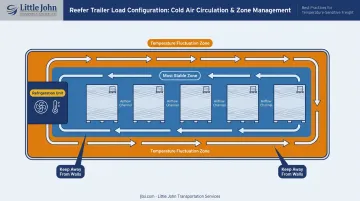
Cases should not be placed directly against trailer walls — temperature fluctuates at the perimeter of a reefer unit, with the most stable zone running down the center of the load. Proper load configuration includes:
- Stretch-wrapped, stable pallets positioned away from side walls
- Adequate spacing between cases to allow airflow around and through the load
- Center-lane stacking where possible to stay in the most temperature-stable zone
How Refrigerated Freight Works for Frozen Seafood
Frozen seafood moves through a defined chain: processing facility to pre-cooled reefer trailer to receiving freezer or cold dock. Each transition point is where temperature excursions happen — and where documentation gaps get carriers and shippers into trouble.
Pre-Cooling and Loading
The reefer trailer must reach the target temperature before loading begins. Per GCCA best practices, pre-cooling typically takes less than 2 hours. Loading pre-frozen product into a pre-cooled trailer maintains temperature integrity. Trying to bring product down to temperature after loading rarely works and risks compliance failures.
At loading, verify and document:
- Trailer air temperature at the nose and tail
- Product internal temperature before it goes on the truck
- Refrigeration unit is functioning correctly
Loading windows should be minimized. GCCA guidance specifies that the refrigeration unit should be off while trailer doors are open during loading — and that door-open time should be kept as short as operationally possible.
In-Transit Temperature Control and Monitoring
FSMA requires carriers to maintain evidence of temperature compliance throughout transit but does not mandate continuous logging or a specific monitoring interval. Industry best practice, per GCCA's Refrigerated Transportation Best Practices Guide, recommends telematics transmissions every 5 minutes, not exceeding 15-minute intervals.
Continuous data logging provides the full audit trail that major retailers and regulatory agencies expect. Periodic manual checks don't. Little John Transportation Services runs 24/7 live temperature monitoring with real-time exception alerts to dispatch, enabling immediate response to any deviation rather than after-the-fact discovery.
Delivery Handoff
At delivery, frozen seafood must transfer directly from the reefer trailer into a receiving freezer or cold dock. The receiving facility must be notified in advance to have dock space and freezer capacity available.
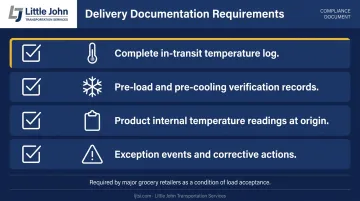
Major grocery retailers and foodservice distributors increasingly require complete temperature documentation as a condition of load acceptance. Carriers should provide the full log at handoff. At minimum, delivery documentation should include:
- Complete in-transit temperature log
- Pre-load and pre-cooling verification records
- Product internal temperature readings at origin
- Any exception events and corrective actions taken
This isn't just regulatory compliance — it's a commercial requirement for repeat business with most major buyers.
Key Factors That Affect Frozen Seafood Reefer Freight
Transit Distance and Route Planning
Longer routes demand more robust packaging, higher dry ice volume (for parcels), and more rigorous monitoring. Routes involving U.S.–Mexico border crossings introduce additional risk from potential inspection delays.
During periods of elevated border scrutiny, commercial wait times at Texas crossings have exceeded 5 hours at some Laredo lanes, according to CBP data. For frozen freight, a 5-hour unplanned dwell at a port of entry without cold storage staging is a serious cold chain risk. C-TPAT-validated carriers with FAST certification qualify for designated expedited processing lanes — a direct operational advantage that reduces dwell-time exposure for perishable loads.
Ambient Temperature and Seasonal Conditions
High summer temperatures increase reefer unit workload and raise the stakes during door-open events. A Purdue University computational fluid dynamics (CFD) study confirmed that outside-air infiltration during door openings disrupts internal temperature distribution — an effect amplified when outside temps exceed 90°F, accelerating thaw near the door zone.
Summer loading in high-heat environments compounds this risk. Key mitigation steps include:
- Scheduling door-open events during cooler parts of the day when possible
- Pre-conditioning the trailer load area before product transfer
- Accelerating loading procedures to minimize ambient air infiltration
FTL vs. LTL Configuration
FTL is the preferred configuration for frozen seafood — a single trailer, no transfers, and no cross-dock exposure. The table above reflects why: fewer handling points means fewer cold chain gaps.
LTL shipments pass through cross-dock facilities where cold chain integrity depends entirely on that facility's freezer capacity and handling speed. If LTL is the only option, shippers should require cold-storage-capable cross-docks and specify maximum dwell times in carrier contracts.
| Factor | FTL | LTL |
|---|---|---|
| Temperature consistency | Single trailer, no transfers | Multiple handling points |
| Cold chain risk | Lower | Higher (cross-dock exposure) |
| Documentation | Simpler | More complex, more gaps |
| Regulatory touchpoints | Fewer | More (each transfer point) |
Common Mistakes in Frozen Seafood Refrigerated Freight
Not Confirming Equipment Temperature Range
Not all reefer units can sustain -10°F to 0°F operation. Some are built for refrigerated (above freezing) loads only. Always confirm the carrier's equipment temperature range before booking — not just that they have "reefer capacity."
Losing the Cold Chain at Transfer Points
Most cold chain failures don't happen during transit. They happen on loading docks, at cross-dock facilities, and during delivery dwell time. Shippers should specify acceptable door-open windows and maximum dock dwell times in carrier contracts, and require documentation confirming those limits were observed.
Treating "Arrived Frozen" as Proof of Compliance
Under FSMA, a shipment that arrives frozen but has no temperature records doesn't satisfy the documentation requirement. Retailers may reject loads that can't produce a complete data trail.
Shippers who can't produce transit temperature records face both regulatory exposure and commercial consequences. Temperature documentation is the evidence that compliance actually occurred — not a paperwork formality.
Conclusion
Refrigerated freight for frozen seafood demands more than cold air and a trailer. Temperature standards, regulatory compliance, packaging protocols, equipment specifications, and documentation requirements all have to work together — without gaps — from the processing facility to the receiving dock.
Carrier selection carries real weight here. Under FSMA, the carrier bears in-transit compliance responsibility — which makes equipment specifications, monitoring capabilities, and documentation practices legitimate vetting criteria, not just nice-to-haves. Before committing to a lane, confirm:
- The carrier's reefer temperature range and setpoint capabilities
- Continuous monitoring capability with data log access
- Cross-border documentation credentials for any U.S.–Mexico routing
Frequently Asked Questions
What are the rules for shipping frozen seafood?
The FSMA Sanitary Transportation Rule (21 CFR Part 1, Subpart O) requires temperature control, sanitary equipment, and written compliance documentation. FDA's seafood HACCP rule (21 CFR Part 123) mandates hazard analysis plans that treat transport temperature as a critical control point — with documented evidence of compliance required throughout transit.
What are the packaging requirements for shipping frozen seafood?
Frozen seafood must be fully frozen before packaging, placed in watertight inner bags, and packed in insulated outer containers. Dry ice is the correct coolant for maintaining sub-zero temperatures. Outer cartons must be labeled "PERISHABLE / KEEP FROZEN" with full shipper and consignee information.
How do you transport frozen seafood?
Frozen seafood must be transported in reefer trailers pre-cooled to 0°F or below, with continuous or logged temperature monitoring throughout transit. The product must transfer directly into freezer storage at delivery without breaking the cold chain.
What temperature should a reefer trailer be set to for frozen seafood?
Reefer trailers for frozen seafood are typically set between -10°F and 0°F. The exact setpoint depends on the species, shipper requirements, or retailer specifications, but the product must never exceed 0°F during transit.
What is the difference between refrigerated and frozen freight for seafood?
Refrigerated freight maintains temperatures between 33°F–39°F, appropriate for fresh seafood packed on ice. Frozen freight must maintain sub-zero temperatures (0°F or below). Using a standard refrigerated trailer for frozen seafood is both a food safety failure and a regulatory violation.
What regulations apply to cross-border frozen seafood shipments between the U.S. and Mexico?
FDA Prior Notice must be submitted at least 2 hours before arrival by road, with full product and shipper details. Country of origin and production method must appear on the master carton under USDA COOL requirements. C-TPAT-certified carriers enrolled in the FAST program qualify for expedited border processing, which reduces cold chain risk from inspection delays.